The Troll Blacksmith has enough restrictions to turn a promising upgrade into a wasted trip. A spare item can be the wrong type, an unidentified ring can be unusable, and reforging first can make an item ineligible for the separate Upgrade service.
Start by checking which operation is blocked. Reforge combines two matching items. Upgrade improves one eligible item below +2. They have different requirements, separate prices and different consequences.
This guide covers the standard game’s v4.0.2 rules. Its worked examples use ordinary armor without an attached seal, curse infusion or other added level modifiers. Mods and other releases can behave differently.
Check these five things before reforging
If you can open Reforge but cannot complete it, inspect both items:
- Both must be identified. Recognizing the item’s general category is not the same as knowing that particular item’s properties.
- Both must be uncursed. The smith does not provide a way to bypass removing a curse.
- Both must be upgradeable. Two items with similar icons are not necessarily valid equipment for this service.
- They must be the exact same item type. Scale Armor needs another Scale Armor. Plate Armor is not a valid substitute. Two different kinds of ring do not form a matching pair just because both are rings.
- They must be two different items. Selecting the same physical item in both slots does not count as a duplicate.
If the Reforge option itself is disabled before you select anything, check your remaining favor and its displayed price first. Having valid equipment cannot compensate for an insufficient balance.
A practical preparation list
Keep the spare for the item you actually intend to improve. Identify it and remove any curse before treating it as usable material. Then check the target as well: a known spare does not make an unknown target eligible.
Do not sell every duplicate automatically, but do not carry a bag full of unrelated weapons in the hope that any two will combine. Record the exact item you need. A second Scale Armor is useful for a Scale Armor plan; another weapon of the same tier is not a replacement for a matching weapon.
Reforge adds one level; it does not add the levels together
For ordinary equipment, the higher-level item survives and receives one upgrade. The other item is consumed. For example:
| Matching items | Result | What disappears |
|---|---|---|
| Scale Armor +3 and Scale Armor +2 | One Scale Armor +4 | The +2 armor |
| Scale Armor +1 and Scale Armor +0 | One Scale Armor +2 | The +0 armor |
| Scale Armor +0 and Scale Armor +0 | One Scale Armor +1 | The item in the right slot |
The first example does not produce +5 or +6 armor. A more upgraded sacrifice does not give extra levels to the survivor. If you have several valid spares, compare what else each could do for your run before consuming one.
The exact selection uses the items’ underlying upgrade level. Added or special level effects are a reason to inspect the item more carefully instead of relying on an unusually large displayed number. The examples above deliberately avoid those complications.
Which item keeps its glyph or enchantment?
When the two underlying levels are equal, the left-hand item survives. When the levels differ, the higher-level item survives, even if it is on the right.
This matters when one copy has a useful glyph or enchantment. Reforging preserves a beneficial glyph or enchantment already on the surviving item. It does not move the sacrificed item’s property onto the survivor. Warrior seals have their own handling, so the examples below use armor without a seal.
Consider two ordinary Scale Armors at +1. One has a glyph you want to keep and the other is plain. Place the glyph-bearing armor on the left. It survives at +2 with that glyph.
Now change the plain armor to +2. Putting the +1 glyph-bearing armor on the left no longer protects it. The stronger plain armor survives and becomes +3; the lower-level armor is consumed. Do not click through expecting the left slot to override the level comparison.
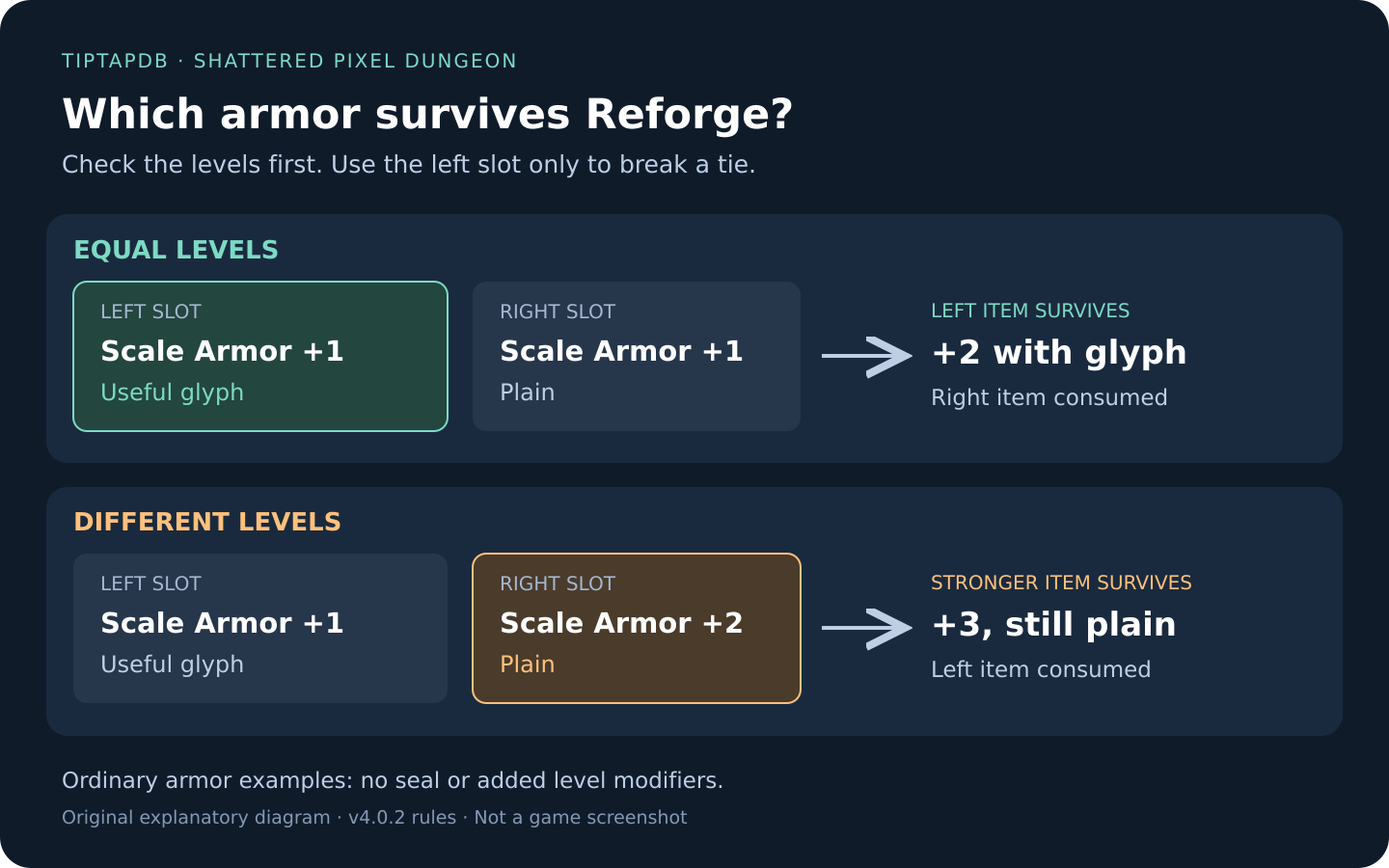
The left slot breaks a tie. It does not overrule a higher upgrade level.
View the diagram at full size
Open the full-size diagram to read the labels clearly on a small screen.
Open full-size diagramIf a particular glyph is central to your build, stop and inspect both copies before confirming.
Use Upgrade before you cross its +2 limit
Upgrade is a separate service. It requires one identified, uncursed, upgradeable item currently below +2. It is not an unrestricted substitute for a Scroll of Upgrade.
A common trap is to bring a +1 target and a +0 spare, choose Reforge, then try Upgrade. The reforge produces +2. That item is now too highly upgraded for the separate service.
If you want both services on that same ordinary item, the useful sequence is:
- Upgrade the +1 target to +2.
- Reforge it with the matching +0 spare.
- Keep the resulting +3 item.
That costs 1,500 favor if neither service has been used before. Reversing the first two actions gets you to +2 but prevents the intended Upgrade afterward. Upgrade eligibility depends on the item’s current level, not whether you have already paid for another service.
This is a rule about eligibility, not a command to spend favor on every +1 item. Decide whether this is equipment you expect to use. Improving an item you are about to replace may be less valuable than preserving favor for a stronger plan.
Plan the whole favor budget
Repeated uses of a service become more expensive. In v4.0.2, the relevant prices are:
| Service | First use | Second use |
|---|---|---|
| Reforge | 500 favor | 1,500 favor |
| Upgrade | 1,000 favor | 2,000 favor |
| Harden | 500 favor | 1,500 favor |
The counters are separate. Using Reforge does not turn your first Upgrade into a second Upgrade. However, all services spend the same favor balance.
Worked example: a +1 target and two +0 spares
Assume you have 3,000 favor, have used no services yet, and have three identified, uncursed Scale Armors: one at +1 and two at +0. You want to improve the +1 armor.
| Step | Action | Target afterward | Favor remaining |
|---|---|---|---|
| Start | Check all three items | +1 | 3,000 |
| 1 | Upgrade the target | +2 | 2,000 |
| 2 | Reforge with the first +0 spare | +3 | 1,500 |
| 3 | Reforge with the second +0 spare | +4 | 0 |
Now compare the tempting alternative. Reforge twice first and the target reaches +3, with 1,000 favor remaining. You have enough favor for the first Upgrade, but the item fails its below-+2 requirement. You can still use the favor on another eligible item or service; it cannot repair the intended order for this armor.
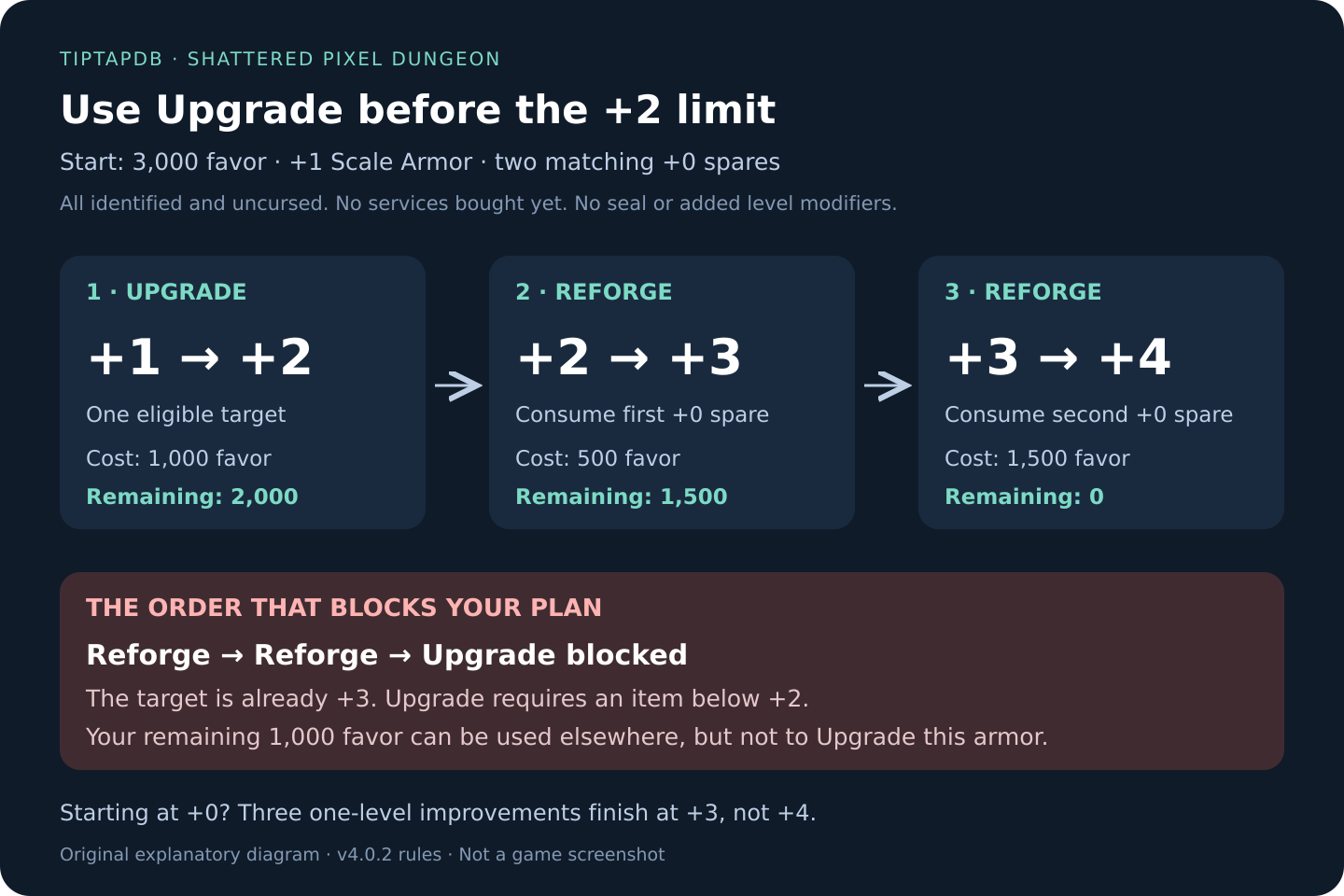
The example needs a +1 starting item, two matching +0 spares and no previous service purchases.
View the diagram at full size
Open the full-size diagram to read the labels clearly on a small screen.
Open full-size diagramWhat if the target starts at +0?
Do not copy the final +4 result without checking the starting level. A +0 target receiving those same three one-level improvements finishes at +3.
For a plain +0 target and two +0 spares, Upgrade → Reforge → Reforge works. Reforge → Upgrade → Reforge also keeps the item eligible at the Upgrade step. Reforge → Reforge → Upgrade does not, because the second reforge has already reached +2.
The practical check is simple: before an intended Upgrade, will this item still be below +2? Write the levels down if you are combining several purchases.
Do you actually have 3,000 favor?
Do not plan the full sequence from memory. Look at the balance in the smith’s menu.
The quest awards 50 favor per piece of dark gold, with ore contributing at most 2,000 favor. Defeating the mine’s boss adds 1,000. That gives these examples:
| Quest result | Favor before purchases |
|---|---|
| 40 ore, boss not defeated | 2,000 |
| 30 ore, boss defeated | 2,500 |
| 40 ore, boss defeated | 3,000 |
More than 40 ore does not raise the ore portion beyond 2,000.
The mine is a one-visit quest: once you leave, you cannot return. Check your ore, the boss objective and any equipment left on the floor before accepting the exit. If survival is in doubt, getting out with a smaller reward can still be better than losing the run.
What about Harden, Smith and Cash Out?
These are different purchases, not extra stages you must complete before reforging.
- Harden concerns keeping a weapon enchantment or armor glyph through later upgrades. It does not itself add an upgrade level, so do not count it as one of the three improvements in the example. Reforge already preserves a beneficial property on its surviving item.
- Smith spends 2,000 favor on creating new equipment choices. Consider it when obtaining equipment matters more than upgrading what you already have. Spending those 2,000 also means you cannot execute the untouched 3,000-favor plan above.
- Cash Out converts your remaining favor into ordinary gold at one gold per favor. It empties the favor balance. Do not use it as a way to close the menu while keeping the option to buy more services later.
Final check before you confirm
Read the current price, then answer four questions:
- Which exact item will survive?
- Is the other item genuinely expendable?
- Will this action block an Upgrade I intended to buy afterward?
- How much favor will remain for the next action?
If the equipment plan itself is still uncertain, use the Shattered Pixel Dungeon armor guide to compare practical Strength requirements before committing your smithing rewards. A correctly executed reforge is only useful if the resulting equipment helps you survive the next part of the run.
Plan your armor upgrades
Compare practical Strength requirements before committing your smithing rewards.
Read the armor guideCheck official release notes
If your installed version differs from v4.0.2, check the developer’s release notes for changes.
Official v4.0.2 notes
Latest comments
Log in to join the conversation
Log InNo comments yet. Be the first to share your thoughts!