
A full battery feeding an empty battery through a diode does not normally empty itself into the other side. The Battery Diode compares the percentage of battery storage filled in two separate power networks. It transfers energy forwards while the input network has the higher percentage, gradually bringing the two percentages together.
With equal storage capacity, one full bank and one empty bank can therefore settle near half full on both sides. That can be normal operation, not a broken connection.
This guide covers the standard Battery Diode in Mindustry v8 Build 160.7. Its examples assume enabled batteries, no mods changing power behavior, and no generation or consumption unless stated.
Check the direction and the two networks first
The diode's back is its input and its front is its output. Put a power-capable building directly behind it and another directly in front, both belonging to your team. A battery immediately on each side is a straightforward test arrangement. A building beside the diode rather than in front or behind is not one of those two endpoints.
The endpoints must belong to different power networks. The diode does not merge them into one shared network; it moves stored energy between them under its own rule.
Look for a connection that joins the two sides elsewhere. A Power Node link around the diode, or a chain of conducting adjacent buildings, can merge the intended input and reserve into one network. In that case, the diode has no separate pair of networks to transfer between.
This is especially easy to miss when adding nodes to an existing base. The buildings may look like two neat groups while one remote link joins them. Trace the complete connections rather than inspecting only the three blocks around the diode.
Compare percentages, not raw stored energy
For each side, use:
Charge percentage = (stored battery energy ÷ total enabled battery capacity) × 100%.
Count the storage across the connected network, not just the battery touching the diode. Its input and output bars represent the corresponding network's battery charge fraction.
The transfer condition is directional:
- Input percentage higher than output: energy can move forwards.
- Percentages equal: the diode has no charge difference to correct.
- Output percentage higher than input: the diode does not send energy backwards.
The amount stored can look misleading when capacities differ. Suppose the input has 1,000 of 4,000, while the output has 2,000 of 12,000. The input is at 25%; the output is at about 16.7%. Forward transfer is possible even though the output already holds twice as much energy.
Conversely, 2,000 in a 12,000-capacity input bank will not feed a 4,000-capacity output bank already holding 1,000. The percentages are approximately 16.7% and 25%, so the input is not ahead.
Worked example: why two batteries stop near half full
A standard Battery stores 4,000 energy in the version covered here. Start with one full standard Battery on the input network and one empty standard Battery on the output network. Keep the networks otherwise idle and separate.
There are 4,000 energy units in total and 8,000 units of combined capacity. The common charge percentage they approach is:
4,000 ÷ 8,000 = 50%.
That gives approximately 2,000 stored on each side. The output does not reach 4,000 by draining the input to zero. Once their percentages match, the diode stops transferring until something changes the balance.
The transfer is gradual rather than one instantaneous jump to the final split. In this version, each update moves half the energy still needed to bring the output to the shared target percentage. Do not treat a screenshot taken during that transition as the final result, or assume a fixed number of seconds across game speeds and simulation conditions.
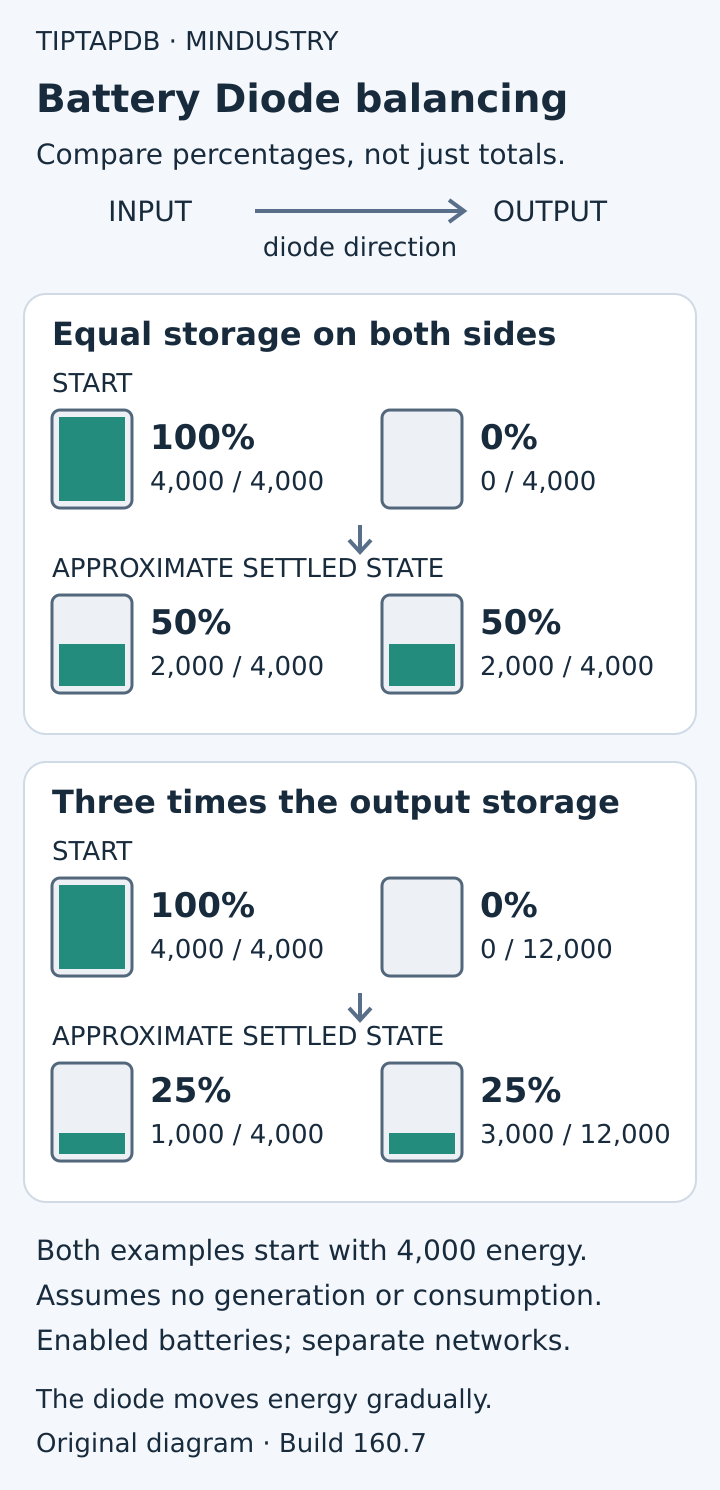
Battery Diode comparison: equal-capacity banks approach 50% each, while a full 4,000-capacity input feeding an empty 12,000-capacity output approaches 25% each. Original explanatory diagram. Approximate settled values for isolated, idle networks with enabled storage; no power generation or consumers.
A bigger reserve changes the final split
Now keep one full standard Battery on the input side, but connect three empty standard Batteries to the output network. The capacities are 4,000 and 12,000.
The same 4,000 stored energy is spread across 16,000 combined capacity, so the common target is 25%:
| Network | Capacity | Approximate settled energy | Charge |
|---|---|---|---|
| Input | 4,000 | 1,000 | 25% |
| Output | 12,000 | 3,000 | 25% |
The reserve receives more energy than in the equal-capacity example, yet its bar finishes lower. Both readings make sense: the reserve is larger.
Adding empty batteries can also lower a network's displayed percentage without destroying the energy it already holds. Before diagnosing a charging failure, compare the stored amount and capacity together.
A Large Battery has a different capacity from a standard Battery. Use the actual totals shown for your networks rather than assuming that two groups containing the same number of battery blocks have equal storage.
Protect a reserve without connecting around the diode
A useful arrangement is an input network with generation and storage, a diode facing outwards, and a separate reserve network with batteries and the consumers you want to keep supplied.
If the input's charge percentage falls below the reserve's, the diode will not drain the reserve backwards into the input. That protection depends on the networks remaining separate. An ordinary connection around the diode gives the power system another route and defeats the intended separation.
The reserve's own consumers can still discharge its batteries. A diode does not freeze the charge or make stored energy last indefinitely. If an output-side factory starts running, the reserve may fall even while energy is arriving through the diode.
Similarly, a generator on the input side can keep supplying new energy. The idle examples above are not a prediction that a live base must stay at 50% or 25%. Those values describe a fixed starting amount with no other energy entering or leaving.
Use the diode to control which way stored energy can cross between networks. Check generation, consumption and reserve size separately when deciding how long the protected equipment can operate. For that broader calculation, see our Mindustry power deficit and battery budgeting guide.
Mindustry power deficit and battery budgeting guide
Read the related guideA controlled check for an apparently inactive diode
Before rebuilding a large power system, test the same arrangement in a safe spare area or a separate test map:
- Use positive battery capacity on both sides. Start with one enabled standard Battery per network. The diode is transferring battery energy; a storage-free endpoint is not a useful test of the balancing behavior.
- Set a clear charge difference. A charged input and an empty output make the expected direction easy to see.
- Check front and back. Both endpoints must touch the correct sides of the diode and be power-capable buildings on your team.
- Check separation. Remove unintended cross-links from the test arrangement. Keep any links within each side from joining the other side.
- Remove changing demand from the test. Observe without active generation or consumers so the stored totals can settle.
- Check whether control logic disabled anything. Disabled batteries do not contribute to the usable storage totals, and a disabled diode does not perform its transfer update.
With two equal-capacity banks starting full and empty, the expected result is approximately half charge on each side. If that works, reconnect the intended loads carefully and watch how the behavior changes. You have established that the basic diode arrangement functions, so the next question is what the larger network adds.
Diagnose the symptom you actually see
- No change despite a charged input: check endpoints, enabled storage, direction and whether both sides accidentally share one network.
- The output stops below full: compare both charge percentages. Matching percentages are an expected stopping condition.
- The output falls while the diode is connected: check its consumers and total energy balance; incoming energy may be less than the load consumes.
- The reserve drains along with the main base: trace bypass links, then check which consumers really belong to the reserve network.
- The charge bar drops after adding batteries: compare stored energy before and after. The denominator may simply have increased.
The most useful habit is to record stored energy, total capacity and connections on both sides. Those three checks explain far more than the output battery's bar alone.
Latest comments
Log in to join the conversation
Log InNo comments yet. Be the first to share your thoughts!