
You finish a second Silk plantation, but your happiness stays exactly where it was. Before building a road or moving a citizen, check whether you already have Silk. In Unciv, an extra copy of a luxury normally gives you more to trade, not another happiness bonus. A different luxury is usually the missing piece.
This guide covers Unciv 4.22.17 with the built-in Civ V - Gods & Kings ruleset. Examples use the ordinary +4 happiness per luxury type, with no difficulty, policy or civilization bonuses. Mods and other rulesets can change the result.
Count different luxuries, not improved tiles
For the normal luxury bonus, one available Silk and three available Silk are both one luxury type. Silk plus Cotton are two types. The bonus applies across your civilization; you do not need a separate Silk supply for each city.
With the +4 baseline:
- One Silk gives +4 luxury happiness.
- Two Silk still give +4.
- Two Silk and one Cotton give +8.
- One Silk, one Cotton and one Gems give +12.
These figures describe the luxury contribution, not your empire's total happiness. Your empire's total also includes other positive and negative sources. Gaining a new luxury while adding population can therefore produce a smaller net improvement than the luxury's own bonus.
The second Silk still has uses. It can become a trade offer while you retain the first copy, and its improved tile can be worth working for its yields. The absence of another happiness bonus does not make the tile worthless.
Why your first luxury might give +5 or +6
The +4 examples need a qualification. In this version's built-in Gods & Kings difficulties, Settler and Chieftain add one happiness per luxury type. Their ordinary value is therefore +5. Warlord through Deity have no such extra point.
Policies can change the value too. Protectionism adds +2 happiness per luxury type, making the ordinary +4 contribution become +6. Cultural Diplomacy gives an additional happiness benefit for luxuries supplied by city-states.
These bonuses do not turn duplicate copies into additional luxury types. Use your happiness breakdown to establish the value in your actual game, then apply the same distinction between copies and types.
Check the resource total before changing your cities
Use the Resources overview to inspect the luxury and its sources. An icon on the map only proves that the deposit exists. It does not prove that you currently have a usable copy after improvements and trades are accounted for.
Compare three things:
- The available total: do you actually have this luxury now?
- The source: does it come from your tiles, a trade or a city-state?
- The happiness breakdown: did the luxury contribution change, even if the empire total did not?
The Resources overview also distinguishes unimproved deposits. Do not add those to your usable supply simply because they are inside your borders. If Silk was already available and its total rises from one to two, unchanged luxury happiness is the expected result.
If the first copy is missing, check its improvement
For an ordinary luxury tile in your territory, check that the correct improvement is complete, unpillaged and supported by your researched technology. A worker standing on the tile or an improvement still under construction is not a completed supply.
Examples in this ruleset include:
- Silk and Cotton need a Plantation, unlocked by Calendar.
- Gems and Silver need a Mine, unlocked by Mining.
- Furs and Ivory need a Camp, unlocked by Trapping.
- Pearls and Whales need Fishing Boats, unlocked by Sailing.
Check the resource's Civilopedia entry when you are unsure. An improvement that produces useful yields is not automatically the improvement that provides that luxury. For example, placing a Great Person improvement over a luxury does not count as its required plantation, mine or camp.
You do not need to assign a citizen to the improved tile to receive its luxury resource. Citizen assignments determine which tile yields your city collects, while resource access is checked separately. Moving someone off a completed Silk plantation should not, by itself, remove Silk from your supply.
You also do not need a road from the luxury to a city or a city connection back to the capital for this resource access. Build roads for their actual movement or connection benefits. If that is your next decision, see when an Unciv city connection pays for its upkeep.
When an Unciv city connection pays for its upkeep
Read the related guideA city founded directly on a luxury has a separate check: it can supply the resource when you have the technology for an appropriate extractive improvement. Settling on Silk does not bypass Calendar. Inspect the resource total after the relevant technology is researched.
Trade a spare copy for a luxury you lack
Suppose your usable domestic supply is two Silk and one Cotton, with no existing imports or exports. At the +4 baseline, those two types provide +8 happiness.
Another civilization offers one Gems in return for one Silk. You have no other Gems supply. If the trade is accepted, you retain one Silk and one Cotton, and gain access to one Gems. You now have three types, so the luxury contribution rises from +8 to +12.
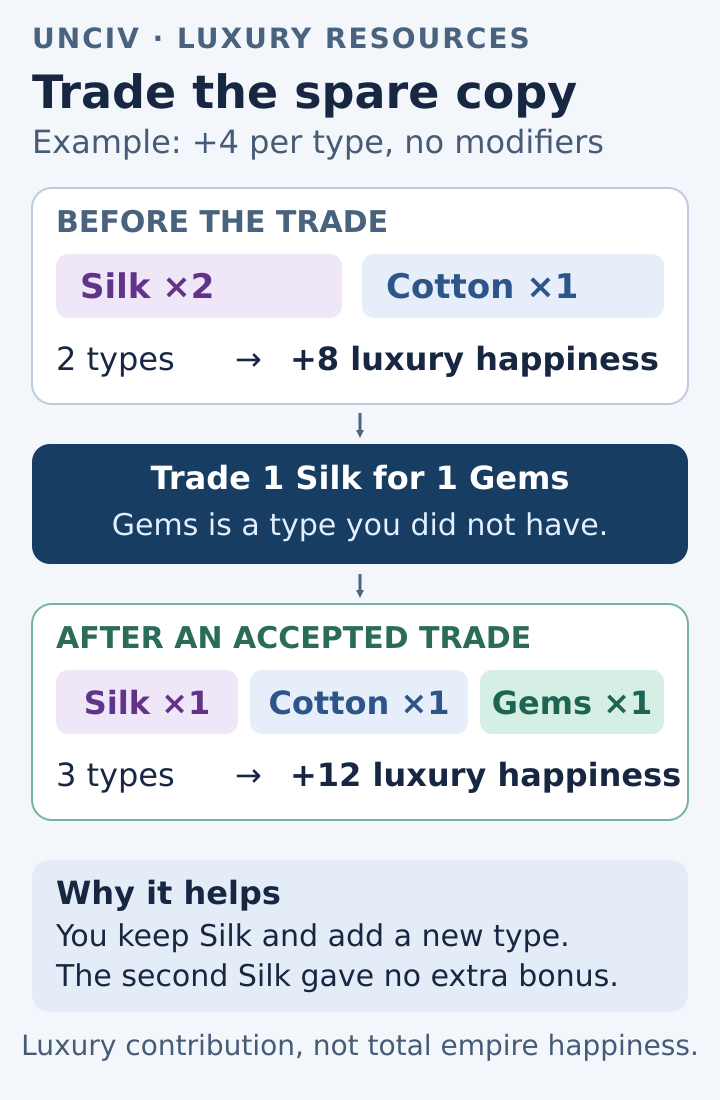
Two Silk and one Cotton provide two luxury types and eight happiness. Trading one spare Silk for Gems leaves one Silk, one Cotton and one Gems, providing three types and twelve happiness. Hypothetical trade at +4 per type, without modifiers. The improvement comes from adding Gems while keeping access to Silk.
Alternatively, imagine selling Silk for gold rather than importing Gems:
- Sell the spare Silk for gold: one Silk remains, so these luxuries still provide +8. The reward is gold rather than extra happiness.
- Then sell your only remaining Silk for gold: you lose access to Silk. With only Cotton left, their ordinary contribution falls to +4.
Do the comparison before accepting, using the supply that will remain. A resource being available to offer does not mean it is safe to export. Nor is a one-for-one exchange guaranteed to be acceptable to the other civilization; this example explains the result of an accepted deal, not an AI pricing rule.
Imported copies and the Netherlands need extra care
The displayed total can include copies that you cannot pass on in another trade. Resources supplied through trade or by allied city-states are kept separate from your tradable domestic supply. If the overview shows two Silk, check where both came from before assuming you have two copies to sell.
An imported copy can still preserve access while you export your own copy. That leaves your happiness dependent on the import continuing. Treat it as a deliberate trade-off rather than a permanently safe surplus.
The Netherlands has a specific exception: its ability retains 50% of a luxury's happiness after the last copy has been traded away. With the ordinary +4 value, that means retaining +2 from that exported luxury rather than losing all four. It does not preserve the full bonus, and it does not mean every civilization can sell its last copy without a cost.
When happiness drops later, trace the lost supply
A luxury deal provides access for its duration. When an import ends, check whether you have another copy of that type. In the worked Silk-for-Gems example, if the whole deal expires and nothing else changes, your exported Silk returns, Gems disappears and the luxury contribution returns to +8. Recovering a second Silk cannot replace the lost Gems bonus.
Also inspect pillaged improvements and city-state alliances. Losing a source matters when it removes your remaining access to a luxury type. Losing one of two otherwise available copies normally leaves the type's bonus intact.
If happiness rose but a city still will not grow, investigate that separately. Our Unciv city-growth checklist covers Settlers, Avoid growth, food and happiness restrictions.
Unciv city-growth checklist
Read the related guideFor your next worker task or trade, ask one practical question: will this give me a luxury type I do not currently have? If yes, check the improvement or deal needed to secure it. If it only adds another copy, decide whether its yields, trade value or backup supply justify the effort.
Latest comments
Log in to join the conversation
Log InNo comments yet. Be the first to share your thoughts!