You place three sheep and expect three points. Sometimes you get seven. On another turn, an apparently similar move gives you only three. The difference is usually the pasture you chose, the animals already inside it, or a bonus triggered by completing that area.
The basic rule: score the animals on your new tile, then score every previously placed tile of that same animal type in the same pasture again. Matching animals elsewhere in your estate do not normally count.
This guide covers the core board-game rules relevant to understanding Digidiced’s digital adaptation. Expansion exceptions are separated below. It is not a guide to The Castles of Burgundy: The Card Game or The Dice Game.
What counts as one pasture?
A pasture is a connected region of light-green spaces printed on your player board. Trace those spaces along their shared edges. The region’s boundary determines which animals can contribute to a placement score.
You do not need a continuous chain of matching animal tiles. An empty green space between two sheep tiles does not split their printed pasture. Neither does a pig tile occupying a space between them. Conversely, a route through a castle, river or city does not merge separate pastures.
There are two different questions here:
- Is the placement legal? Your new tile must satisfy the normal placement rules, including touching a previously placed tile and matching the destination’s color and required die value.
- Which animals score? Look throughout the new tile’s printed pasture for the matching animal type. Those matching tiles need not touch the new tile.
The publisher’s livestock rules explicitly distinguish sharing a pasture from being directly adjacent. See the livestock section on page 8 of the official Special Edition rulebook.
Official Special Edition rulebook
Open official reference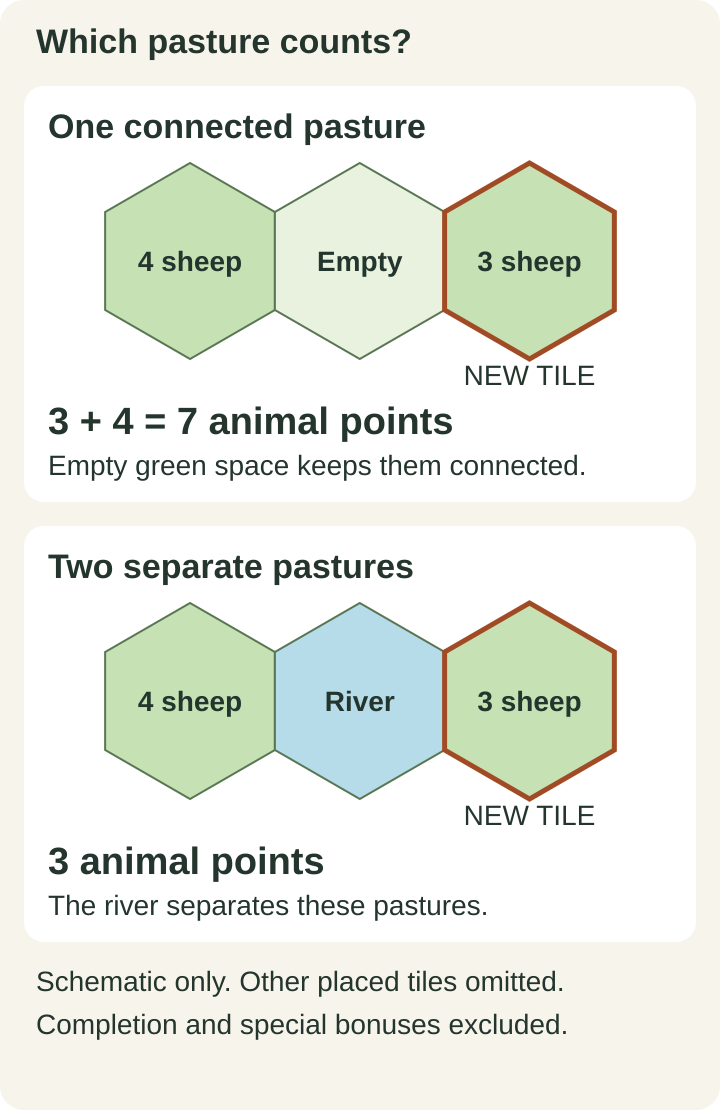
Diagram: four sheep and three new sheep score seven across an empty space in one pasture; a river between the same sheep tiles leaves separate pastures, so only the three new sheep score. Original schematic, not a game screenshot. Other placed tiles that make the new placement legal are omitted. Values show animal points only.
Calculate a placement in four steps
Before adding completion rewards or special abilities:
- Count the animals pictured on the tile you are placing.
- Identify its pasture.
- Add the animal counts from every earlier tile of the same type in that pasture.
- Ignore different animal types and matching animals in other pastures.
Think of the score as a fresh subtotal for the animal type you just placed. Do not add up everything that has ever scored in that pasture.
For example, suppose a pasture contains a four-sheep tile and a two-pig tile. Adding three sheep gives 3 + 4 = 7 animal points. The pigs contribute nothing to this sheep placement. If the new tile instead showed three pigs, the calculation would be 3 + 2 = 5.
A four-sheep tile in a separate pasture would not change either answer.
Worked example: why the same sheep keep scoring
Assume you place these tiles into one sufficiently large pasture, in this order, with no special scoring ability:
| Placement | Animal points gained now | Running total from these placements |
|---|---|---|
| Four sheep | 4 | 4 |
| Two pigs | 2 | 6 |
| Three sheep | 3 + 4 = 7 | 13 |
| Two sheep | 2 + 4 + 3 = 9 | 22 |
The last sheep placement gives nine points, not twenty-two. Twenty-two is the cumulative total earned across all four placements, including the pigs’ earlier two points.
The old four-sheep tile contributes three times: when first placed, when the three-sheep tile arrives, and when the two-sheep tile arrives. The pigs remain worth zero during those later sheep placements.
This also shows why placement order can matter. With only a four-sheep and a two-sheep tile, placing four first earns 4 + 6 = 10 across both placements. Placing two first earns 2 + 6 = 8. Both orders end with six sheep in the pasture, but their scoring history differs.
That is a useful planning advantage when everything else is equal. It is not a reason to delay a valuable completion blindly: dice, accessible spaces and timing can make the other order better overall.
Why the score jump can be much larger
Animal points are only one part of what a placement can earn. Finishing a colored region also awards its size-based points and the current phase’s completion bonus. Completing every space of a color can earn a separate bonus tile if you qualify.
Keep those rewards separate when checking a surprising total. For a hypothetical placement that earns seven animal points and finishes a three-space pasture during phase A:
- Animals: 7.
- Completed three-space region: 6.
- Phase A completion bonus: 10.
- Total before any color-completion or special bonus: 23.
The sheep did not suddenly become worth twenty-three points. Seven came from animals; sixteen came from completing the pasture at that time. The publisher explains these additional scoring layers on page 9 of the official rulebook.
Yellow tile 7: count scoring tiles, not individual animals
The animal-scoring ability on yellow tile 7 adds one point for each animal tile that scores during the placement. It does not add one point for every animal pictured, and it is not limited to the newly placed tile.
Suppose the pasture already holds four sheep and two sheep on separate tiles. You place three more sheep:
- Normal animal score: 4 + 2 + 3 = 9.
- Three animal tiles are scoring: +3.
- Total animal-related score with tile 7: 12.
A pig tile in that pasture adds neither its pigs nor another tile-7 point to this sheep calculation. Without any earlier matching animals, a new three-sheep tile would instead earn 3 + 1 = 4.
Yellow tile 24 is different: it awards end-game points for distinct animal types in your estate. Do not use that end-game reward to recalculate each placement. Both abilities are described in the publisher’s yellow-tile reference on pages 11–12.
Edition and expansion exceptions
The normal pasture boundary is the starting point, but an explicit special ability can override it. In the Special Edition’s Shields expansion, shield 1 makes pasture spaces count as connected for its livestock benefit. The Geese expansion also has its own animal-matching rules. Do not apply either exception to an ordinary base-game example.
In the digital game, apply only the modules and abilities actually present in your match. A tabletop expansion rule does not automatically apply to the app.
If your expected score still does not match
Check the move in this order:
- Did you place the tile into your estate? Taking it into storage does not trigger animal scoring.
- Did you count pictures or tiles? Ordinary animal points use the pictured animal count. Tile 7 uses the number of scoring tiles for its extra points.
- Did you cross a pasture boundary? Nearby matching animals can still belong to a separate region.
- Did you wrongly exclude a distant matching tile? An empty space or a different animal inside the same printed pasture does not stop it counting.
- Did the move complete an area? Separate the region and phase rewards from the animal subtotal.
- Are you comparing this move’s gain with your accumulated score? Earlier gains remain on your score track; they are not added wholesale to the next calculation.
If none explains the difference, record the board before and after the move, the new tile, any relevant yellow tiles, the phase and your app version. Digidiced’s official support page lists support@digidiced.com for questions. A reproducible example is more useful than assuming every unexpected total is a bug.
Official support page
Open official referenceThe quickest habit to build is simple: identify the pasture first, total the matching animals second, then add separate bonuses.
Latest comments
Log in to join the conversation
Log InNo comments yet. Be the first to share your thoughts!