
You roll for gold, add a tool, and receive exactly as much gold as before. The tool worked. Your improved total simply did not reach the next payout.
In Stone Age: Digital Edition, tools add points to a gathering roll; they do not directly add resources. The useful question is: how many more points will earn the next item, and which whole tools should I spend to get there?
This guide covers the base game’s regular tool tiles and one-use Civilization cards, including gathering thresholds, action order and planning several rolls in one round.
1. Add the dice, add tools, then divide
For a gathering location, roll one die per worker you placed there. Add the dice together, optionally add available tools, and divide the resulting total by the location's number. Keep only the whole-number result.
The numbers are:
- Food: 2 points per food.
- Wood: 3 points per wood.
- Clay: 4 points per clay.
- Stone: 5 points per stone.
- Gold: 6 points per gold.
These rules appear on printed page 6 of the official Stone Age rulebook. Tools modify the total after the dice are rolled. They neither reroll a die nor grant another worker's roll.
Official Stone Age rulebook
Open official referenceFor example, a gold total of 9 pays one gold. Raising it to 11 still pays one. Raising it to 12 pays two. The first increase changed the total, but not the number of complete groups of six.
2. Find the next payout before selecting a tool
Use a short mental check:
- Count what the roll already earns.
- Find the next multiple of the location's number.
- Subtract your roll from that target.
- Check whether your unused tools can supply that much.
For gold at 9, the next target is 12, so you need 3 extra points. A value-2 tool alone achieves nothing extra. A value-3 tool, or a value-2 tool together with a value-1 tool, reaches the target.
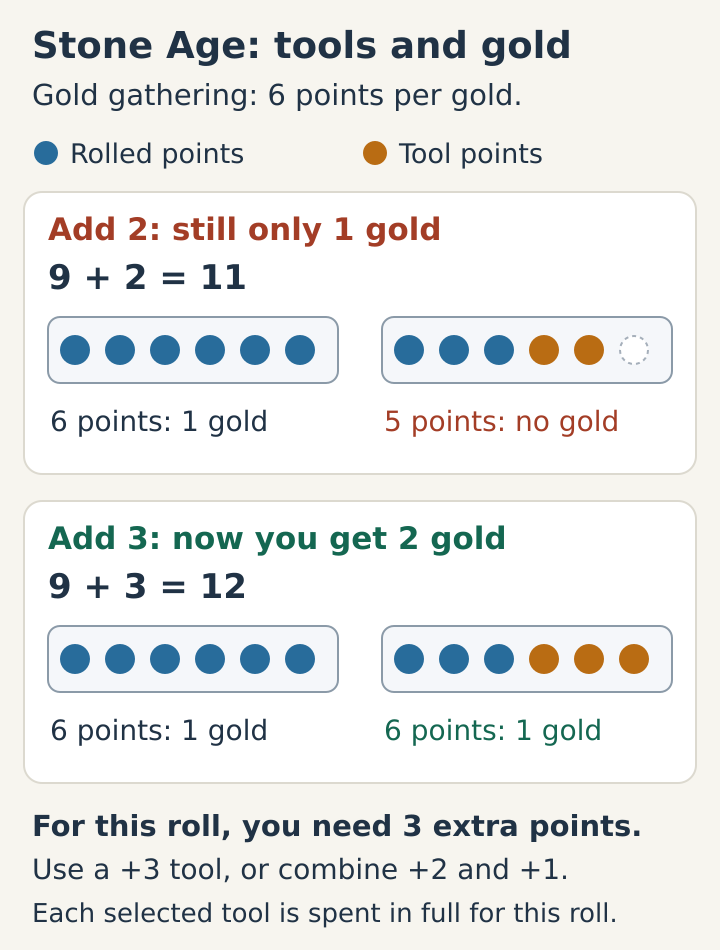
A gold-gathering roll of nine plus two tool points totals eleven and still earns one gold. Adding three points reaches twelve and earns two gold. Each group of six points produces one gold. Original arithmetic diagram. The dots represent points in the final roll total, not individual dice or workers.
Now compare a wood total of 9. It already pays three wood, but the next wood costs another 3 points. Being exactly on a payout does not make a value-1 tool useful. At a wood total of 11, however, that same tool reaches 12 and earns a fourth wood.
Do not assume expensive resources always deserve your tools first. One extra food that prevents a shortage may matter more than gold you have no immediate use for. Start with your planned purchases and food needs, then examine the arithmetic.
3. A tool tile is indivisible
Each regular tool can be used once per round. You may combine several available tools on one roll, but you must use each selected tool's entire value. You cannot take one point from a value-2 tool now and save its other point for hunting later.
This makes two value-1 tools different from one value-2 tool. Both can add 2 to one roll. Only the two separate tools can add 1 to each of two different rolls.
Suppose a stone roll totals 14 and your only available tool is worth 2. The next stone needs just 1 point, but using that tool adds the full 2, making 16. You collect three stone instead of two; the extra point beyond 15 is not banked anywhere. That can still be a good use if you need the stone.
Likewise, the unspent remainder of a roll does not move to another location. A gold result of 11 pays one gold; it does not leave five points available for the next forest roll.
4. Worked round: three rolls, three tools
You have seven workers gathering: three in the forest, two in the quarry, and two at the river. Food is already covered. Your available regular tools are 2, 1 and 1.
The following results arrive one at a time. You must decide about the current roll without knowing the later ones.
Forest: the dice total 8.
Wood needs groups of 3. You already earn two wood, and the next target is 9. Spend one value-1 tool. Your total becomes 9 and you receive three wood. The value-2 and the other value-1 tool remain unused.
Quarry: the dice total 8.
Stone needs groups of 5. You already earn one stone, and the next target is 10. Spend the value-2 tool. You receive two stone, keeping your last value-1 tool.
River: the dice total 11.
Gold needs groups of 6. Spend the remaining value-1 tool to reach 12 and receive two gold.
Across those rolls, your four tool points bought three additional resources: one wood, one stone and one gold.
Now change only the first decision. If you had used the value-2 tool on the forest roll, 8 would become 10, still paying three wood. You would then need both value-1 tools to lift the quarry result to 10, leaving none for the river. Your first tool use earned the same wood but left a less useful combination for the later outcomes.
That is an illustration, not a guarantee about future dice. A practical default is to use the smallest available combination that achieves the result you need, while remembering that later rolls may create better or worse opportunities.
5. Resolve a new tool before the roll that needs it
During action resolution, you choose the order of your occupied locations. If one of your workers is at the tool maker, resolving it before gathering can make the new tool available for those rolls. The publisher explicitly recommends this in the tips on page 2 of its Civilization cards summary sheet.
Civilization cards summary sheet
Open official referenceFor instance, you have no tools, one worker at the tool maker and workers in the quarry. Taking the tool first gives you a possible +1 when you later roll for stone. Resolving the quarry first leaves that roll without the tool. You cannot retroactively improve a gathering action already completed.
The same ordering principle applies to purchases: collect the materials you need before resolving the building or Civilization card that costs them. Prioritise a roll essential to that purchase if you want to decide its tool use before spending tools elsewhere.
6. Regular tools and one-use tools do not refresh alike
Regular tool tiles become available again for the next round. They do not refresh merely because you move from the forest to the quarry or finish one roll.
Some Civilization cards instead provide a one-use tool. You may save it for a later roll or use it in the turn you acquire it. It can supplement your regular tools, but its bonus is spent once for the entire game. Using it does not discard the card's separate end-game scoring section.
The summary sheet's second page also distinguishes resource-gathering cards that let you roll two dice. Those rolls may be improved with unused tools. Do not confuse them with the shared reward-selection cards, where players choose dice to receive the depicted rewards.
Keep a powerful one-use bonus for a result that matters, but do not save it automatically until it has no useful job left. Before spending it, compare the actual extra items with the building, card or feeding problem they would solve.
Before confirming a tool choice
- Correct divisor? Gold needs 6; stone needs 5.
- Higher payout? A higher total may still give the same result.
- Whole tools counted? There are no leftover tool points to spend later.
- Still available? A regular tool already used this round cannot help again.
- Right kind of tool? A one-use card does not return next round.
- Useful result? Prefer an item that advances your current plan over a bigger number for its own sake.
Read the next payout first, then choose the tools. That small habit makes a limited tool supply work across an entire round.
Latest comments
Log in to join the conversation
Log InNo comments yet. Be the first to share your thoughts!