A Nimble enemy surviving your attack is not a random miss. It can dodge the first attack against it each turn, provided it has somewhere to go. The useful question is not just “can I reach this goblin?” It is “where will it be after I attack, and can I still hit it?”
There are three practical answers: deny the escape square, hit the enemy again during the same turn, or catch its dodge with the correct Splash upgrade. Other defensive traits can still interfere, so check the whole enemy description before committing.
This guide concerns the released Pawnbarian, not the separate Pawnbarian Classic game-jam prototype. The examples apply developer explanations from 2021–2022, supported by later mobile coverage; they are illustrative positions, not a current-build playtest.
Read the dodge direction before choosing the card
The developer’s answer to a player confused about Knight attacks gives the rule: a Nimble enemy steps one square in the direction of the incoming attack. If your move changes only one coordinate, the dodge follows that axis. If it changes both, the dodge is diagonal. It does not repeat the full distance or shape of your card’s move.
For a direct attack:
- A straight Rook move sends the dodge one square straight onward.
- A diagonal Bishop move sends it one square diagonally onward.
- A Knight move changes both coordinates, so its dodge is one diagonal step, not another Knight jump.
- With a Queen or King, use the direction of the move you actually chose.
Mark that destination mentally before playing. The card determines how you reach the enemy; Nimble determines where the enemy escapes.
Knight example: b2 to c4 sends the enemy to d5
Use files a–e from left to right and ranks 1–5 from bottom to top. Imagine your hero on b2 and a Nimble enemy on c4. All other squares are empty, the enemy has not dodged this turn, and no other defensive trait is active.
A Knight attack reaches c4 by moving one file right and two ranks up. The enemy’s dodge uses those same directions but only one square on each axis: from c4 to d5. Your hero finishes on c4.
The enemy is now diagonally adjacent. A follow-up must reach d5 from your new position, not from b2. Another Knight card cannot make that one-step diagonal move. A suitable diagonal move can, if you still have an action and the card available.
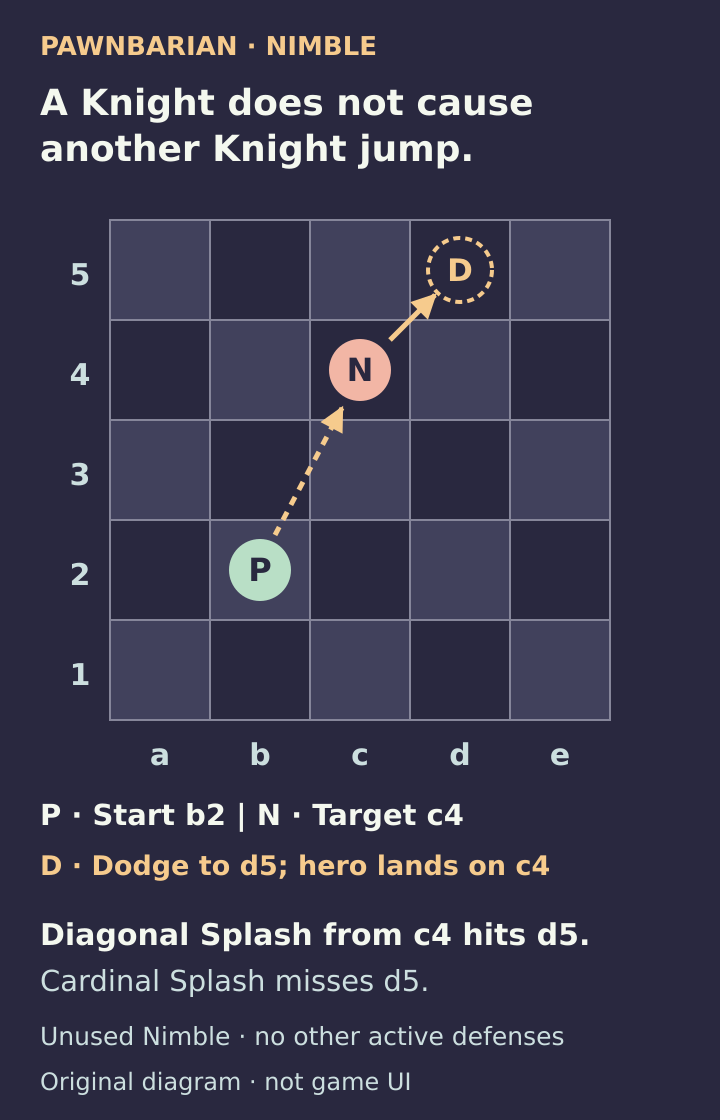
Illustrative position with no other active traits. After the attack, the hero is on c4 and the enemy is on d5.
Match Splash to the escape square
The developer’s rule compendium states that the landing-square attack resolves before surrounding Splash attacks. That order lets an enemy dodge the direct hit and then be struck by the same card’s Splash.
In the b2-to-c4 example, Diagonal Splash reaches d5 from c4. Cardinal Splash does not. The relevant upgrade is the one on the card you are playing, and the relevant shape is measured around your landing square.
For a straight Rook attack, the escape square lies cardinally adjacent to the landing square, so Cardinal Splash is the matching shape. This is why “Splash beats Nimble” is incomplete advice: the wrong pattern misses the escaped enemy. The community All Chains guide specifically corroborates the Knight/Diagonal and Rook/Cardinal combinations.
Use this as a two-step check: first locate the dodge destination, then ask whether the played card’s Splash covers it. Do not choose an upgrade merely because it deals damage somewhere nearby.
Block the exact escape square
Nimble needs a legal destination. Apple’s mobile feature explicitly recommends attacking enemies pinned by the board edge or another enemy.
The important word is exact. An enemy can be near an edge without being trapped in the direction of your attack.
Consider two separate Rook attacks, each against a target with Nimble but no other active defense:
- Hero b3, target d3, another enemy on e3: the attempted dodge is to e3. That square is occupied, so the target cannot escape the hit.
- Hero b3, target e3: the attempted dodge would be to f3, outside the five-file board. The edge prevents it.
In both examples, the squares between hero and target are clear. Now change the second example: put the hero on e1 and attack the same target on e3. The dodge goes to e4, which may be open. Standing on the right edge did not make the target vulnerable from every direction.
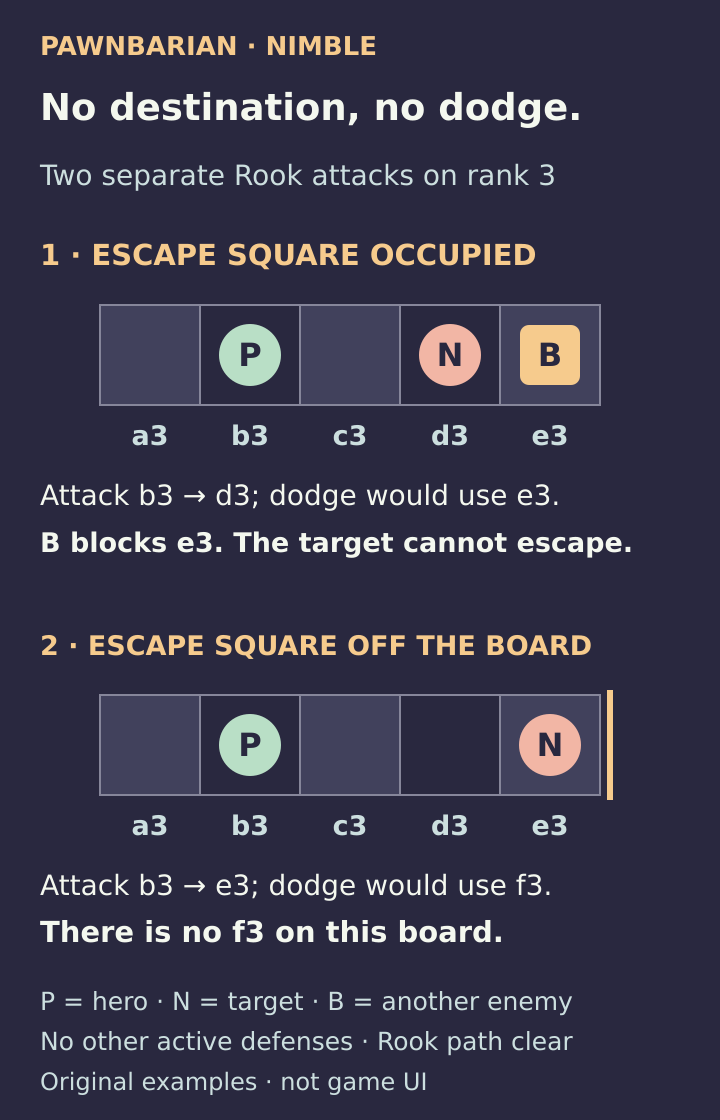
Only the destination behind the target matters for these direct attacks. Other active defenses could still stop the hit.
Follow up before Nimble resets
Nimble is not a permanent extra hit point. Once that enemy has dodged, plan the follow-up before the turn ends. If you wait for a new turn, you should expect its first-attack dodge again.
Before spending your first action on a dodge, check your remaining movement options from the landing square. Reaching the target once is not enough if every remaining card leaves you unable to reach its new location.
You do not always need to finish immediately. If pursuing the enemy would leave your hero exposed, preserving a safe ending position may be better than forcing the kill. The point is to make that choice deliberately, rather than discovering too late that the second card cannot connect.
If the next hit still fails, check immunity
An enemy can have more than Nimble. The developer has separately answered an “immunity bug” report by pointing out that some defenses depend on your position; being the last enemy alive does not remove every kind of immunity.
One example is Brawler, which protects an enemy while your hero is cardinally adjacent. After a straight dodge, your hero may be in exactly that relationship to the target. Do not interpret every failed follow-up as a second Nimble dodge.
Check the current description and position again. A blocked escape solves the movement defense; it does not promise to cancel a separate immunity.
There is another important limit to a big Splash attack: the developer’s compendium says enemy deaths are handled after the full attack. You cannot remove the remaining enemies and an immune Champion in that same attack merely by arranging the Splash order. Plan another attack after the protection is actually gone.
A five-question check before attacking
- Has this particular enemy already dodged during the current turn?
- Which square would the dodge use from this attack direction?
- Is that square open, occupied, or outside the board?
- Does this card’s Splash hit it, or can a remaining card reach it afterward?
- Does another defensive trait change the answer, and where will my hero end the turn?
Start with an uncomplicated Nimble enemy and learn the escape pattern. Once you can predict the destination, the apparent miss becomes a position you can plan around.
Sources and further reading
Community explanation of Nimble and Splash
The Enemy Traits section describes Nimble, its per-turn dodge and matching Splash shapes. This is a historical community guide; its broader builds and older enemy details are outside this guide’s scope.
Read the sourceDeveloper’s distinction between Pawnbarian and Classic
The developer distinguishes the released game from Pawnbarian Classic, the game-jam prototype. The old itch.io browser demo is no longer available.
Read the sourceDeveloper explanation of Nimble direction
Read the developer’s answer to a player asking where Nimble enemies go after a Knight attack. It explains the one-square movement on the same axis or axes as the player’s move.
Read the sourceDeveloper’s attack-order rules
The pinned developer compendium explains direct-hit and Splash order, and why removing the remaining enemies does not also remove a protected Champion in the same attack.
Read the sourceApp Store tip about blocked dodges
Apple’s mobile feature recommends attacking Nimble enemies whose escape is blocked by the board edge or another enemy. It complements the developer’s direction rule.
Read the sourceDeveloper answer about different immunities
The developer explains that Champion is only one source of immunity. Other protections depend on the hero’s position, so an enemy being alone is not enough to make it vulnerable.
Read the source
Latest comments
Log in to join the conversation
Log InNo comments yet. Be the first to share your thoughts!