A gap between two monsters costs one reputation point at the end of the season, not two. Leave it empty, however, and it can cost you again next season.
For ordinary monster scoring, count each empty square that shares a side with at least one monster square. Count that empty square once, however many monsters touch it. Diagonal contact does not count.
This guide explains that base-game calculation for Cartographers players on mobile, with worked examples and a way to judge which gaps deserve your next shape. A short section below covers the important distinction when Heroes or other special effects are active.
Count the exposed empty squares
Start with the empty spaces around the monsters, rather than adding four sides for each purple square. Use this check:
- Find an empty square on your map.
- Look immediately above, below, left and right.
- If any of those neighboring squares contains ordinary monster terrain, include the empty square in the penalty.
- Once counted, move on. Additional monsters touching that same square do not add another point.
A monster square is itself filled, so it does not contribute an empty-space penalty. Two monsters touching each other do not create a penalty on their shared boundary. Likewise, there are no off-board empty squares to count beyond the map edge.
This is why the number of monster squares is a poor estimate of the damage. The arrangement of their empty neighbors determines the ordinary penalty. The publisher states the unique-space rule on page 8 and the adjacency rules on page 9 of the official Cartographers rulebook.
Official Cartographers rulebook
Open official referenceWorked example: two monsters share one gap
In the schematic below, two monster squares sit in the same row with one empty square between them. Each monster has four empty neighbors, but the middle gap belongs to both sets.
The combined count is 4 + 4 − 1 = 7 unique empty squares. That local arrangement causes a seven-point seasonal penalty.
Now fill the middle gap with an allowed ordinary terrain type, such as forest. Six exposed empty squares remain. The penalty falls from seven to six, not from seven to five: you filled one penalized space, even though it touched two monsters.
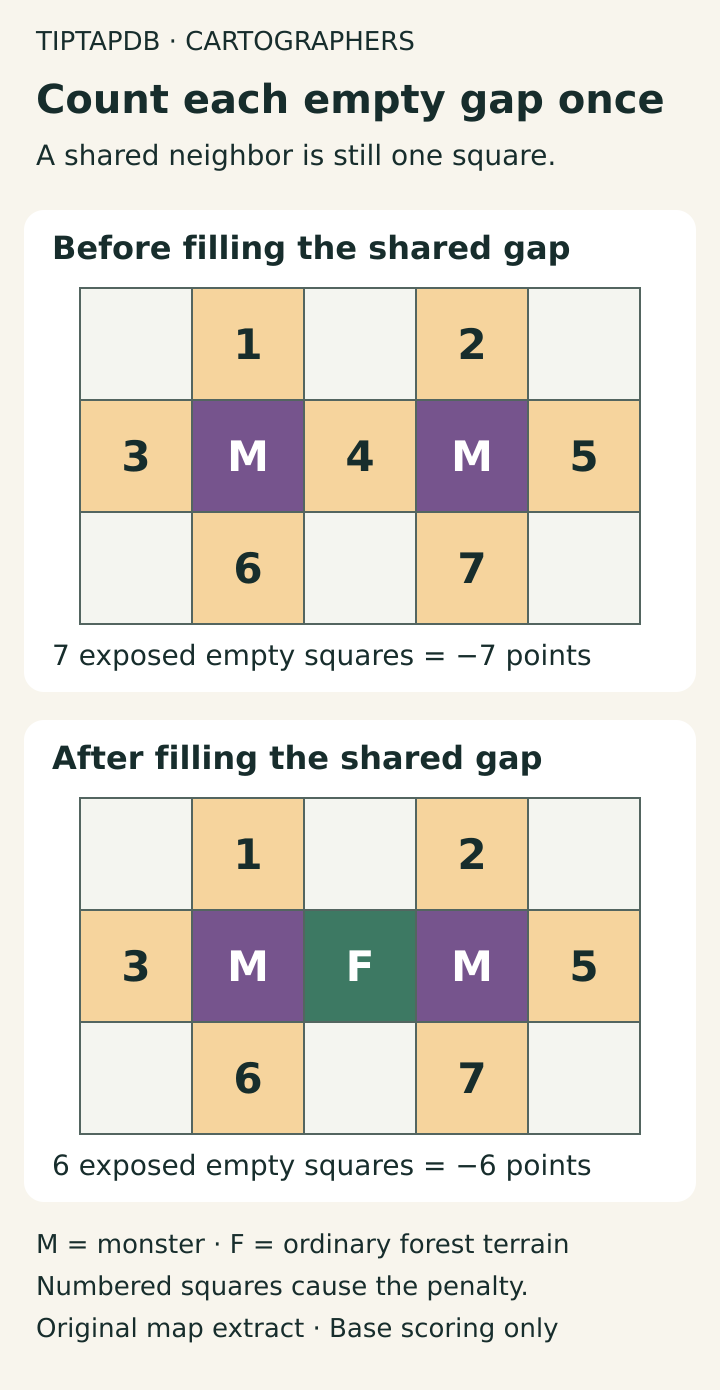
Two monster spaces share one empty neighbor, producing seven distinct penalized spaces. Filling their shared gap leaves six, not five. Original map schematic, not a game screenshot or a particular Ambush card. Numbers mark distinct empty neighbors; ordinary terrain fills the shared gap in the second panel.
Use the same method for larger monster groups. Mark or mentally count the exposed empty squares once each. Counting every monster edge separately will overstate the penalty wherever their neighborhoods overlap.
Which spaces are actually empty?
Several printed features can make this harder to read:
- Mountain: already filled. You cannot place ordinary terrain over it, and it is not an empty neighbor for monster scoring.
- Wasteland: also filled under the base rules.
- Ruins symbol with no terrain drawn on it: still empty. A monster next to it can cause a penalty.
- Ruins covered by a legal terrain placement: filled. The printed symbol does not leave an extra empty space underneath.
- Corner contact only: not adjacent. A diagonally nearby gap adds no penalty unless it also shares a side with another monster.
Ordinary forest, village, farm or water can close a gap when the revealed card permits that terrain and shape. You do not need a particular “defensive” terrain for the base monster calculation.
Keep the whole shape legal. It must fit within the map and avoid filled spaces. A convenient hole is not permission to overlap a mountain or place just part of a larger shape.
Why the penalty returns next season
Monster penalties are evaluated from the map at the end of each season. They are not a one-time charge paid when an Ambush appears. Ordinary monsters remain drawn on the map after their Ambush card has been resolved.
Imagine three exposed empty squares remain at the end of spring. You leave them unchanged in summer, then fill two with ordinary terrain before autumn ends. With no other relevant changes:
| Season | Exposed empty squares at scoring | Penalty that season |
|---|---|---|
| Spring | 3 | −3 |
| Summer | 3 | −3 |
| Autumn | 1 | −1 |
| Winter | 1 | −1 |
The total loss is eight points. Leaving all three gaps open throughout would have cost twelve, so the autumn repairs saved four. They did not refund the six points already lost in spring and summer.
For a quick planning estimate, multiply the number of exposed gaps you would close by the number of seasonal scorings still ahead. Closing two before summer can prevent 2 × 3 = 6 points of later loss across summer, autumn and winter, assuming those gaps would otherwise remain exposed and no special effects change the situation.
That estimate measures the penalty avoided. You still need to compare what the placement contributes to the scoring cards and what you give up by using the shape there.
Repair gaps that also help your scoring plan
The strongest repair often does another useful job: extends a needed terrain cluster, completes a row, or finishes surrounding a mountain.
Mountain example: an empty square borders a monster and is also the last unfilled neighbor of a mountain. Filling it with legal ordinary terrain removes one exposed gap and earns the mountain's coin, provided your coin track still has room. The lower penalty is worth one point at each remaining seasonal scoring, and that new coin contributes another point each season. With three scorings left, those two benefits can add up to six points, before considering the scoring cards.
Check that all four mountain neighbors really are filled. A diagonally placed tile does not finish the mountain, and a bare ruins symbol in one of its neighboring squares does not count as terrain.
There is also a useful exception to the instinct to fill every small hole. The Cauldrons rewards an empty square enclosed on all four sides by filled spaces or the map edge. Monsters count as filled spaces for that condition.
An enclosed hole touching a monster can therefore earn one Cauldrons point and lose one monster point in a season when Cauldrons is scored. Filling it removes both of those contributions. For that particular square, the immediate net change is zero unless the placement creates another benefit. In a season when Cauldrons is not scored, its monster penalty still applies.
Read the active scoring cards before committing a precious small shape. The most obvious monster gap is not automatically the best destination. The official rules cover mountain rewards on page 6, seasonal coin income on page 8 and The Cauldrons on page 11.
Enclosing monsters and destroying them are different effects
Under the ordinary base rules, enclosing a monster stops its empty-neighbor penalties once there are no exposed gaps left. It does not erase the monster terrain or turn its square into buildable space.
If your game includes Heroes, check its additional rules. A hero's attack pattern can destroy monster spaces. Those destroyed spaces stay filled but lose their terrain type; destroying a monster does not create a fresh empty hole. Empty spaces merely marked by an attack pattern are still empty.
That distinction matters when a score seems inconsistent with the base example. Check whether a purple monster is still present, has actually been destroyed, or is affected by a special Ambush rule. The official Heroes rulebook explains hero attacks, destruction and seasonal effects on pages 8–11. Apply those rules only when that content is part of your match.
Official Heroes rulebook
Open official referenceBefore the season ends
The base game's season check happens after the drawing step. When the revealed cards' time total reaches or exceeds the current season's threshold, scoring follows; you do not get an extra normal placement to tidy the border afterwards.
Before confirming a late-season shape:
- Count distinct exposed empty squares, including any unfilled ruins.
- Ignore diagonal-only contact and space beyond the board.
- Check whether the shape can close several gaps legally.
- Compare the penalty saved with the active scoring cards, including any benefit from leaving a Cauldrons hole open.
- Include future seasons when the repair will keep helping.
If the app's result still differs, preserve a screenshot of the map and seasonal score, plus the active scoring cards and special effects. A single highlighted gap often explains the discrepancy. The base penalty calculation is local: find the empty square, check its side-neighbors, and count it once.
Latest comments
Log in to join the conversation
Log InNo comments yet. Be the first to share your thoughts!