Morrigan at a glance
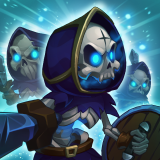
Morrigan is an Eternity Healer who uses skeletons as both battlefield bodies and a damage-sharing resource. Bone Armor favors her own faction, while Necromancy changes resurrection interactions. Her contribution should be evaluated through allied survival and denied revivals as well as healing totals. She is not simply a direct-heal substitute with a decorative summon.
Keep the skeleton economy visible
Watch how many skeletons remain when Empathy activates and how quickly they are removed afterward. A strong summon count at the beginning does not guarantee sustained protection through repeated area damage. Bone Armor and Empathy also add skeletons, so the ultimate is not the only reinforcement source. The army cap prevents interpreting every summon event as limitless growth.
Eternity partners and mixed-team tradeoffs
Corvus and other Eternity allies can use the full defensive benefits, while mixed-faction recipients get reduced Bone Armor effectiveness. The publisher also identifies a Morrigan–Octavia interaction because skeletons count as Eternity heroes and can receive relevant buffs. That does not override Octavia's more specific original-team targeting conditions on particular skills; inspect each effect separately.
Resurrection can cut both ways
Necromancy interferes with friendly resurrection attempts as well as enemy ones, and Morrigan's own revival requires Soul Essence. Pairing her with Astaroth or another revival source therefore needs an explicit interaction test. Losing skeletons can also erode Empathy's practical value. Do not claim a permanent answer to every resurrection hero or assume an ordinary enemy death automatically supplies a charge.
Development for durable support
Magic Attack appears in healing, summon Health, redistribution limits and revival Health. Her Armor and Magic Defense also matter because newly summoned skeletons inherit those defenses. This creates a reason to compare support scaling with survival rather than blindly maximizing one number. If the army disappears immediately, a better defensive snapshot may matter more than a larger theoretical heal.
Artifacts for a physical Eternity partner
Raven's Skull provides team Armor Penetration, even though Morrigan herself scales mainly from Magic Attack. Tome of Arcane Knowledge gives personal Magic Attack and Health; Ring of Intelligence develops her primary attribute. The weapon can serve a physical teammate, while the book supports her own kit. A magic-only lineup may value those choices differently from one built around a physical carry.
Glyphs and skins
Her documented glyphs are Health, Magic Attack, Intelligence, Magic Defense and Armor. Spring and Winter are Magic Attack examples; Dark Depths gives Health and Lunar gives Armor. The defensive choices affect both Morrigan's survival and the reported summon-time inheritance. A skin catalogue does not establish present shop access, and additional owned skin stats remain active regardless of the selected appearance.
Talismans and summon survival
The publisher lists Necromancy with Intelligence and Bones with Armor. The community entries associate the former with Health slots and the latter with Magic Attack slots. Compare the entire item when deciding whether she needs stronger scaling, greater personal durability or a sturdier defense snapshot for skeletons. The name Necromancy does not itself grant extra Soul Essence.
Class effects, Relics and uncertain numbers
Healer-class damage conversion can appear alongside Bone Armor healing and should not be mistaken for a base skeleton mechanic. Any Relic changes must be recorded separately. The reviewed tooltip has inconsistent skeleton-attack arithmetic and mismatched example totals; those are explicitly retained as open verification items rather than silently “repaired” into new formulas. The underlying four-skill structure remains distinct from these extra systems.