
A strong Exploration Arena team needs five heroes who work together, not just the three newest heroes or the five largest power numbers. Build a frontline that survives long enough for your damage and control skills to matter, then replace the weakest job in that team as your state unlocks new generations.
Exploration and Expedition Arena
Read Century Games’ release notes for the two Arena modes.
Arena update notesStart with five jobs rather than five names
Start with two durable heroes in front and damage or support in the three rear positions. This is not a compulsory two-Infantry class ratio: the wiki’s early example puts Jessie, a Lancer, beside Sergey.
Build around these jobs:
| Job | What the team needs | Warning sign |
|---|---|---|
| Main frontline anchor | Enough durability to keep the opening exchange from collapsing | This hero falls before your important skills take effect |
| Second frontline position | Another survivor, not merely your next-highest power hero | One side opens immediately while the other tank remains healthy |
| Main damage source | Damage that reaches the enemies you need to remove | Your team survives but cannot finish targets |
| Control or support | A useful interruption, protection, heal or cleanse | A slot contributes an effect your team does not currently need |
| Flexible fifth slot | More damage, more survival, or a specific answer to the opponent | You keep the same fifth hero against every matchup without knowing why |
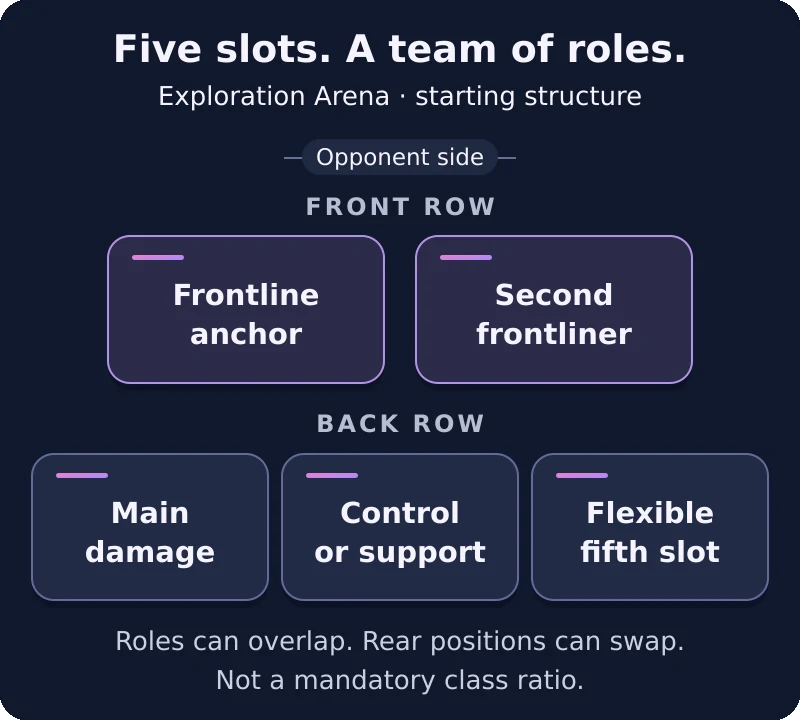
Two frontline positions and three backline positions, with flexible roles for an Exploration Arena team.
These are jobs, not exclusive labels. A hero can cover several. That is why replacing an older hero can change more than the team’s power number: you may gain raw damage but lose the only heal or interruption that held the formation together.
Use the right skill column
Exploration Arena uses heroes’ Exploration skills. Rally advice about a joiner’s first Expedition skill does not describe this combat system. Likewise, an Expedition damage bonus is not evidence that a hero will be your best five-hero Arena choice.
Read an Exploration kit in this order:
- What does the main skill actually hit? One target, an area, a line and every enemy are different things.
- What else happens? A freeze, stun, heal or protective effect may decide whether another hero gets to act.
- What is the condition? A benefit below a health threshold or after several attacks is not an unconditional opening bonus.
- What changes with skill level? Compare the skill level you have, not only the maximum printed in a guide.
- Is the effect part of exclusive gear? Do not credit a newly recruited hero with an upgrade you have not built.
Here are concrete examples of what that reading reveals. The tactical uses below are suggestions based on the listed kits, not a universal ranking.
| Hero | Relevant Exploration mechanic | How to use that information |
|---|---|---|
| Molly | Super Snowball combines area damage with a 1.5-second freeze | An early damage slot can also provide control; replacing her with a pure damage hero changes both jobs |
| Alonso | Trapnet deals area damage and immobilizes enemies for 1.5 seconds; Harpoon Blast has a repeated-attack stun | Judge his control alongside his damage, rather than valuing him only as a newer Marksman |
| Ahmose | Cthugha’s Protection gives him a two-second invulnerable period and reduces damage to nearby friendly troops; he cannot move or cast skills during it | A frontline upgrade can buy time rather than simply raise damage; “nearby” is not a promise of full-board protection |
| Lynn | Her kit includes debuff removal and temporary immunity, plus enemy healing reduction | Consider her when control or healing is the problem, rather than demanding that every back-row slot be a damage specialist |
| Aisling | Wild Growth damages nearby enemies and stuns for two seconds; Fruits of Plenty heals the allied hero with the lowest remaining health | She can combine damage, control and targeted recovery; this is not a team-wide heal |
Compare hero skills
Open the Whiteout Survival Wiki hero index to compare the Exploration kits available in your state.
Browse hero skillsWhy the newest generation is not a complete team
Generation 2 introduces Flint, Philly and Alonso; Generation 3 introduces Logan, Mia and Greg. Those are three heroes, while your formation needs five. Mixing generations is therefore normal, not a sign that you built your account incorrectly. Hero releases also follow state progression rather than a single global roster available to every player.
The practical question is not “Can I use the new generation?” It is “Which existing slot does this particular hero improve at the investment I can actually afford?”
| Situation | Better decision |
|---|---|
| The new hero fills the same job and is developed enough to perform it | Compare a one-for-one replacement |
| The new hero has attractive damage but removes your only reliable frontline survivor | Keep the survivor and investigate a different slot |
| A newer support duplicates an effect you already have, while damage is lacking | Try a damage alternative before building a second support |
| The new hero needs resources you also need to finish your main damage source | Compare the complete upgrade paths, not recruitment cost alone |
| Your existing hero works, but a particular opponent consistently defeats the lineup | Keep a matchup alternative instead of rebuilding the whole team |
There is no dependable shortcut such as “every three-star new hero beats every five-star old hero.” A stat comparison cannot tell you whether a missing stun, a weaker skill or unavailable exclusive gear will change the fight.
Three starting formations and what they teach
These are historical early-generation starting points, not a claim that they beat later-generation teams. Use them when the heroes are available and sufficiently developed.
| Roster stage | Front row | Back row | Lesson |
|---|---|---|---|
| Early accessible roster | Sergey, Jessie | Molly, Bahiti, Gina | A workable team need not have five Mythic heroes |
| Developed Generation 2 roster | Flint, Natalia | Molly, Alonso, Philly | New heroes can join older heroes rather than replace the whole roster |
| Developed Generation 3 roster | Flint, Logan | Mia, Alonso or Philly, Greg | One flexible seat can change the balance between damage and recovery |
These combinations come from the wiki’s Exploration lineup examples. They are starting points, not a reason to buy an undeveloped hero. Choose between alternatives using your own star levels, skills and equipment.
For example, if you have the Generation 2 trio but no developed Natalia, the table does not instruct you to put an unusable Natalia in front. Keep a viable frontline hero from your actual roster. A list of names only becomes a formation when all five can do their jobs.
Change position before buying an upgrade
Treat a loss as information about where the team failed. The first useful distinction is whether the front collapsed, the backline was removed, or your survivors could not finish the enemy.
| What happens in the fight | First adjustment to compare | What not to assume |
|---|---|---|
| One frontline hero dies much earlier than the other | Swap the two front positions while keeping the roster and gear unchanged | The lower-power hero must automatically be replaced |
| Your key damage hero is repeatedly disabled or eliminated before contributing | Compare a back-row swap, then a suitable protection or cleanse option | A back-row position guarantees safety |
| Your heroes survive but the enemy recovers faster than you finish targets | Compare more finishing damage or an available healing-reduction kit | A third survival-oriented hero will solve it |
| A new hero raises displayed power but the team performs worse | Restore the old hero, then identify the lost control, healing or survival role | Higher combined power proves better synergy |
| One opponent is easy but another similar-power opponent is not | Compare their skill mix and formation, not power alone | One lineup is equally good into every team |
Do not change three heroes, move all the equipment and rearrange every position at once. Even if the next battle goes better, you will not know which change mattered.
A simple comparison routine is enough: keep your current formation as the baseline, change one position or one hero, and observe whether the same failure still occurs. When repeated comparable encounters are available, use more than one result before declaring a winner. This is a way to make better decisions, not a promised win-rate formula.
Gear makes copying a team more expensive than copying five names
Hero Gear enhancement improves the relevant piece’s hero and command bonuses, while exclusive gear belongs to a specific hero and adds its own stats and skills. Treat exclusive gear as a separate investment when comparing replacements.
A formation has five simultaneously active heroes. If your useful equipment is concentrated on three, the remaining two seats are a real constraint. Moving your strongest equipment to a candidate can make that candidate look better while weakening the teammate who lost it. Compare the finished five-hero loadout, not the candidate in isolation.
The same care applies to exclusive-gear skills. Alonso’s Ocean’s Bounty adds healing for the weakest hero to his basic attacks; it is separate from his three base Exploration skills. Do not count that recovery unless his exclusive gear provides it.
Hero Gear is not irrelevant just because the battle is called Exploration. The July 2024 update specifically extended enhancement and mastery benefits to Exploration escort troops and Arena.
Before committing scarce materials, answer three questions:
- Does this upgrade fix the slot that is actually failing?
- Can the rest of the team keep its working equipment?
- Am I funding a hero I can finish, or spreading resources across several incomplete replacements?
Avoid turning the fifth Arena slot into an open-ended spending project. If your current team’s main damage source still lacks important development, completing that hero may be the more useful comparison than starting another long upgrade path.
A practical upgrade order for your own roster
Start by fixing a clear failure, rather than following a universal shopping list.
If the front collapses: stabilize the vulnerable frontline slot. Compare its position, current development and protective kit before adding another back-row attacker.
If your damage hero never gets to work: preserve the damage slot and investigate why it is being removed or controlled. A formation change or an already-built support may be more useful than recruiting a different attacker.
If the team survives but cannot win: examine damage and finishing ability. More survival is not automatically better. Consider whether the enemy’s healing is the specific obstacle.
If a new generation arrives: shortlist the hero that improves your weakest job, calculate a realistic build alongside the other four, and replace one slot first. Keep an older hero if its contribution is still important.
The goal is a complete team that can execute its plan: survive the opening, land useful damage and control, and finish the opponent. New generations give you more ways to accomplish that—not a requirement to discard every hero who came before them.
Latest comments
Log in to join the conversation
Log InNo comments yet. Be the first to share your thoughts!