
If your Threat reads 9 (14) while you are Vulnerable, you need 9 actual Block to clear that Threat. The 14 is the projected HP loss if you leave it unresolved, not extra Threat and not a second amount to block. Developer Bugphobia answered this exact question in April 2024.
This guide covers ordinary Threat and the standard +50% Vulnerable effect. The examples are calculations, not tests of a current PC or mobile build. Special effects can change the outcome; check their tooltips and the updated damage preview before ending your turn.
Read the two numbers separately
In this example, the first number is the Threat on you. The parenthesized number is what that Threat would do to your HP under Vulnerable. Do not add them together: 9 (14) does not mean 23 incoming damage.
Ordinary Block removes Threat first. Vulnerable then increases the damage from whatever Threat remains when it triggers. That order explains why blocking nine is enough even though the initial preview says fourteen.
Partial Block: subtract first, then apply Vulnerable
For these examples, start with 9 Threat. Assume the stated amount of Block actually resolves, Vulnerable is still active when Threat triggers, and no other effects or new Threat intervene.
- 0 Block: 9 Threat remains. 9 × 1.5 = 13.5, rounded up to 14 HP damage.
- 3 Block: 6 Threat remains. 6 × 1.5 = 9 HP damage.
- 4 Block: 5 Threat remains. 5 × 1.5 = 7.5, rounded up to 8 HP damage.
- 8 Block: 1 Threat remains. 1 × 1.5 = 1.5, rounded up to 2 HP damage.
- 9 Block: no Threat remains, so this stack deals 0 HP damage.
The common wrong calculation is 14 minus 4 equals 10. Four Block does not subtract four from that original damage preview. It changes the Threat that the preview is calculated from.
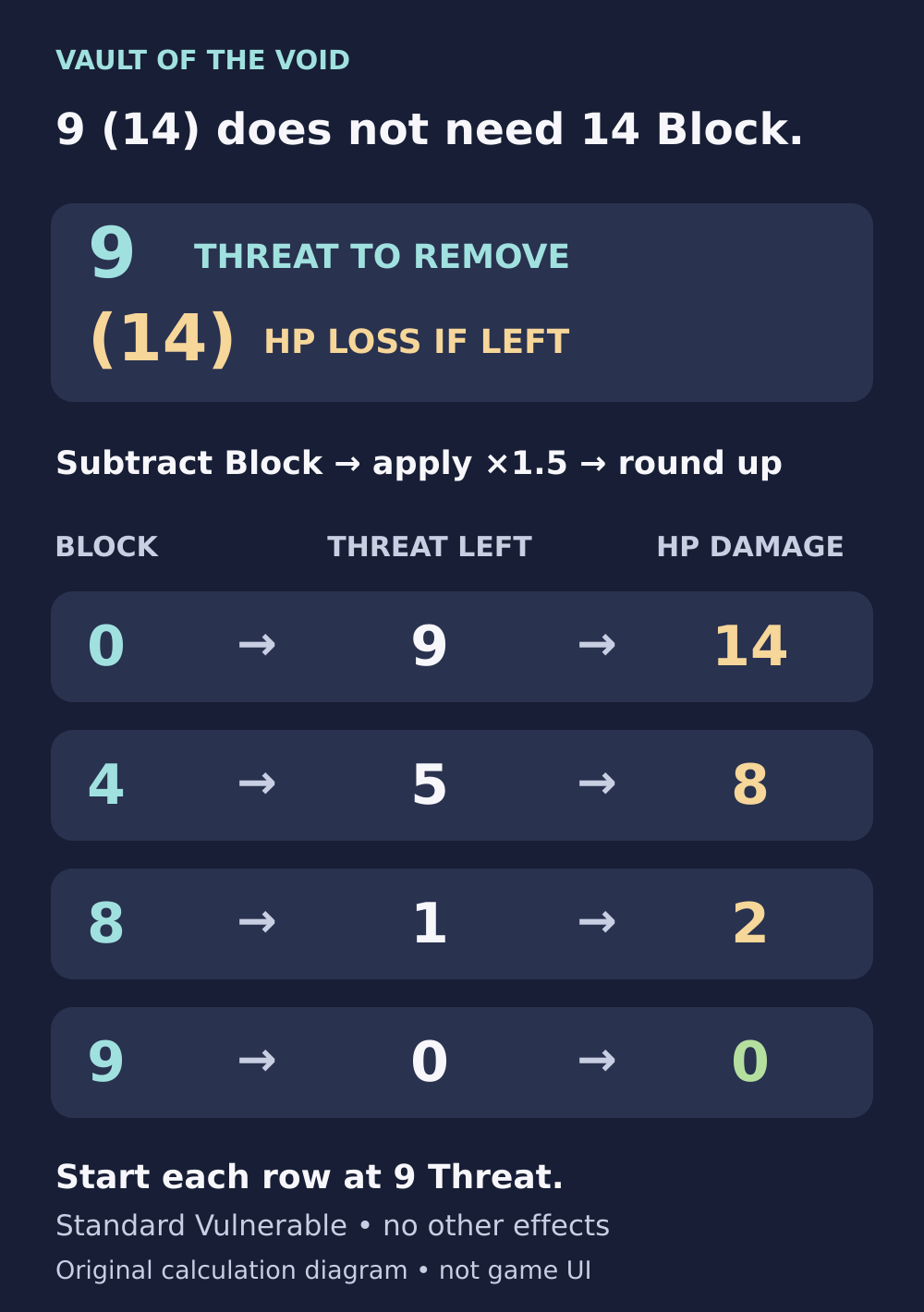
Block removes raw Threat before standard Vulnerable increases the remaining damage. These are separate arithmetic examples without other effects.
The one-Block-short case matters when your HP is low. In this example, being one Block short still costs two HP. Compare the updated damage preview with your remaining HP rather than assuming a nearly cleared stack is harmless.
Make sure you are blocking the current stack
Vault of the Void gives you a response turn after enemies attack. Their actions add Threat; during your following turn, you can reduce it. The remaining stack then damages your HP when that player turn ends. The official game description calls this reactive blocking.
That creates two different questions:
- Current Threat: what must I deal with before ending this turn?
- Next-turn forecast: what could the coming enemy actions add afterward?
Do not combine those displays into one current Block requirement. If you have 9 current Threat and a forecast of 12 from upcoming attacks, that forecast does not turn the current stack into 21. Deal with the nine now, then plan for the next cycle. The forecast can change as enemies and effects change.
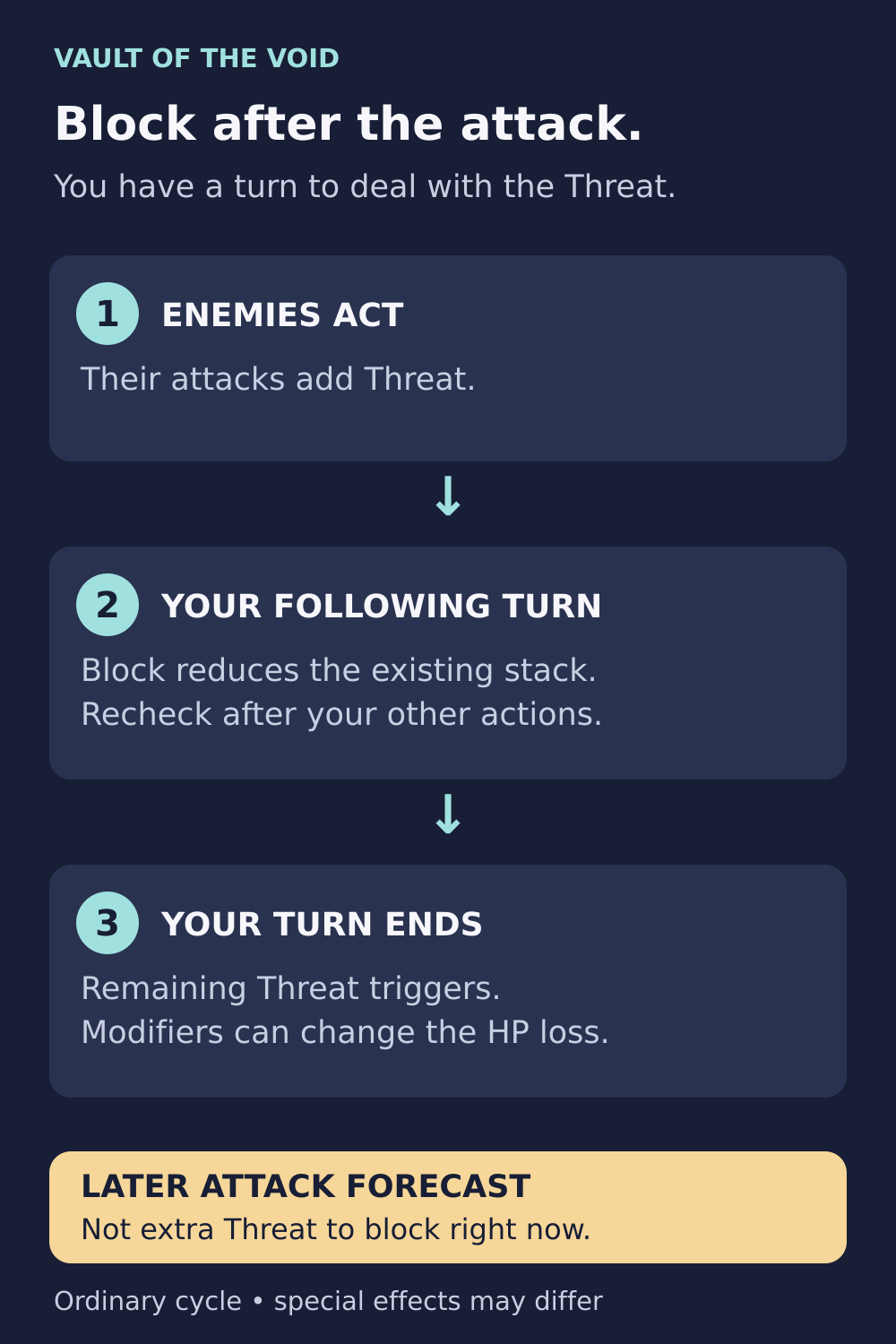
Follow the existing stack through the response turn. A forecast of later attacks is a separate planning problem, not another amount to add to it.
Why playing Block early did not protect you
Ordinary Block is an immediate reduction of existing Threat. It is not a shield balance that waits for a future attack. If you generate ordinary Block while there is nothing to remove, do not expect that value to protect you later.
This also matters within one turn. Threat added after your Block resolves is not automatically covered by the Block you played earlier. Dabor's explanation specifically uses retaliation-type effects to illustrate this distinction.
Before spending a defensive card, check what is already on the stack and whether your remaining actions could add more. After those actions, read the current Threat and HP-loss preview again. A zero you saw earlier in the turn is not a promise about the final state.
Keeping a card is different from storing Block
You can prepare by keeping a useful Block card unplayed for a later turn. Cards and Energy carry over, but retaining a card does not resolve its defensive effect now. The coauthored beginner guide by Dabor and Josh Bruce makes this distinction when explaining how to prepare for incoming damage.
Delay Block is a separate, forward-looking effect. Follow its own timing and tooltip. Do not count it as ordinary Block already applied to the current stack, or assume that all unused ordinary Block becomes Delay Block.
Why killing the attacker did not clear Threat
Enemy attacks contribute to a shared Threat total. Once an attack has added to it, killing that enemy does not itself undo the contribution. Josh Bruce's June 2021 explanation confirms that Block works on the combined stack rather than on individual attack cards.
For example, imagine two enemies have already added 6 and 3 Threat. Killing the second one does not automatically turn the current nine into six. It may improve what happens next, but you still need to inspect the existing stack.
Winning the encounter before unresolved Threat triggers is different from killing one attacker. Do not rely on an apparent final kill without checking the encounter state: reinforcements can mean the fight is not over. Avoid spending your last defensive option on the assumption that one death will clear the stack.
A short check before End Turn
- Read current Threat, separately from the next enemy-action forecast.
- Check whether Vulnerable or another effect changes the projected HP loss.
- Count Block that actually resolves now, not just the value of cards still in your hand or a delayed effect.
- After attacks, kills or other effects, read the stack and damage preview again.
- If Threat remains, make sure its projected damage is survivable. Do not count on an unfinished encounter ending for you.
For the simple 9 (14) case, the decision is straightforward: nine effective Block clears the stack. If you can only produce eight, plan around the two HP damage left by ordinary Vulnerable.
If your result still differs
Check the text of the active effects and the actual amount of Block generated before assuming a bug. A changed stack, a delayed defensive effect, or a modifier outside this example can invalidate the simple calculation.
If the discrepancy remains, keep a screenshot showing Threat, HP, active effects and the relevant card text, plus your platform and game version. That is more useful for reproducing a problem than reporting only that the brackets looked wrong.
Check your platform's version notes if the mismatch involves an end-of-turn effect. The Android listing updated on 11 February 2026 includes fixes to Shii spread and Threat-trigger timing. For class, artifact or combo interactions, use the relevant tooltips rather than extending these ordinary-Block examples to a special trigger order.
Sources and further reading
Developer explanation of 9 (14)
Read developer Bugphobia’s 14 April 2024 answer: Block reduces Threat before ordinary Vulnerable increases remaining HP damage, with upward rounding.
Read the sourceOfficial explanation of reactive Block
Read the current official Steam description of the response turn between enemy attacks adding Threat and that stack damaging the player.
Read the sourceModerator explanation of the next-turn display
Read Dabor’s June 2021 explanation of the upcoming attack forecast. This historical discussion is used for the current-versus-future distinction, not special combo timing.
Read the sourceModerator explanation of Block and Delay Block
Read Dabor’s December 2020 explanation that ordinary Block reduces existing Threat rather than storing a shield, including same-turn retaliation and Delay Block.
Read the sourceCoauthored guide to reactive defense and retained cards
Read Dabor and Josh Bruce’s beginner guide, last updated September 2022, for retaining cards, reactive Block and reinforcements. Historical special-combo sequencing is outside this guide.
Read the sourceDeveloper explanation of the shared Threat stack
Read Josh Bruce’s June 2021 explanation of combined Threat. The thread also distinguishes defeating an attacker from ending the encounter; the battle-ending comment is by another player.
Read the sourceOfficial mobile listing and update notes
Check the official Android listing, updated 11 February 2026, including Threat-trigger timing fixes. Store notes do not establish a hands-on test or platform build parity.
Read the source
Latest comments
Log in to join the conversation
Log InNo comments yet. Be the first to share your thoughts!