A factory with no input, a factory holding finished goods, and a dock waiting to sell cargo can all look like an economy that has stopped. They need different fixes. Before building another Teamsters’ Office, find the last place where the goods are actually moving.
This guide covers Feral’s Tropico for Android and iOS, whose underlying game is Tropico 3. It uses the original 2009 rules and later community explanations, not Tropico 6 logistics. The current mobile build has not been play-tested here, so the checks below do not depend on an exact phone-menu layout.
Start with one chain, not your treasury
Choose one struggling product. For a simple example, follow tobacco from a farm to a cigar factory, then follow the cigars toward export. Keep the investigation on that chain until you know which stage needs attention.
The original manual distinguishes a building’s current output stock from the input stock that another building uses. Teamsters move goods between these locations and the docks; export involves loading cargo onto a freighter. A stockpile and a completed sale are different stages.
Pause and record four things: the supplier’s stock, the factory’s input, its finished output, and the relevant cargo at the dock. Also note filled jobs in the affected buildings. Then resume and compare the same locations later. One screenshot tells you where goods are now, not whether they are moving.
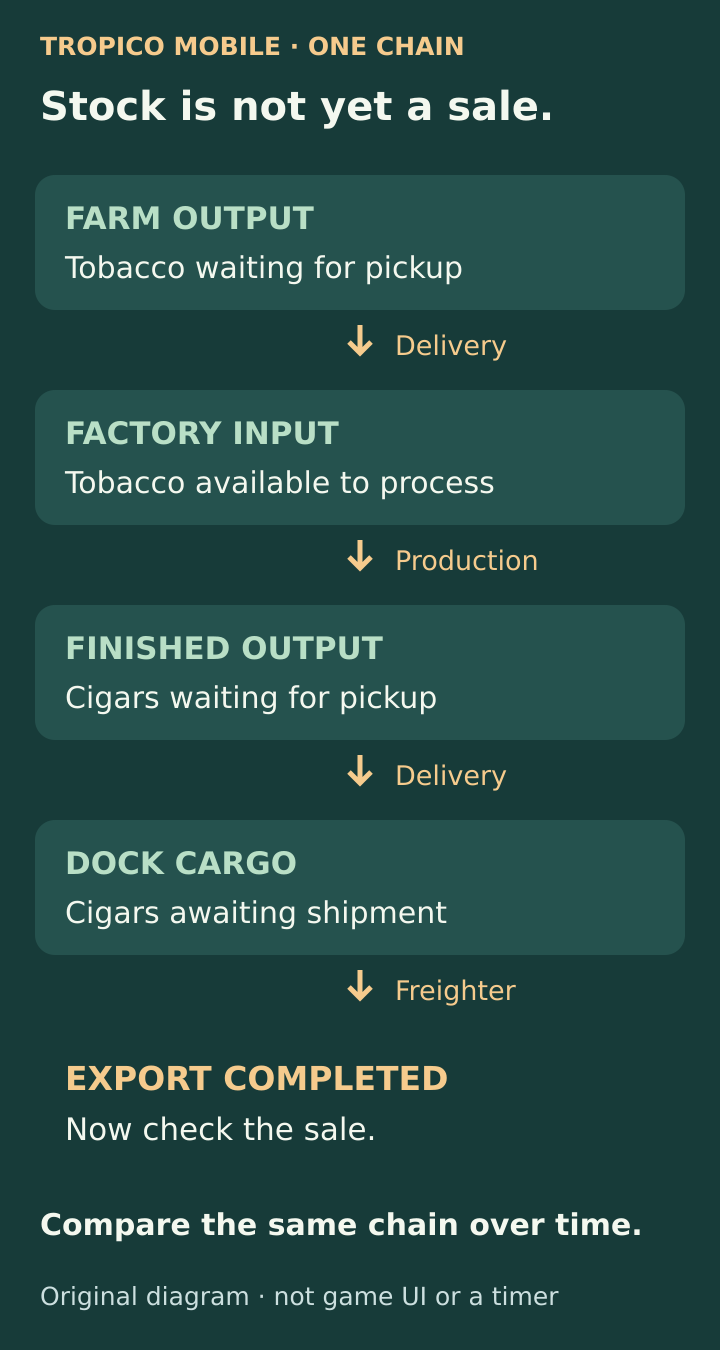
Follow one product from stock to sale. This is a conceptual diagram, not a reproduction of the mobile interface.
Factory input is empty: check the supplier first
An empty input store does not identify the cause by itself. Open the building that should supply that material.
- The supplier is also empty: watch whether it produces and whether stock is being collected. A low balance can mean little supply, but it can also mean prompt pickup.
- The supplier retains stock while the factory stays empty: investigate the delivery leg. Look at transport staffing and the journey between those two buildings.
- Input arrives, then disappears again: the route is doing something. Watch whether the factory converts that input into finished goods before declaring it broken.
If supply itself is weak, look at the producer rather than expanding the factory. Check crop conditions for farms and remaining deposits for mines. A new factory does not make unsuitable farmland produce more tobacco.
Make the observation specific: “this farm keeps tobacco while this cigar factory stays empty” is much more useful than “my island needs more Teamsters.” It gives you two buildings to inspect and one journey to improve.
Input is available, but finished output is not growing
Now the missing step may be processing rather than delivery. Check the factory’s filled jobs and any unmet requirement shown in its details. Cigar manufacturing needs high-school-educated workers, so a large population is not the same as a suitable workforce.
Do not use a single low output reading as your production test. Finished goods might have just been collected. Compare input and output over time, and look downstream for the product you expected to see.
For example, suppose a factory has input at the first check and less at the second, while cigars appear at the dock. That is evidence of movement through the chain, even if the factory’s own output remains low. Conversely, unchanged input and no new finished goods point you back toward the factory. These are clues for where to look, not proof of one particular bug.
Finished goods remain at the factory
If the finished stock keeps building up, focus on the journey out. Adding more raw-material production would feed the same unresolved problem.
Count workers, not just buildings. A new transport building with unfilled jobs is not a useful substitute for checking the offices already on the island. Travel matters too: look for long detours between producers, industry and the dock.
Walk through the likely route on the map. Is there a conspicuous traffic bottleneck? Are workplaces and useful garage access far apart? Is the factory awkwardly placed relative to both its supplier and the dock? These observations help you choose an adjustment instead of scattering new offices around the island.
Roads deserve attention, but avoid a misleading shortcut: the original manual does not say that every unconnected building stops functioning. It says that such a building is outside the road network. Garages and road access affect travel; “no road means no production” is too broad a diagnosis for this game.
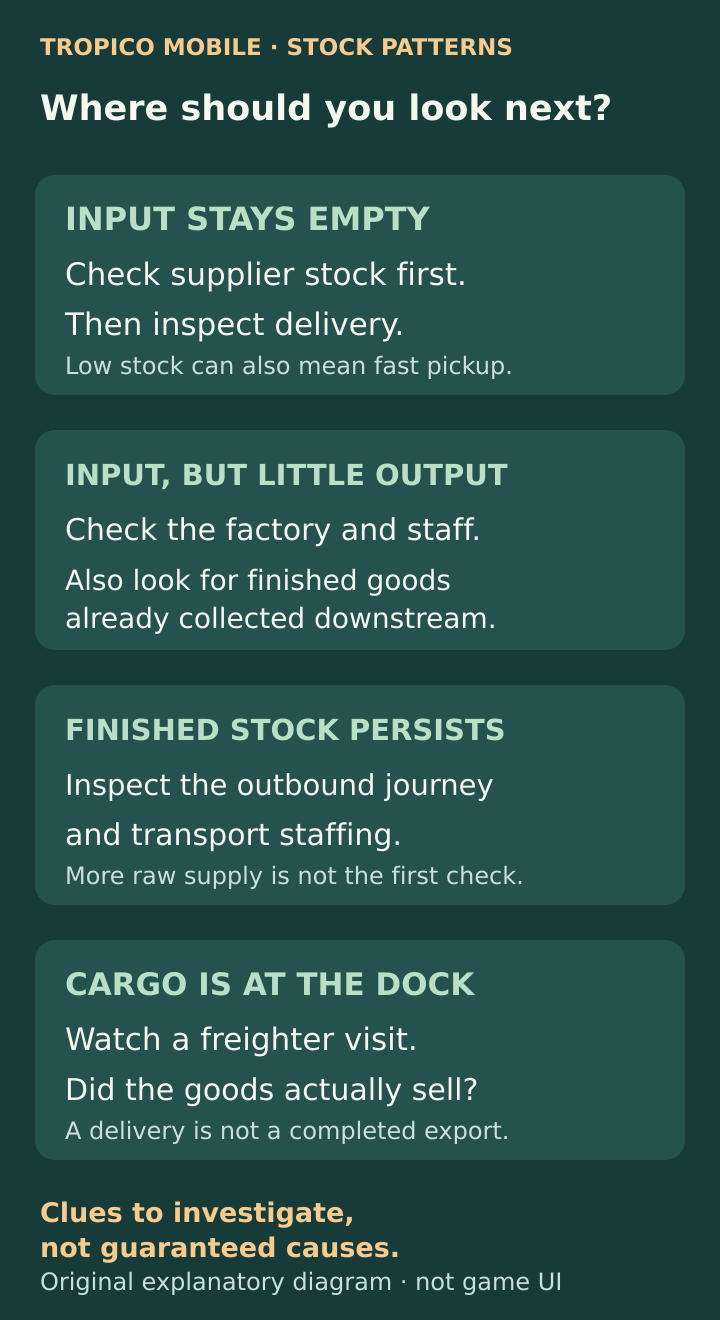
Use the pattern to choose the next check. Confirm it over time before spending money on a fix.
Goods reached the dock, but income still looks wrong
Follow the cargo across a freighter visit. Goods reaching the dock have completed a transport step; they have not necessarily completed the export step yet. The manual also notes that export prices can change over time. Moving the same product successfully does not guarantee the same revenue forever.
If the cargo sells, stop treating that particular shipment as stranded. You can then ask a different question: is the chain earning enough for your island’s expenses? Do not keep rebuilding its transport simply because the treasury remains disappointing.
If goods remain after the visit you watched, inspect the dock’s staffing and what happened during loading. Record the product and whether its quantity changed. Avoid deciding that a second dock is necessary from one unexplained balance alone.
Raw tobacco is exported despite a cigar factory
Raw exports do not automatically mean that Teamsters ignored your industry. A February 2014 Arqade answer about Tropico 3 explains that factories have limited input storage; once that capacity is occupied, surplus raw materials can go to export instead. This is a historical community explanation, not a guarantee about every dispatch in the current mobile build.
Check the factory before reacting. If its input is well supplied, sending surplus tobacco away is a different situation from an empty factory beside a stocked farm. The first invites a processing-capacity check; the second invites a delivery check. Neither is solved by assuming all raw exports are an error.
Test one change and look for the missing movement
Make a manual save before restructuring the island. On iOS, Feral documents Save Game in the Pause menu, accessible through the cog in the upper-right corner.
- Choose the stock pattern that persists across your observations.
- Make one targeted adjustment, such as addressing vacant transport jobs or improving an awkward connection.
- Resume long enough to observe the affected journey or a freighter visit. There is no universal countdown that proves a repair.
- Recheck the same supplier, factory and dock. Look for progress at the stage that was missing.
- Only then decide whether more production or transport capacity is justified.
For a useful before-and-after note, write: “Farm retains tobacco; factory input stays empty. Changed one connection. After resuming: did tobacco reach the factory?” That is a testable question. “Built three offices; treasury went up” leaves too many possible explanations.
The best next purchase is the one that addresses the blocked stage you can actually see. Find that stage first.
Sources and further reading
Official mobile edition announcement
The May 8, 2019 publisher announcement identifies the mobile edition as a port based on Tropico 3, with a redesigned touch interface.
Read the sourceTropico 3 and mobile production examples
This 2024 community guide covers Tropico 3 and mobile production chains, workforce requirements and resource checks. Its opening strategy is optional, not a required troubleshooting sequence.
Read the sourceOriginal Tropico 3 manual
Read the original PC manual: pages 18–20 explain road access, resource stocks and exports. The mobile edition is based on this game, but this PDF is not a mobile interface guide.
Read the sourceHistorical transport and staffing advice
The Garages and Remember sections explain travel and workforce considerations in Tropico 3. Treat the author’s preferred layout as advice rather than a universal building ratio.
Read the sourceHistorical explanation of raw-material exports
This Tropico 3 question and answer describe finite factory input storage and why surplus tobacco can be exported even when a cigar factory exists.
Read the sourceFeral’s mobile pause and save instructions
Feral’s iOS FAQ explains opening the Pause menu and making a manual save. It is a control reference rather than a production or transport manual.
Read the source
Latest comments
Log in to join the conversation
Log InNo comments yet. Be the first to share your thoughts!