A fusion can keep both traits you wanted and still stop qualifying for your team’s race bonus. The result takes its race from the first parent and its class from the second. Putting an Ent in the second slot does not make the resulting creature count as an Ent.
The trait slots matter too. The first parent supplies the innate trait; the second supplies the fused trait. Both belong to the finished creature, but an effect that specifically copies innate traits does not automatically copy both.
The examples below cover ordinary fusions under Siralim Ultimate’s 2.0-era rules, without additional race-changing or trait-replacing effects. They are not a current mobile-build playtest.
Separate race, class, trait and appearance
Before deciding a fusion has failed, identify what your intended bonus actually checks:
- Race: a family such as Golem, Unicorn or Ent.
- Class: Chaos, Death, Life, Nature or Sorcery. This is the creature’s class, not your character’s specialization.
- Trait source: innate, fused or another source, such as an Artifact. Those labels are not interchangeable.
- Appearance: the body, skin and palette you see. A color choice is not a reliable way to check a mechanical class requirement.
For example, “your Golems” does not mean “your Sorcery creatures.” A Golem can have a different class after fusion and still be a Golem. Conversely, taking a Sorcery parent does not turn an unrelated body into the Golem race.
Read the exact noun in the trait or perk you are trying to use. “Same race,” “same class” and “innate traits” ask three different questions. The community’s Codex transcription separates these systems and labels its rules as version 2.0.37.
Read the parents as two different jobs
For an ordinary two-creature fusion, use this checklist:
- First parent, the body: determines the result’s race and which parental trait is innate. Its personality is also retained.
- Second parent, the aura: determines the result’s class and supplies the fused trait.
- Both parents: contribute a trait. You are not choosing one trait and throwing the other away.
The developer directly confirmed that a fused creature receives both parents’ traits. Losing an expected party interaction is therefore not, by itself, evidence that the second trait disappeared. Check what the interaction is allowed to affect.
Reversing the same pair changes which creature supplies each job. It is a build decision, not merely a choice between two pictures. If both parents share a class, the resulting class may stay the same in either order, while the race or innate slot can still change.
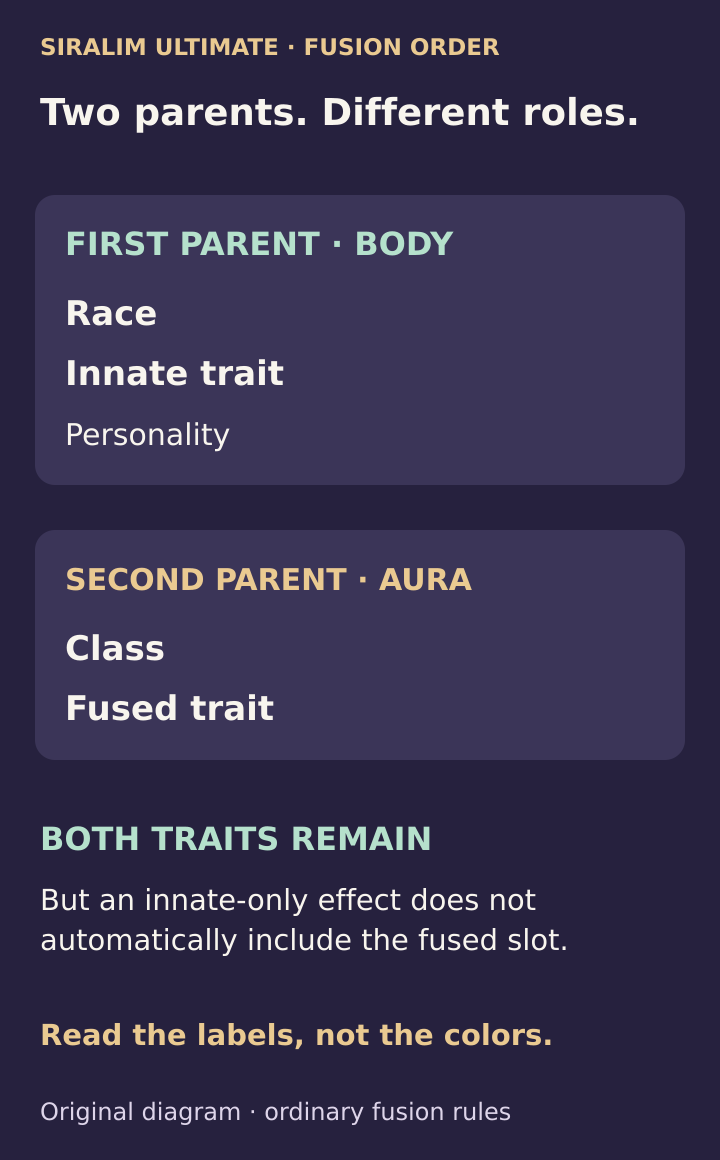
Ordinary fusion inheritance. Other traits and perks can introduce additional effects in battle.
Compare both orders before choosing
Consider Iron Golem and Unicorn Vivifier. Iron Golem is a Sorcery-class Golem with Self-Awareness. Unicorn Vivifier is a Life-class Unicorn with Reinvigoration, its attack-triggered resurrection trait.
With Iron Golem first and Unicorn Vivifier second, the ordinary result is:
- Race: Golem.
- Class: Life.
- Innate trait: Self-Awareness.
- Fused trait: Reinvigoration.
With Unicorn Vivifier first and Iron Golem second, it becomes:
- Race: Unicorn.
- Class: Sorcery.
- Innate trait: Reinvigoration.
- Fused trait: Self-Awareness.
Neither order loses one of the two traits. Yet the outputs satisfy different race and class requirements, and a different trait occupies the innate slot. These examples explain inheritance; they are not a recommendation that this pair is the best use of either creature.
Why Iron Golem does not share every fused ability
Self-Awareness lets your Golems share their innate traits. There are two restrictions in that statement: the creatures must qualify as Golems, and the traits being shared must be innate. Players have mistaken it for sharing everything on a fused Golem, then found that the fused abilities did not spread.
Apply those restrictions to the two orders above:
- Iron Golem body: the result is a Golem, but Reinvigoration sits in its fused slot. It is not the innate ability Self-Awareness shares with the other Golems.
- Unicorn Vivifier body: Reinvigoration is now innate, but the result is a Unicorn. Reversing the parents has not made that innate resurrection trait belong to a Golem.
So simply flipping these parents does not give the whole Golem team Reinvigoration through Self-Awareness. One order misses the trait-source requirement; the other misses the race requirement.
That does not make either trait disappear or mean a fused trait is inactive. The carrier still has Reinvigoration for its own use. Self-Awareness can still enable your other Golems to share their innate traits when it occupies this Unicorn’s fused slot; it does not say its carrier must itself be a Golem. The failed plan is specifically sharing the Unicorn’s resurrection trait through this race-restricted effect.
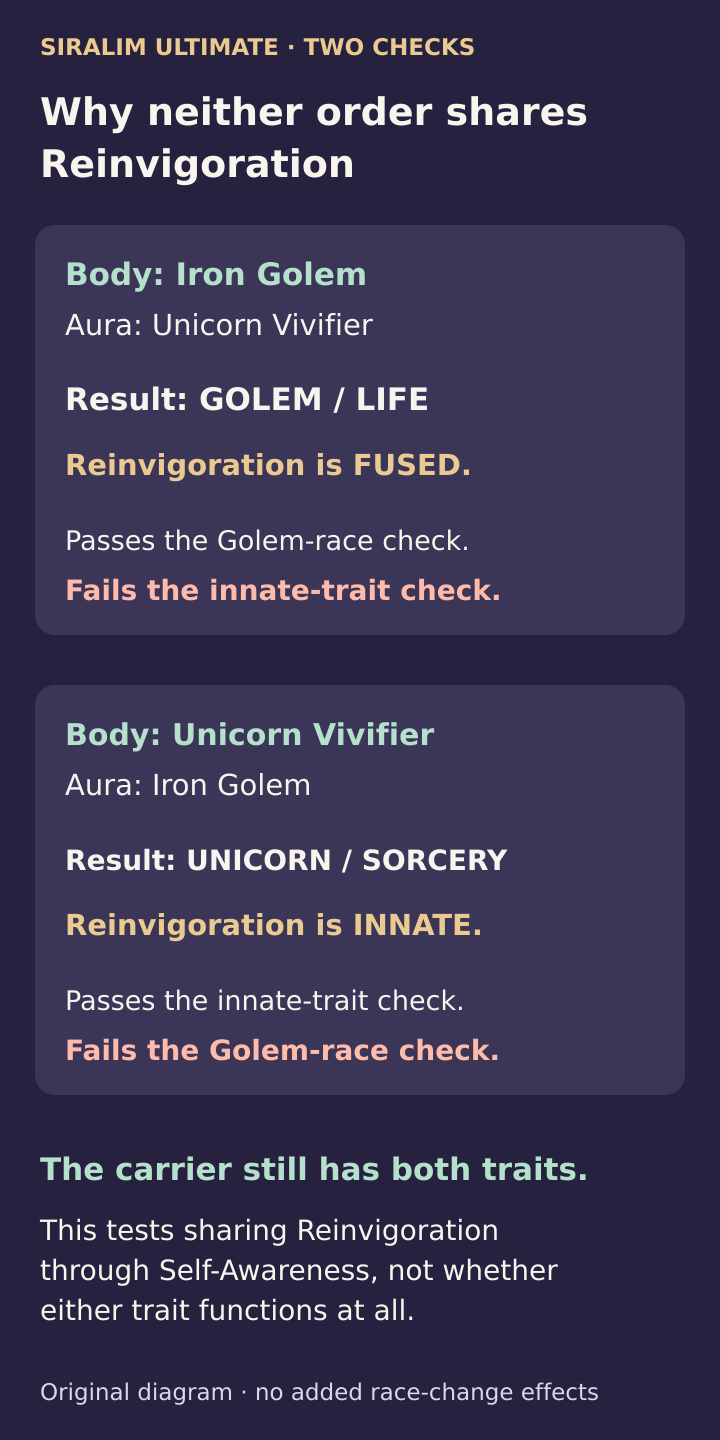
Both traits remain on the carrier. The diagram tests whether Reinvigoration qualifies for sharing, not whether either trait exists or functions at all.
If a Spell Gem no longer fits, check class
A spell problem can come from the second parent even when you chose the first parent to preserve your race. Ordinary Spell Gem access is class-dependent, with properties and other effects able to change the restrictions. The Codex describes those systems separately from race.
In the worked example, the Golem-bodied result is Life, not Sorcery. The Unicorn-bodied result is Sorcery, not Life. Before replacing a useful creature, compare the finished creature’s class with the gem and any relevant properties or perks. Keeping the same body does not promise the same ordinary gem access.
If the plan requires both a particular race and a particular class, choose the body for the race and evaluate the aura for the class. Then check that the two traits still do what your team needs. A fusion that fixes one requirement can break another.
Do not diagnose the result from its palette
Old fusion advice often concentrates on the first parent’s silhouette and the second parent’s colors. That is especially risky as a class check: the official 2.0 patch notes added an option to keep the primary parent’s appearance without applying a fusion palette. They also added another palette choice.
Read the displayed race, class and trait labels. A familiar-looking creature may have a different class, and changing its colors is not evidence that you changed its race or moved a trait into the innate slot.
Audit one creature before rebuilding the team
For the creature that seems to have lost a bonus, write down these four things: finished race, finished class, innate trait and fused trait. Then compare them with the exact requirement you wanted to satisfy.
- Does the effect name a race or a class?
- Does the finished creature actually have that race or class?
- Does the effect accept any trait, or specifically an innate trait?
- Is the desired ability in the correct source slot?
- Are you relying on an additional in-battle transformation or race change?
If the fifth answer is yes, fusion inheritance alone cannot settle the interaction. The Codex orders start-of-battle trait granting and sharing before race and class changes, so a race shown later in combat is not proof that an earlier sharing step included the creature.
Start with the smallest failed requirement. “This Golem has Reinvigoration only as a fused trait” gives you a precise reason to change the plan. “Fusion broke my team” does not.
Sources and further reading
Community answer on race and class inheritance
A player asks whether an Ent used as the second parent counts toward an Ent party. The accepted community reply distinguishes the first parent’s race from the second parent’s class.
Read the sourceCommunity explanation of fusion order
This discussion distinguishes innate and fused trait labels, race, class and personality. It directly addresses the mistaken idea that selecting the first parent only changes appearance.
Read the sourceCommunity-maintained Codex reference
An out-of-game transcription of the Codex, labeled version 2.0.37. Its creature, Spell Gem and start-of-battle sections explain the separate systems used in this diagnostic; it is community-maintained.
Read the sourceDeveloper confirmation that fusion retains both traits
The developer directly answers that the resulting creature receives both parents’ traits. The later community replies should not be confused with developer statements.
Read the sourceIron Golem’s class and trait
This Japanese-language creature reference retains the English class and trait names. The Iron Golem entry identifies Sorcery and Self-Awareness, supporting the worked example.
Read the sourceUnicorn Vivifier’s class and trait
The Japanese-language Unicorn page identifies Unicorn Vivifier as Life class with Reinvigoration. It provides the second input for the example without prescribing a complete team.
Read the sourcePlayer report about Iron Golem’s innate-only sharing
A player reports that fused abilities did not spread across a Golem team. The replies explain why innate sharing does not include the second parent’s fused trait.
Read the sourceOfficial 2.0 changes to fusion appearance
The official 2.0 notes add another fusion palette and an option to retain the primary parent’s appearance. These changes make palette-based guesses about the result especially unreliable.
Read the source
Latest comments
Log in to join the conversation
Log InNo comments yet. Be the first to share your thoughts!