
If you cannot attack a nearby tribe in The Battle of Polytopia, check your relationship before changing your army. An active Peace Treaty prevents attacks. Breaking it does not start an immediate battle: your units stop acting for the rest of your turn, and your former ally gets a preparation turn before you can attack.
The player who breaks peace gets the first opportunity to attack, on their next turn. That is an advantage, not a guarantee that the attack will succeed.
Sources checked on November 5, 2026. This guide combines official documentation, developer explanations and newer player reports; it has not been tested in a live game. Menu labels and edge cases may differ in older builds.
Check whether peace is actually blocking the attack
Open Game Stats, select the other tribe's portrait, and inspect the relationship. You can also open its diplomacy panel by tapping the tribe's name bubble on the map. The official Diplomacy FAQ documents both routes.
There are three different situations:
- Peace is still active: the panel offers Break Peace. You cannot attack that tribe while the treaty remains in place.
- Peace just ended: you are in the temporary waiting period. Ending the treaty has worked, but the attack window has not opened yet.
- There is no treaty or recent break: check the selected unit's remaining actions, range and reachable tiles. A missing attack option is not always a diplomacy problem.
An embassy alone is not the same as a Peace Treaty. Check the relationship itself rather than assuming that diplomatic contact means you are allies.
Do not confirm Break Peace merely to test whether a button works. It has immediate consequences for both your units and your turn.
What happens to units inside each other's borders
The removal rule follows who breaks peace, not whose territory contains more troops.
If you break the treaty:
- Your units inside the former ally's territory are destroyed.
- Your units outside that territory are not destroyed by this rule, although their remaining actions are disabled for the turn.
- The former ally's units inside your territory stay there.
If the other tribe breaks the treaty, reverse those roles. Its units inside your borders are removed; yours inside its borders are not removed by that declaration.
The official Diplomacy page and FAQ warn that the aggressor loses units in the defending tribe's territory. This is not a retreat or a teleport back to a friendly city. Do not count those troops as part of your opening attack.
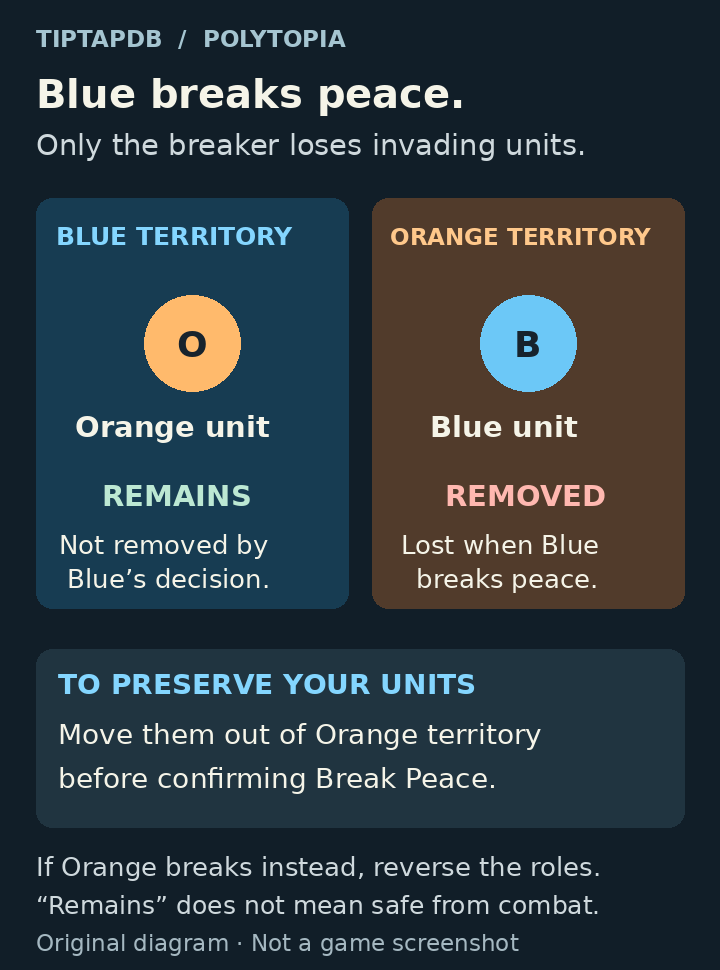
Conceptual territory diagram showing that when Blue breaks peace, Blue units in Orange territory are removed while Orange units in Blue territory remain. Original rules diagram, not an in-game screenshot. “Remain” refers only to the treaty’s removal rule, not protection from later combat.
Example: you have two units across Orange's border, while Orange has one unit beside your capital inside your land. Breaking peace now removes your two intruders. It does not remove Orange's unit beside the capital. You have gained the first attack opportunity at the cost of two units, while the threat at home remains.
Move your exposed units out first if you want to preserve them. If they cannot all leave this turn, waiting may be better than confirming a declaration your army is not ready to survive.
Who attacks first after peace breaks
Read the sequence in player turns, not as “wait one round.” Assume you are Blue and you break peace with Orange:
- Your current turn: finish your unit actions, then break peace. You cannot attack Orange immediately, and your remaining unit actions are disabled.
- Orange's response turn: Orange can reposition and prepare defenses, but cannot attack you yet.
- Your next turn: you get the first opportunity to attack Orange.
- Orange's following turn: Orange can attack you in return.
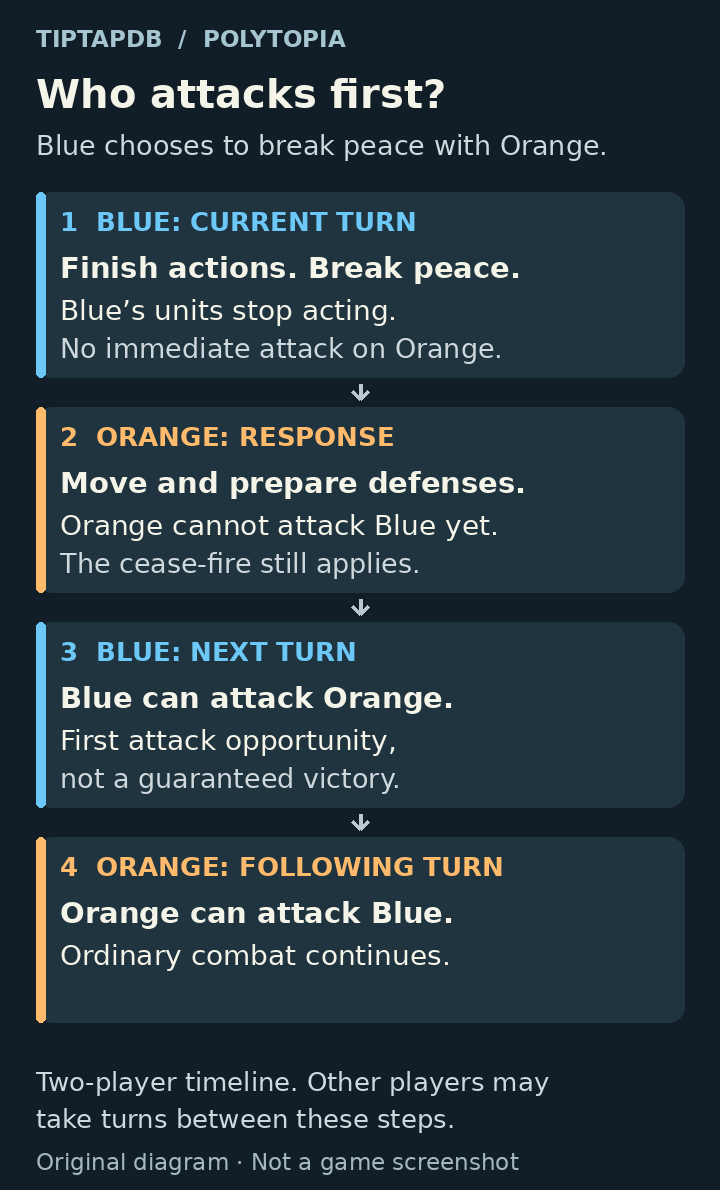
Four-step timeline: Blue breaks peace after its actions, Orange prepares without attacking Blue, Blue gets the first attack opportunity, then Orange can attack Blue. Original two-player timeline. In a larger match, other players may take turns between these steps; the diagram describes the relationship between these two tribes.
This is intentional. In a developer explanation of the waiting period, Zoythrus explains that the declaring player keeps the initiative while the defender receives time to prepare.
Developer explanation of the waiting period
Developer explanation or official documentation.
View the sourceIf Orange broke peace with you, your next turn is the preparation stage shown in step 2, with the colors reversed. Being unable to attack Orange during that turn is expected. Move vulnerable units, reinforce the threatened approach and plan for Orange's first attack instead of spending the turn looking for an instant counterattack.
Make Break Peace your last unit-related decision
The disablement is not limited to units beside the former ally. It affects your units across the map. This matters especially in a match where you are already fighting a third tribe.
Before committing to the break:
- Check the whole border. Find your units in the prospective enemy's territory, including Cloaks and units away from the main army. Cloaks are not exempt from removal.
- Move out the units you want to keep. Recheck their final tiles, not just their starting positions.
- Finish other unit actions. Complete movement and attacks elsewhere before the declaration disables them.
- Protect the home front. Assume any former ally's troops already inside your territory will still be there after you break peace.
- Plan for repositioning. Your opponent gets to move before your first attack. Do not build the plan around a target staying in exactly the same place.
- Choose Break Peace and read the warning. If the dialog says your units will be disbanded and you did not intend that, cancel and inspect the board again. Confirm only when the consequences match your plan.
Zoythrus confirmed the all-unit movement lock as intentional in an early developer response. The community-maintained English text reference records the game's warning that all your units will be disabled for the rest of the turn, plus a separate warning for units inside the other tribe's territory. Treat those as two different costs: moving out prevents the territorial loss, but does not preserve unused actions after the declaration.
Community-maintained English text reference
Community-maintained game text reference.
View the sourceDecide whether breaking now is worth it
Do not reduce the decision to “the first attacker always wins.” Ask what your army will look like after the removals and the opponent's preparation turn.
Break now when the units you need are safely positioned, your other useful actions are complete, and you have a worthwhile attack even if the opponent rearranges its defense.
Wait when important units are still trapped across the border, your exposed cities need reinforcement, or your plan only works if the opponent leaves a fragile unit untouched.
If you expect the opponent to break first, prepare for the defensive turn rather than relying on it to make a mistake. Its units inside your borders would be removed if it declared now, but it can move them out before declaring. Current positioning is information, not a promise about the next turn.
When the attack window does open, peace timing has only solved the permission to attack. Capturing a city still needs a unit to enter and hold it. Use the separate Polytopia city-attack guide for that part of the plan.
Avoid two misleading shortcuts
“Both sides lose their invading units.” No. The territorial removal applies to the player breaking the treaty. Switching who declares can change which army loses units.
“Use splash damage while direct attacks are blocked.” Do not plan around old loopholes. The developer's Path of the Ocean pre-release notes list fixes for Smash, Splash, Explode and related damage during the cease-fire. Old forum tactics can describe behavior that was subsequently patched.
Path of the Ocean pre-release notes
Developer explanation or official documentation.
View the sourceThe reliable sequence is simple: check the relationship, evacuate your units, finish their actions, break peace, then use your next turn's attack opportunity. If the other tribe declared first, use your intervening turn to prepare for its attack.
Latest comments
Log in to join the conversation
Log InNo comments yet. Be the first to share your thoughts!