
Four good enchanted books do not automatically make a cheap finished tool. Their order can change both the levels you spend today and the penalty attached to your next upgrade. The useful question is not simply “Which book goes first?” It is “Which books should go straight onto the tool, and which should become a small pair first?”
This guide covers vanilla Minecraft Java Edition 26.3 in Survival. It uses a fresh pickaxe and four specific books to show a 23-level route beside a 27-level route, then explains when those numbers stop applying. Bedrock, modified servers and custom enchantment data are outside this calculation.
First identify what the anvil is refusing
A numeric cost that you cannot currently afford is different from “Too Expensive!” For ordinary Survival combining, 39 levels is allowed; a calculated cost of 40 or more is blocked even if you have hundreds of levels. Java's rename-only operation has a separate 39-level cap, so it is not evidence that another enchantment will fit.
No useful output can also mean the proposed enchantment does not apply, conflicts with the target or changes nothing. Books do not bypass compatibility: Fortune and Silk Touch cannot coexist on the same normal pickaxe. When a mixed book contains usable and unusable enchantments, consuming it can discard the unusable ones.
| Situation | Productive next move |
|---|---|
| A valid result has an affordable-looking numeric charge, but you lack levels | Earn the shortfall; do not rebuild the book plan merely because your current balance is low. |
| The operation says Too Expensive! | Revisit the inputs and their histories. More farming alone will not change that operation. |
| Your intended enchantment is absent from the output | Resolve item eligibility or incompatibility before paying. Keep a valuable mixed book for a target that can use what matters to you. |
| A familiar recipe costs more than the example below | Stop before taking the result. Compare book history, enchantment levels and any extra operation against the example's inputs. |
The two numbers to track
Put the target on the left and the book being consumed on the right. For the distinct, compatible book enchantments used here, with no repair or renaming:
- Current charge = the right book's enchantment cost + the left input's prior-work penalty + the right input's prior-work penalty.
- Output penalty = 2 × the larger input penalty + 1.
Fresh inputs start at penalty 0. Repeated work along one item's history produces 0, 1, 3, 7, 15, 31 and onward. The output penalty is not an extra payment at that moment: it is part of the cost of later work. Combining books creates history too.
This gives you two separate planning columns: “pay now” and “carry forward.” Mixing them together makes a cheap-looking intermediate book surprisingly expensive when it finally reaches the tool.
Prepare the exact four-book example
Start with one unenchanted, undamaged pickaxe that has never been repaired or enchanted in an anvil. Set aside four separate books, also with no previous anvil work. They must already have the levels below; a book you made by combining lower-level copies is a different starting input.
| Book | Book multiplier | Enchantment cost used in this example |
|---|---|---|
| Fortune III | 2 | 3 × 2 = 6 |
| Efficiency V | 1 | 5 × 1 = 5 |
| Unbreaking III | 1 | 3 × 1 = 3 |
| Mending | 2 | 1 × 2 = 2 |
Keep renaming and repairs out of this walkthrough. Those are separate jobs, not free additions to the numbers in the tables. You also do not need to turn all four books into one book before touching the pickaxe.
A practical 23-level route
First make the inexpensive pair. Then put the two larger individual costs onto the pickaxe directly. In every pickaxe operation below, the pickaxe stays in the left slot.
| Step | Left input | Right input | Charge now | Output penalty |
|---|---|---|---|---|
| 1 | Fresh Unbreaking III book | Fresh Mending book | 2 + 0 + 0 = 2 | 1 on the paired book |
| 2 | Fresh pickaxe | Fresh Fortune III book | 6 + 0 + 0 = 6 | 1 on the pickaxe |
| 3 | Pickaxe from step 2 | Fresh Efficiency V book | 5 + 1 + 0 = 6 | 3 on the pickaxe |
| 4 | Pickaxe from step 3 | Paired book from step 1 | 5 + 3 + 1 = 9 | 7 on the pickaxe |
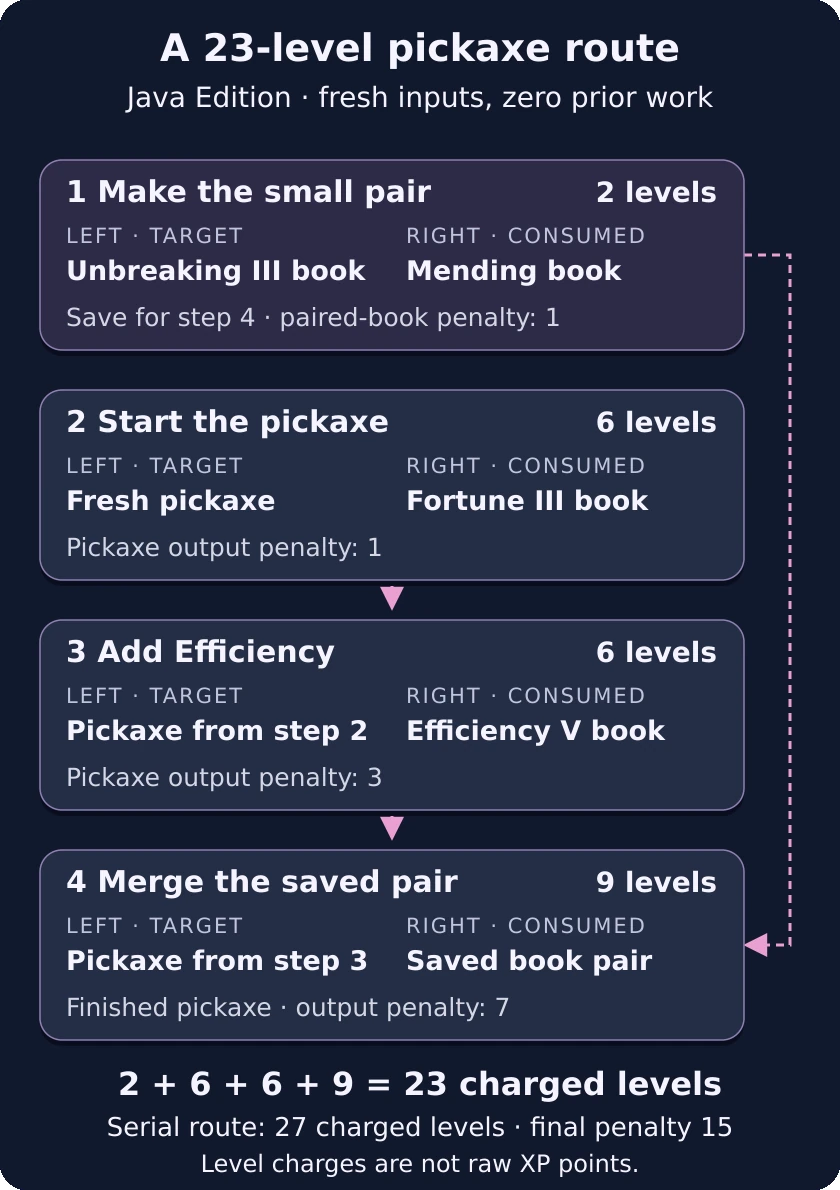
Fresh Java inputs: pair Unbreaking III and Mending for 2 levels, add Fortune III for 6 and Efficiency V for 6, then merge the pair for 9. Total 23 charged levels; final prior-work penalty 7. No repairs or renaming.
Total: 2 + 6 + 6 + 9 = 23 charged levels. The highest individual bill is 9. Your finished pickaxe has all four enchantments and a prior-work penalty of 7.
Step 4 is where mistakes are easiest. Its right book contains costs 3 and 2, so the enchantment portion is 5. But that book also carries penalty 1 from step 1. Counting only the pickaxe's history would incorrectly predict an eight-level charge.
The pairing operation can happen before or after the two independent pickaxe operations; it simply must happen before the final merge. If you are preparing several tools, keep each paired book with its intended project so you do not substitute a book with a different history halfway through.
Why adding every book directly costs 27
Now use the same starting materials, but apply each book straight to the pickaxe in this order:
| Right-hand book | Pickaxe penalty before operation | Charge now | Pickaxe penalty afterward |
|---|---|---|---|
| Fortune III | 0 | 6 | 1 |
| Efficiency V | 1 | 6 | 3 |
| Unbreaking III | 3 | 6 | 7 |
| Mending | 7 | 9 | 15 |
That is 6 + 6 + 6 + 9 = 27 levels. Both routes perform four operations overall. The difference is where the work happens: the first route builds one small branch away from the pickaxe instead of placing every operation along the pickaxe's history.
For these inputs, the pair saves four charged levels and leaves penalty 7 rather than 15. That eight-point difference matters when planning another anvil job, but it is not eight levels refunded now. Nor does it promise a fixed number of future upgrades: each future operation still has its own inputs and charge.
Why one giant book is not automatically better
Consider another plausible plan: make Fortune III + Efficiency V, make Unbreaking III + Mending, combine those books, and finally apply the result to the fresh pickaxe.
| Operation, left + right | Charge | Output penalty |
|---|---|---|
| Fortune III + Efficiency V | 5 | 1 |
| Unbreaking III + Mending | 2 | 1 |
| First pair + second pair | 5 + 1 + 1 = 7 | 3 |
| Fresh pickaxe + four-enchantment book | 16 + 0 + 3 = 19 | 7 |
Total: 33 levels. It reaches the same final penalty as the 23-level route, yet costs ten more levels to assemble. The added book-building has made you pay to transfer some enchantments more than once.
This is why “always make one book” and “always use a balanced tree” are incomplete advice. Low final penalty, low total charges and a low largest individual bill are different objectives. A sensible plan compares all three rather than optimizing the shape of the tree alone.
Charged levels are not raw XP points
The 23-level total is a sum of four anvil bills. It does not mean “collect exactly the XP needed to reach level 23,” and it does not require you to hold all 23 levels before starting. You can earn levels between operations.
Minecraft's level bar is not linear. Reaching level 30 from zero takes 1,395 XP points; going from level 27 to 30 takes 306. Three levels near the top of that range represent much more XP than three levels near zero.
For a simple illustration, suppose you begin at exactly level 30 with an empty progress bar and pay all the 23-level route's bills without earning XP in between. You finish at level 7. The represented XP difference is 1,395 − 91 = 1,304 points.
Alternatively, start each operation at exactly its required level, having replenished from zero after the previous operation. The costs 2, 6, 6 and 9 correspond to 16 + 72 + 72 + 135 = 295 points. That is a deliberately different earning schedule, not a claim that your actual mining session will generate exactly those amounts.
The practical lesson is to avoid treating a large stored level balance as a discount. Decide whether you want fewer total charges, less grinding under your own refill routine or fewer trips between the anvil and your XP source. Those preferences can change which route is most convenient.
When your books are not fresh
Suppose your Unbreaking III book was itself made in one previous anvil combination. Its starting penalty is 1 instead of 0. Keeping every other input unchanged, making the Unbreaking–Mending pair now costs 3 and produces penalty 3. The final merge then costs 5 + 3 + 3 = 11. The route becomes 3 + 6 + 6 + 11 = 26 levels, still ending at penalty 7.
This is not a small cosmetic difference: the book's visible enchantment stayed Unbreaking III, but its history changed two later bills. A chest full of identical-looking books is not necessarily a chest full of interchangeable cost inputs.
Before committing a scarce book, make a short project list: the desired final enchantments, each starting item's known history, the planned pairs and the final merge. If you do not know a book's history, do not force the fresh-input numbers onto it. Use the actual proposed charge to revise the remaining plan before consuming anything.
Decide whether to finish an old tool or start another
An expensive tool is not automatically worthless. If it already does the job you need, keep using it rather than rebuilding solely to make a prettier cost history. Mending repairs equipped or held damaged gear through collected XP orbs; it does not require repeated anvil repairs.
A grindstone is a reset with a sacrifice: it clears prior-work penalty but removes non-curse enchantments. Curses and custom names remain. It is not a way to keep your valuable enchantments while obtaining a fresh anvil history.
| Your actual goal | Better decision question |
|---|---|
| Finish a fresh four-book pickaxe | Can you follow the exact inputs and pairing above without substituting preworked books? |
| Add one missing enchantment to a useful old tool | Is that final improvement affordable as proposed, or would replacing the tool save more than the existing enchantments are worth to you? |
| Maintain a completed tool | Can its existing Mending handle maintenance instead of scheduling more anvil repairs? |
| Rebuild after a blocked operation | Can you preserve the old tool as a spare while assembling a clean replacement, rather than stripping it immediately? |
Choose the final result first, preserve the expensive inputs, and compare the full route before taking the first output. For the fresh four-book example, the small Unbreaking–Mending pair is enough: you do not need a giant book, a huge level stockpile or a complicated seven-enchantment recipe.
Anvil mechanics reference
The community-maintained Minecraft Wiki provides the complete Java and Bedrock rules for cases beyond this four-book example.
Read the detailed rules
Latest comments
Log in to join the conversation
Log InNo comments yet. Be the first to share your thoughts!