If your character started missing more often after equipping a second weapon, compare the displayed attack bonuses before replaying the fight or spending a feat. Extra weapon damage is not the same as a better chance to hit.
This guide covers the original Star Wars: Knights of the Old Republic on Android and iOS. Start with the equipment check below. If you also changed your attack choice, use the optional comparison to separate the two changes.
First, read Attack Bonus rather than Damage
The original manual distinguishes Attack Bonus from Damage for each hand. Where your mobile build shows those equipment values, record them before and after equipping the second weapon. Official KOTOR manual, printed page 11
Official KOTOR manual, printed page 11
Open official reference- Select the character you are actually diagnosing. Keep their main weapon and other equipment unchanged.
- With one weapon equipped, write down the main-hand Attack Bonus.
- Add the second weapon. Record the displayed main-hand and off-hand Attack Bonus separately.
- Compare the main-hand value before and after. Keep both new hand values separate from their damage ranges.
If the main-hand bonus fell, the new setup has traded away some displayed accuracy. That is useful information immediately; you do not need four replays to establish the change. Inspect the character’s Two-Weapon Fighting feats and the equipped items’ descriptions before deciding whether the trade is worthwhile.
Treat these figures as an equipment comparison, not a complete prediction of every combat roll. Do not assume the static screen includes every selected-attack, temporary or target-specific modifier. If your build does not show the values clearly, move to the optional fight check rather than guessing them.
Why the attack bonus matters
KOTOR compares a random roll from 1 to 20, plus your attack bonus, against the enemy’s Defence. Imagine Defence 17 and two hypothetical total bonuses:
- With +7, a roll of 10 reaches 17.
- With +3, that same roll reaches only 13.
- The second setup needs a roll of 14 to reach 17.
Those bonuses are illustrative, not KOTOR’s dual-wield penalties. The example explains why a larger damage range can disappoint if attacks fail to connect. It also shows why a combination that works against one enemy can struggle against a harder-to-hit opponent. The attack-versus-Defence rule is documented on printed page 28 of the manual.
Check the right feat path
The manual identifies two relevant passive paths:
- Two-Weapon Fighting → Improved Two-Weapon Fighting → Master Two-Weapon Fighting: reduces penalties for paired weapons and double-bladed weapons.
- Dueling → Improved Dueling → Master Dueling: improves attack and Defence with a compatible single-weapon setup. Check its in-game description.
These passive feats do not need to be selected as attacks. Flurry, Power Attack and other active combat feats are separate choices. Read the description of the exact rank you own, including drawbacks, rather than assuming you have the higher rank’s benefits.
If dual wielding is your long-term goal, review the Two-Weapon Fighting line before your next feat choice. Dueling is not a substitute. A double-bladed weapon belongs in this discussion even though it occupies a single inventory item.
Still unclear? Try a controlled fight comparison
Use this when equipment values do not explain the problem, especially if you equipped another weapon and began using a special attack together. You only need the comparisons relevant to what changed.
Make a separate save before a manageable encounter and preserve your original save. Keep the character, opponent, difficulty, main weapon and other equipment unchanged. Avoid introducing a new temporary boost midway through. Keep party involvement as consistent as practical and watch your selected character, not just the party’s total damage.
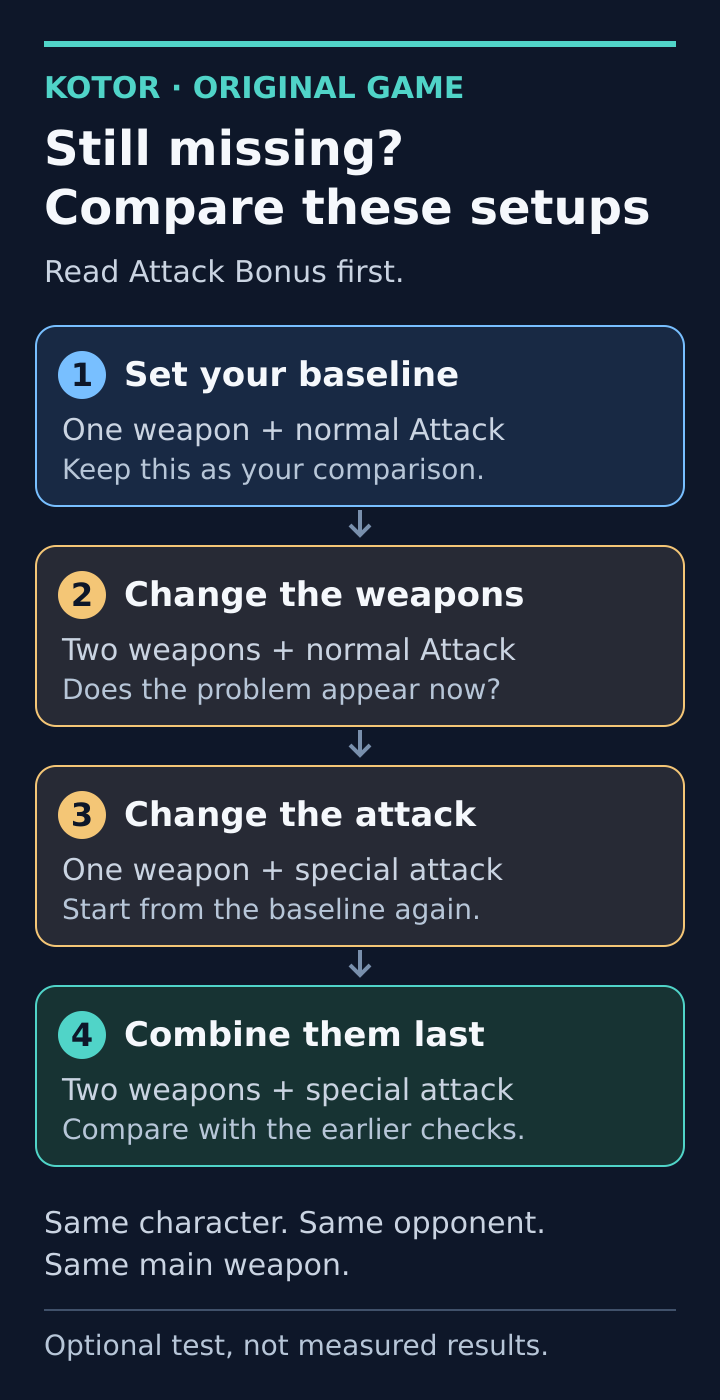
An optional four-setup comparison: one weapon with normal Attack as a baseline, add only a second weapon, return to one weapon and change only the attack, then combine both changes. Original diagnostic plan. Read the equipment bonuses first; use these comparisons only if needed. This is not game interface artwork or measured test data.
Baseline: one weapon + normal Attack. Establish whether this setup lands hits and survives reasonably comfortably. If it already struggles, the empty off hand does not establish the cause.
Weapon check: two weapons + normal Attack. Return to the same starting save and change only the second weapon. If the problem appears here, concentrate on equipment and fighting-style feats.
Attack check: one weapon + the special attack. Start from the baseline again. If the problem follows the attack choice without the second weapon, reread that feat’s current-rank description. Keep normal Attack as your fallback.
Combined check: two weapons + the special attack. Compare this last, if needed. Testing the full combination first conceals which change is responsible.
A few unlucky rolls are not a verdict. Repeat an uncertain comparison, but do not turn the exercise into a long testing session once you have found a reliable setup. These are practical checks, not a statistical benchmark.
Judge results, not blade animations
BioWare’s developers describe round-based combat with synchronized, choreographed movements between opponents. The visible exchange is designed to resemble a flowing Star Wars fight.
Watch the reported hits and misses rather than counting every blade movement. A dramatic exchange is not a useful measurement of whether the second weapon helped, and one frustrating miss does not invalidate a workable build.
What to change next
Only the two-weapon setup struggles: use the reliable single-weapon setup for difficult encounters while you develop the fighting style you want. Recheck the equipment bonuses after meaningful upgrades.
Only the special attack struggles: use normal Attack while reviewing the selected feat. Avoid blaming the weapons for a problem that followed the attack choice.
Everything struggles: broaden the diagnosis. Inspect the selected character’s equipment and abilities, then compare against a less demanding opponent. Avoid adding several new changes at once.
Both styles work: choose according to the character you want to build. This check is not an instruction to abandon two weapons. It gives you a reliable fallback and a way to assess upgrades without guessing from damage ranges alone.
Latest comments
Log in to join the conversation
Log InNo comments yet. Be the first to share your thoughts!