
Learning a blessing in King of Dragon Pass does not, by itself, give your clan its benefit. Knowledge makes the blessing available. An ordinary ongoing blessing then needs either a successful sacrifice for a year of benefit or a supported shrine or temple with that blessing selected.
Before sacrificing again, check three things: Do you know the blessing? What is keeping it active? Is that support still in place? A learned name, an existing building and a recent sacrifice are three different pieces of information.
Start with the active blessing, not the sacrifice icon
Open the Magic screen, choose the deity, and inspect the blessing’s current state. In A Sharp’s iOS manual, the More Info summaries distinguish known blessings from active ones. The flame beside a deity means that you sacrificed within the last year; it does not identify which blessing is currently helping you.
Use this order before spending anything:
- Confirm the exact blessing is known, not merely that you have sacrificed to this god.
- If it is inactive, decide whether you need a temporary sacrifice or continuing building support.
- If a building exists, check its current size and selected blessings.
- If the effect used to work, check for an expired sacrifice, a changed selection or a reduced temple.
- If it is already active, read what it actually improves before treating a disappointing result as a failure.
Mysteries teaches; it does not switch the benefit on
A successful Mysteries sacrifice can reveal a blessing or deepen your knowledge of a sacred myth. Those are both useful results, but they are not interchangeable. Learning more of a heroquest story does not necessarily unlock the blessing you wanted.
Read the sacrifice’s result before trying again. If you learned the blessing, move on to activation. If you learned myth details, check what remains unknown. If the sacrifice failed, paying the offering was not proof of success.
Sacred Time magic allocated to Mysteries improves the early Mysteries sacrifices of that year. It is help with learning, not an automatic grant of every known blessing. Nor is Sacred Time preparation a strict prerequisite for a sacrifice to succeed. Developer David Dunham confirmed that it improves the odds rather than making success possible in the first place.
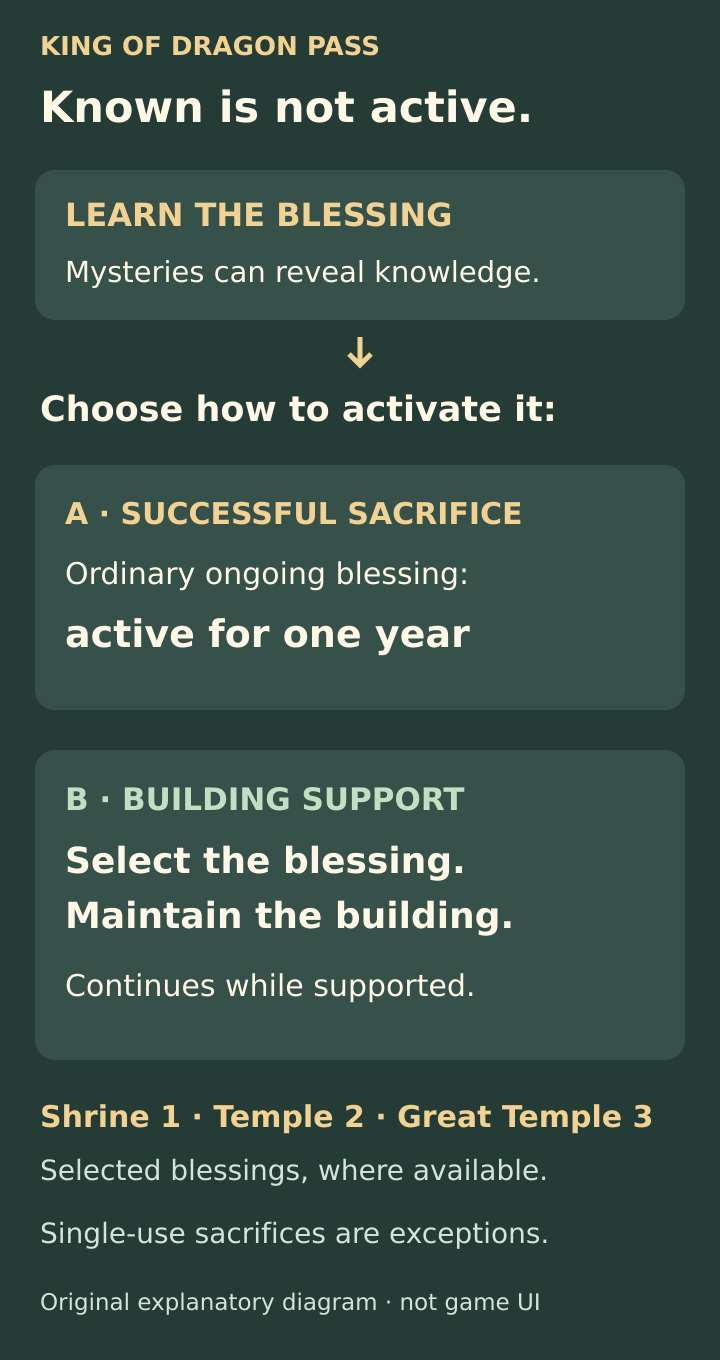
Knowing an ordinary blessing makes it available. A successful sacrifice activates it for a year; a maintained building sustains a selected blessing.
Choose between a year-long sacrifice and continuing support
For an ordinary ongoing blessing, a successful sacrifice gives one year of benefit. It is temporary even if its name remains in your list afterward. Learning survives the end of that activation; the effect does not.
A religious building can instead sustain selected blessings:
- A shrine supports one.
- A temple supports two.
- A Great Temple supports three.
You need the corresponding blessing knowledge to build the larger tiers. This is the general capacity rule, not a promise that every deity offers every building size or that every sacrifice can occupy a slot.
Building-supported blessings continue until you change the selection or something happens to their support. Here, “permanent” means ongoing while maintained. It does not mean free, irreversible or automatically attached to every blessing you know.
Choose temporary support when you need a particular effect for a limited period. Consider a building when you expect to keep the effect and can support its annual obligations. Before upgrading, check that the extra slot would solve your actual problem.
Example: two Barntar blessings, one shrine
Suppose your clan knows both Plowsong and Vigor, but Barntar has only a shrine. You have two possible choices and one building-supported blessing, not two active effects simply because both are known.
Plowsong reduces how many oxen you need to plow the fields. Vigor helps farmers work longer and harder, reducing the farmers needed to tend crops and herds. If the immediate shortage is oxen, inspect Plowsong. If you are short of farm labor, inspect Vigor.
To change the shrine’s support, replace its selected blessing and check the active summary afterward. Changing a building’s selection is different from learning another blessing. If you need both effects, a successful temporary sacrifice for the other ordinary blessing is separate from the shrine’s selected support. Check the active summary after the sacrifice rather than treating knowledge of both as activation.
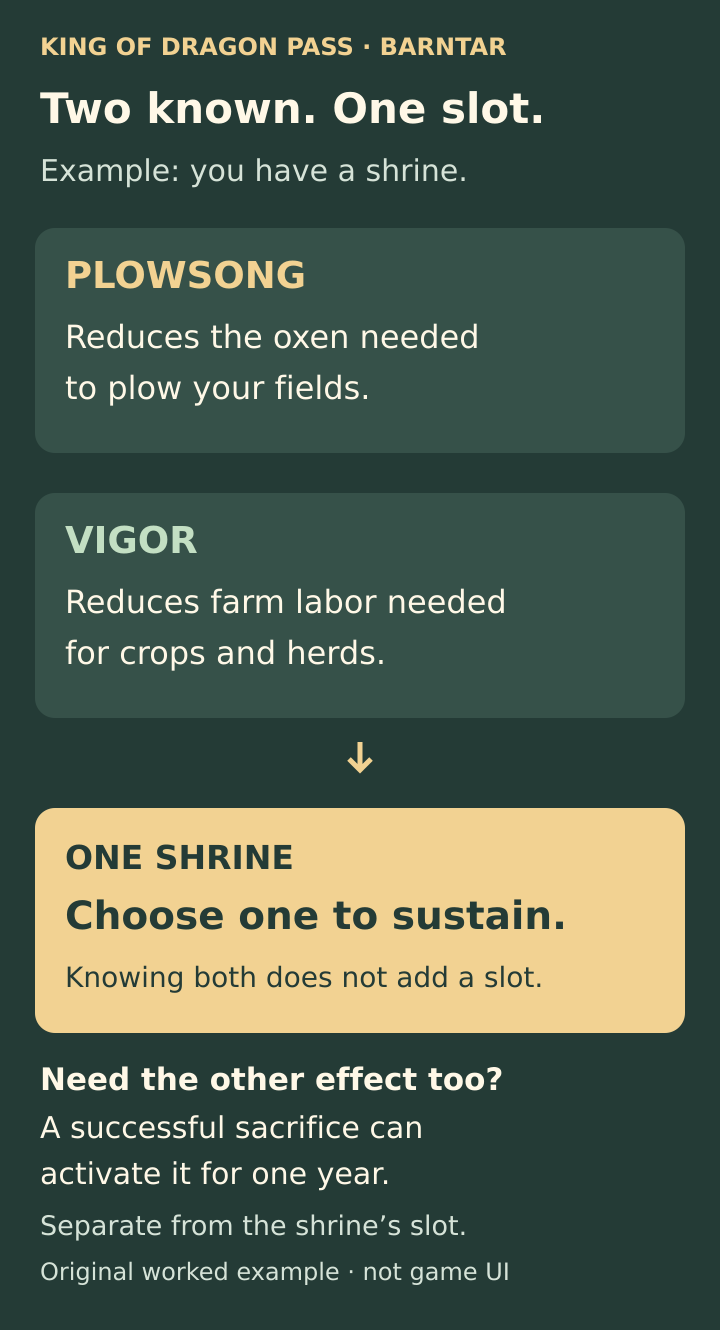
One Barntar shrine sustains one selected blessing. Plowsong addresses ox requirements; Vigor addresses farm labor. Other temporary effects are separate.
If it disappeared after Sacred Time, inspect the building
Shrines and temples require annual goods and cattle. Supporting too many can spread the clan too thin. The manual says that if the clan cannot support all its temples at Sacred Time, one will be reduced.
Compare the building you have now with the building you remember. A reduced tier cannot supply the old number of ongoing blessings. Check its selection and your ability to maintain it before rebuilding the same expensive arrangement.
Also read any message about insufficient worshippers. This is a different obstacle from having enough goods to pay construction costs. Players have reported being unable to expand temples even with a large clan, so total population alone is a poor shortcut. Use the build feedback rather than chasing an assumed universal headcount.
Repeating an active blessing usually does not strengthen it
For most blessings, sacrificing again while the effect is active does not increase its potency. First check whether the effect is missing, rather than assuming another offering will make an existing one stronger.
Chalana Arroy’s Healing and Curing are important exceptions. Ongoing Healing speeds the normal recovery of wounded people; a one-time sacrifice can heal people immediately. Curing makes the same distinction for sickness. These sacrifices can therefore have a purpose even while the shrine-backed effect is active. Larger offerings can help more people, but this is not a promise to heal everyone.
Some sacrifices are single-use services rather than year-long buffs. Resurrection is one example. The developer’s explanation of the Magic screen explicitly distinguishes the sacrifice list from the blessings a building can sustain. Do not apply the one-year timer or the one/two/three slot rule indiscriminately to every entry.
An active blessing is not a guaranteed outcome
Sacrifice success depends on more than the offering size, including the clan ring’s Magic skill, devotion, clan magic and other circumstances. Bigger offerings improve chances; they do not create a guaranteed price list for success. Repeatedly spending more is a costly way to diagnose the wrong problem.
Likewise, an active farming blessing does not guarantee a good harvest. Dunham notes that food production has many influences, including disasters, heroquests and blessings from other clans. Sacred Time allocations and divine blessings can complement each other, but they are not the same switch.
The useful habit is simple: verify knowledge, activation and continued support separately. Then check whether the chosen blessing addresses the shortage you actually have.
Version and interface scope
These rules follow A Sharp’s September 2011 iOS manual and the developer explanations linked below. HeroCraft’s Android interface and later builds can differ; a current mobile build has not been play-tested for this guide. Use your version’s blessing status and build messages rather than relying on old screenshot positions or assuming that construction selected the effect you wanted.
Sources and further reading
Official manual: Magic and Sacred Time
Read the Magic screen section on PDF pages 40–42 for learning, activation, building capacity, upkeep and Healing/Curing. The Sacred Time section explains how ritual allocations complement divine blessings.
Read the sourceDeveloper answers about sacrifice odds
Read David Dunham’s developer-labeled replies from September 2015 and June 2017. They explain why larger offerings and Sacred Time preparation improve chances without guaranteeing success.
Read the sourcePlayer discussion of temple worshipper limits
See the May 28, 2022 comment numbered 13 for a player’s report of insufficient worshippers despite a large clan. The thread does not provide a universal population formula.
Read the sourceDeveloper explanation of sacrifices and ongoing blessings
David Dunham’s January 18, 2011 iOS interface article distinguishes available sacrifices from sustainable blessings and names Resurrection as a single-use effect.
Read the sourceDeveloper explanation of food-production effects
Read the developer’s April 23, 2016 reply explaining why many factors affect food production. His answer also distinguishes herd growth from a direct food increase.
Read the sourceOfficial Android listing and update information
The official HeroCraft listing identifies the Android edition and provides its maintenance notes. Its current screenshots and support details are useful when your interface differs from older iOS guides.
Read the source
Latest comments
Log in to join the conversation
Log InNo comments yet. Be the first to share your thoughts!