
A five-Resin craft can be sensible for one character and wasteful for another. The deciding question is not how impressive the finished piece might look. It is which missing stat is preventing your current team from doing its job—and how much control you need to fix that problem.
Start with the character and slot you want to improve, then choose the crafting method. Do not start with a rare item in your inventory and search for somewhere to spend it.
Know what each crafting choice buys
Relic synthesis uses 100 Relic Remains per piece and lets you choose its set and slot. Ordinary synthesis leaves the variable stats random. Customized Synthesis adds control through Self-Modeling Resin. The table below covers slots with a selectable main stat, such as Body, Feet, Planar Sphere and Link Rope.
| Crafting choice | Relic Remains | Total Self-Modeling Resin | What you choose |
|---|---|---|---|
| Ordinary synthesis | 100 | 0 | Set and slot |
| Main stat only | 100 | 1 | Set, slot and main stat |
| Main stat plus one substat | 100 | 2 | Those choices plus one substat type |
| Main stat plus two substats | 100 | 5 | Those choices plus two substat types |
The two- and five-Resin prices are totals, not extra charges on top of the main-stat Resin. Moving from one selected substat to two costs three additional Resins. It does not cost just one more.
Head and Hands have fixed main stats, so do not spend on them merely to solve a main-stat problem. This guide’s numerical customization examples use selectable-main-stat slots; they are not a claim that every slot has the same customization menu.
Wishful Resin advice from early Version 3.0 guides is outdated. Version 3.5 merged it into Self-Modeling Resin. You no longer need to plan two separate Resin balances for main-stat and substat selection.
Describe the problem before choosing a price
A useful target has three parts: who will equip the piece, what it replaces, and which improvement would make the replacement worth using. “A better relic” is too vague to guide a scarce-resource decision.
Consider a character whose current Feet piece has the wrong main stat for the build you intend to use. A craft that fixes that stat may solve the immediate problem even if its substats are ordinary. By contrast, a character already wearing a suitable main stat and several useful substats needs a much narrower improvement. Another merely acceptable piece may never leave the inventory.
| Your actual bottleneck | Start by considering | Why |
|---|---|---|
| Wrong main stat; otherwise the team is usable | Main-stat-only customization | Buy the control needed to fix the stated problem |
| Correct main stat plus one particular substat type is essential | Two-Resin customization | Secure that combination without paying for a second preference |
| Both selected substat types matter and the existing piece is already strong | Five-Resin customization | A narrower starting piece may justify the larger commitment |
| Existing relic has useful stat types but disappointing enhancement results | Evaluate a reroll instead | Creating another starting piece may not address the real problem |
| You cannot name a character who would equip the result | Keep the materials | An available craft is not necessarily an upgrade |
Treat these as starting decisions, not an automatic ranking. A five-Resin craft can be the right purchase when the rest of the team is settled. It is less attractive when several characters still have basic equipment problems.
A ten-Resin budget: breadth versus precision
Suppose you have 10 Self-Modeling Resins and enough Relic Remains. You are comparing crafts for slots with variable main stats.
| Plan | Resin calculation | Remains required | What the budget secures |
|---|---|---|---|
| Fix ten main-stat slots | 10 × 1 = 10 | 1,000 | Ten chosen main stats |
| Target five main-stat/substat combinations | 5 × 2 = 10 | 500 | Five pieces, each with one selected substat |
| Target two tightly specified pieces | 2 × 5 = 10 | 200 | Two pieces, each with two selected substats |
| Mix immediate repairs and one precise craft | 5 + 2 + 2 + 1 = 10 | 400 | Four pieces with different amounts of control |
More pieces do not automatically mean a better result. Ten main-stat fixes are pointless if only one slot needs replacing. Equally, two precise pieces are not automatically better than five targeted ones if those five would help several active characters.
The table is a budget comparison, not a probability calculation. Selecting substat types does not promise that later enhancement increases will land where you want. The extra control buys a starting condition, not a guaranteed finished stat total.
Write down the planned recipient beside each craft. If a result would only be useful to a character you might build someday, compare that speculative use with the character you are using now. Saving part of the budget is also a valid plan; you do not have to spend all ten together.
A two-character example: protect the repair budget
Imagine you have seven Resins. Character A lacks a suitable main-stat piece and needs one particular substat type. Character B has the same kind of gap in another slot. A third possible craft would polish a piece that is already usable.
Two targeted repairs cost 2 + 2 = 4 Resins, leaving three. Starting with the luxury five-Resin craft leaves only two: enough for one repair, not both. The issue is not that five-Resin customization is inherently bad. It is that it consumes resources already needed for two named problems.
A practical order is to reserve the four Resins first, complete the two repairs, and then reassess the team. If the immediate problem disappears, there is no reason to convert the remaining balance into another craft just because you can afford something.
This also prevents sunk-cost chasing. An expensive relic that enhances poorly does not become a better candidate for your next rare item merely because you already spent five Resins on it. Judge what it is now, not what it cost to create.
Relic Remains are a separate budget
The monthly synthesis recipe exchanges 800 Relic Remains for one Self-Modeling Resin, up to twice per month. That is a conversion choice, not a reason to use the recipe automatically.
For example, start with 1,000 Remains and two Resins. Without conversion, you can fund ten ordinary crafts, although only two could receive main-stat-only customization from that Resin balance. Convert 800 Remains first and you instead have 200 Remains and three Resins: enough Remains for only two crafts.
That second balance can fund one two-Resin craft and one main-stat-only craft. It cannot fund three new pieces simply because you now own three Resins. The material that runs out first controls the plan.
If your goal is one exact replacement, the conversion may help. If you are filling many empty or poor slots and can use a wider range of outcomes, losing eight ordinary crafting opportunities may be too large a trade. Neither answer requires treating Remains and Resin as interchangeable currencies.
Before salvaging relics to fund the plan, protect equipped pieces, viable alternatives and pieces reserved for another character. Inspect the selection before confirming. Do not destroy a useful backup just to finish a crafting budget that can wait.
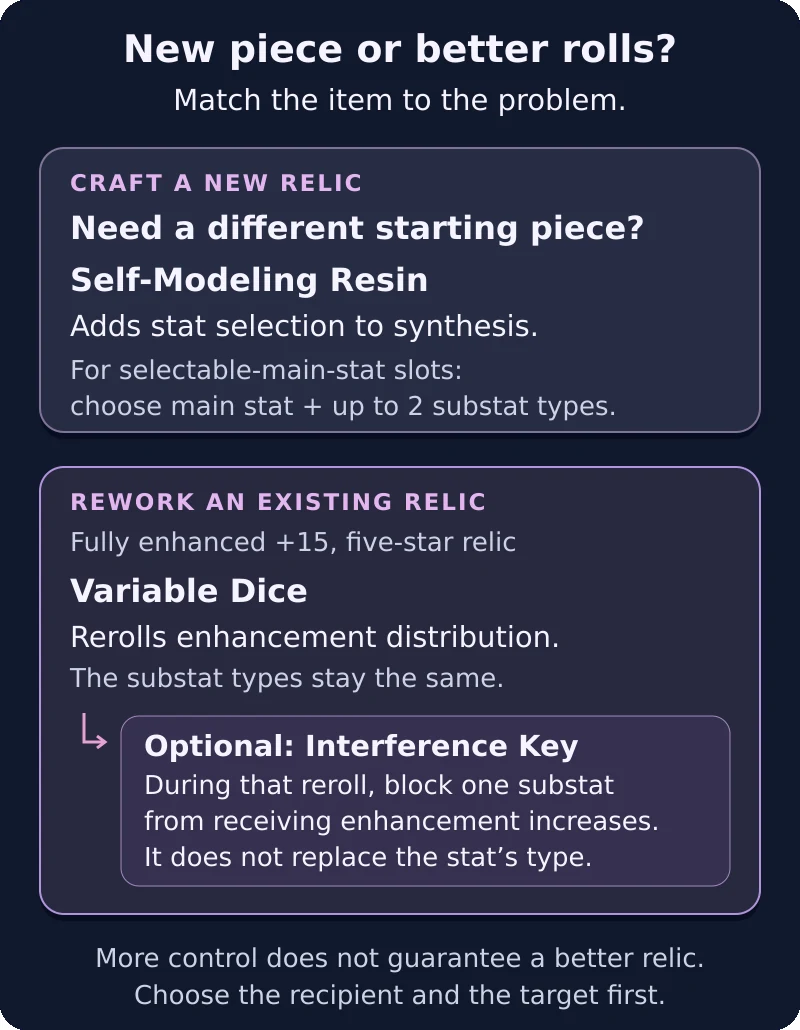
Crafting selects a new starting piece; Variable Dice rerolls enhancement distribution on an existing fully enhanced +15 five-star relic. An optional Interference Key blocks one substat from receiving increases during that reroll without replacing its type.
When Variable Dice addresses a different problem
Variable Dice rerolls enhancement distribution on a fully enhanced level-15 five-star relic. It does not turn the piece into another set or slot, replace its main stat, or supply an entirely new collection of substat types. You can compare the old and rerolled result and keep the preferred one.
This makes the distinction between a bad foundation and poor enhancement results important. A wrong-main-stat piece remains wrong for the intended build after a reroll. A piece with several useful substat types but poorly placed increases is a more logical candidate.
Compare these three hypothetical pieces:
- Piece A has the correct set and main stat, but only one of its four substat types helps your intended build. A reroll still works within that limited selection.
- Piece B has the correct set and main stat, and three substat types help your intended build. Its current enhancement distribution favored the fourth. Rerolling addresses the specific thing that went wrong.
- Piece C is already useful, but you cannot explain what improvement would justify another rare item. Keep using it while you identify a more consequential target.
One Variable Dice can also be synthesized from three Self-Modeling Resins. That creates a direct opportunity cost: those three Resins could instead pay for one two-Resin targeted craft and one main-stat-only craft, provided you also have 200 Remains. Compare the actual relic you would reroll with those two actual replacements—not an imaginary perfect outcome on either side.
What an Interference Key changes—and what it does not
Version 3.6 added Interference Keys. During a Variable Dice reroll, one Key can block one substat from receiving enhancement increases in that reroll. Blocking a stat does not replace its underlying type with a new one.
For Piece B above, excluding the unhelpful substat directly addresses the undesirable destination for enhancement increases. For Piece A, excluding one bad destination still leaves other unwanted destinations. The Key does not make those two starting pieces equivalent.
Choose the blocked stat for the character who will actually equip the relic. A stat that is unhelpful to one build may matter to another. If you are unsure who the piece belongs to, resolve that before spending both a Dice and a Key.
Nor should “I can keep the old result” become a reason to reroll every acceptable piece. Preserving usable equipment and deciding whether the attempt deserves scarce materials are separate questions. Set a limit before starting, rather than letting one disappointing result decide the next expenditure.
A short crafting session that ends with a decision
- Choose one active character and one replacement slot. Compare the current piece with any usable alternatives already owned.
- Define the minimum improvement you need: main stat, one substat type, two types, or better enhancement distribution on an existing piece.
- Reserve materials for other immediate repairs before assigning a luxury budget.
- Check both balances. Count 100 Remains for each new piece and the total Resin cost for the chosen customization.
- Choose the least restrictive option that solves the stated problem. More selections are useful only when they matter to the intended result.
- Evaluate the result before spending again. Keep useful alternatives and stop if the next craft would only repeat a solved problem.
The best use of a rare crafting item is not always the most selective option. It is the option that changes what your team can do without quietly consuming the resources needed for its next important repair.
Official customization prices
HoYoverse confirms the total Resin cost for selecting one or two substats.
Read the cost reference
Latest comments
Log in to join the conversation
Log InNo comments yet. Be the first to share your thoughts!