Hero Wars: Alliance gives each hero several independent upgrade tracks. Level, equipment, skills, Glyphs, skins, artifacts and evolution all matter, but their resources are not interchangeable. The best next upgrade is the one that fixes the reason your chosen team is losing, rather than the one that adds the most visible power.
Use this as a decision guide for the Alliance version. Hero Wars: Dominion Era is a different game: do not copy its upgrade caps or hero-specific priorities into Alliance. Check the current hero screen and prices before spending, because availability and offers change.
Start with a team and a battle problem
Pick a main five for the mode you play most. Usually that means a frontline, a principal damage dealer, healing or protection, and teammates whose buffs or control serve that plan. It is a starting framework, not a mandatory formation. Read faction and skill conditions before committing scarce resources. Corvus and Morrigan, for example, both have skills that benefit Way of Eternity allies; their faction label alone does not make every Eternity combination unbeatable.
Watch a lost battle. Does the tank die before the team can act? Does the damage dealer survive but fail to finish a target? Does a healer die before casting? Choose one bottleneck, improve it, and repeat a comparable battle. An upgrade cannot fix every matchup: Morrigan can prevent Astaroth’s resurrection, for example, so simply adding more stats may not solve that counter.
| Observed problem | First thing to inspect | Candidate investment |
|---|---|---|
| Frontline falls to physical attacks | Incoming damage type and tank health | Armor or health, if available, plus relevant defensive skills and gear |
| Frontline falls to magic damage | Incoming damage and support timing | Magic defense or health; verify whether a healer or control change matters more |
| Damage dealer survives but attacks are resisted | Damage type and target defenses | Matching penetration, when the hero has it and target still has defense to ignore |
| Healer survives but healing is too small | Skill description and scaling stat | Skill levels and the stat shown in the healing formula |
| A key support dies before acting | Who attacks the support and when | Survival, level or equipment before an optional offensive stat |
What each upgrade actually costs
| Track | What you spend | What it changes |
|---|---|---|
| Level | EXP resources | Raises hero level and allows higher-level equipment and skills, subject to their requirements |
| Skills | Skill Points and gold | Improves specific skill values; check the individual description |
| Equipment and rank | Items and fragments, crafting resources, and campaign energy or other sources | Adds item stats and enables promotion when the rank’s equipment requirements are met |
| Evolution | Hero-specific Soul Stones and gold | Raises star rank and main stats |
| Glyphs | Rune Stones or emeralds | Improves the selected stat; class progress has additional requirements |
| Skins | Skin Stones for levels; additional skins have their own unlock cost or source | Adds permanent stat bonuses across unlocked skins |
| Artifacts | Essence, Scrolls or Metal for levels; Chaos Cores and artifact fragments for evolution | Weapon team bonus or personal Book/Ring stats |
| Spark of Power | Sparks of Power and gold | Raises all three main stats; the upgrade cannot be reset |
These pools compete within their own tracks. Choosing a Glyph does not spend Skin Stones, for example, but two heroes who need the same Skin Stone type do compete. Preview the next in-game price and reserve enough for the hero and stat you actually chose. Avoid spending emeralds for convenience until you have compared alternatives.
Level, skills and equipment: build the foundation
Keep your core heroes at useful levels rather than spreading experience across every unlocked character. Level requirements can prevent an item from being equipped. Bring the main tank and damage dealer forward first if their levels are stopping the team, then catch up the healer or support who is missing an important skill or dying early.
Open each important skill and read what changes at the next level. Skill Points and gold pay for upgrades. The standard automatic refill is one point every five minutes, up to 20; optional purchases can change the refill or cap, so check your own account. A skill that the team relies on generally deserves attention before a rarely relevant one. Do not assume every skill scales with the same stat or that a higher hero level automatically levels all skills.
Farm the missing equipment fragments shown on the hero’s screen. Compare the campaign stage, energy and other available sources, then prioritize the item that advances a useful stat or promotion. Promotion unlocks skills and Glyph slots; it is separate from evolution stars. Some Red equipment may appear in the list before it is obtainable, so inspect its current source rather than assuming every listed item can be farmed today.
Glyphs: buy the stat that changes the fight
Each hero has five Glyphs. The first two unlock at Blue rank, the third at Violet, the fourth at Violet +1 and the fifth at Violet +2. Upgrade a Glyph with Rune Stones or emeralds. You do not need to raise the five evenly at the start: direct the next stones toward the statistic that addresses your battle problem, provided it exists on that hero.
- A tank taking mostly physical damage: consider armor and health. Against a magic-heavy opponent, armor alone will not solve the problem; compare magic defense and health.
- A physical damage dealer: if the target retains armor after penetration, armor penetration can increase damage. Once relevant target armor is already fully ignored, more penetration has no further effect against that target; physical attack or survival may then be more useful.
- A magic damage dealer: make the same comparison between magic penetration, magic attack and survival. Read the skill first: scaling stat and damage type are not necessarily the same thing.
- A healer or support: inspect the skill formula. Invest in the stat it actually uses, but protect the hero if they die before contributing. Some utility is conditional on level or matchup rather than simply on a larger attack number.
Class Runes are a later shared investment. When all five Glyphs on one hero reach level 40, that hero can unlock a Class Rune using Rune Spheres. The class ability applies to every hero of that class, even those without five level-40 Glyphs. The first Rune upgrade raises that hero’s Glyph cap to 45. Each subsequent step requires all five Glyphs to reach the current cap and raises it by five, until all five reach 80 for the ninth and final contribution. Do not rush an otherwise weak stat solely for this threshold if an immediate team bottleneck matters more.
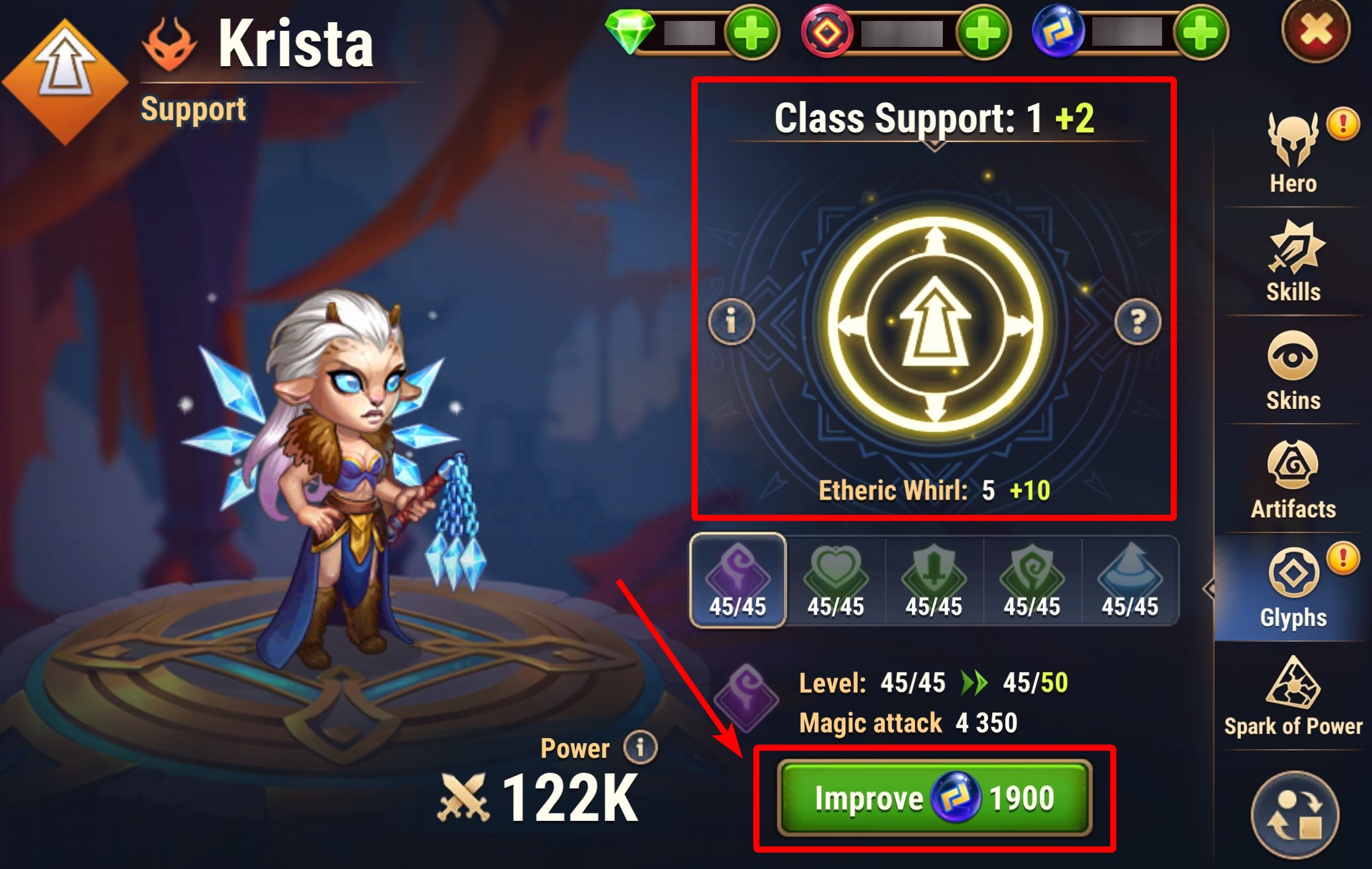
Krista’s five Glyphs at level 45, with a Class Rune upgrade raising their cap to 50. Image: Nexters.
Skins: the bonus stays even when you change appearance
A Default skin boosts a hero’s main stat. Additional skins boost secondary stats. All unlocked and upgraded skin bonuses stack, regardless of which appearance the hero wears. Switching the displayed skin is therefore a cosmetic choice, not a way to select only one active bonus.
Before unlocking another skin, look at the stat it grants, its unlock method and the Skin Stones needed to upgrade it. A new skin competes with levels on existing skins for resources. As a practical example, if your main tank keeps dying to physical damage and has an armor skin available, an armor investment is a reasonable candidate; against magic damage, compare health or magic defense instead. This is a matchup test, not a universal Astaroth or tank skin order.
Skin+ is a separate upgrade available for some skins, with its own availability and requirements; the original hero and skin are needed. Do not treat a Skin+ offer as a free replacement for deciding whether the base stat is useful. Check its actual price and current event rules.
Three hero examples
Astaroth as your frontline: if physical attacks drop him before his allies can cast, test his armor Glyph or, if already unlocked, his Barbarian armor skin. If magic is the main cause instead, compare his magic-defense Glyph or Lunar skin and health. Check the next price and the battle replay before buying a skin; these are alternatives for different problems, not a fixed order.
Keira as your damage dealer: she is a physical marksman. If she survives but armored opponents remain standing, compare the armor penetration and physical attack available on her current build. If enemy armor is already fully ignored, extra penetration has no further effect on that target. If Corvus’s Altar is punishing her repeated attacks, try a different matchup or lineup before spending more just to force the fight.
Phobos as a control hero: his Paralysis targets the enemy with the highest magic attack, so identify that enemy before deciding the skill is failing. Level the relevant skill when its current effect is inadequate, and improve his survival if he is defeated before he can control the target. Raising a different stat blindly will not change the targeting rule.
Understand attack, penetration and defense
Armor reduces physical damage; magic defense reduces magic damage. One point of matching penetration ignores one point of that defense, but the remaining defense cannot go below zero. For example, 6,000 armor penetration against 8,000 armor leaves 2,000 armor; against 5,000 armor it leaves zero, not negative 1,000. This is why penetration is often valuable against armored targets, but is not automatically the best next purchase in every fight.
Main stats also have effects: each strength point grants 40 health; each intelligence point gives three magic attack and one magic defense; each agility point gives two physical attack and one armor. A hero also receives one physical attack per point of their own primary stat. Direct health, attack, defense or penetration can still be the better next upgrade depending on price and the skill you are improving.
Artifacts, evolution and other long-term tracks
An Artifact Weapon can provide a team bonus when its owner uses the first skill. The usual duration is nine seconds; Celeste is an official exception at 4.5 seconds. Evolution affects activation chance: 30% at one star, 60% at two and 100% from three stars. The weapon bonus applies to the activating skill too. A useful team-wide bonus and reliable activation can justify investment, but the exact stat, hero and team timing determine the priority. The Book adds two secondary stats; the Ring adds a primary stat.
Evolution uses the hero’s Soul Stones and gold. For an already summoned hero, moving from one to two stars takes 20 stones, then 50, 100, 150 and 300 for each successive star through six. Initial summoning costs differ for heroes first obtained at two or three stars. Farm reliably available stones where it suits the team, but do not replace a strong synergy simply because a different hero is easier to evolve.
Sparks of Power and gold improve a hero’s three main stats permanently. Sparks come from upgrading titans, among other sources. Place them deliberately on heroes you expect to use. Talismans require hero level 120, and their availability and upgrade resources depend on the current game and events. Relics are another separate system. A Relic unlocks at hero level 50 and four stars and requires 50 individual Relic Shards; later levels can use individual or universal Shards. It adds skills and stats, with further milestones and requirements. Inspect the hero’s Relic tab before committing shards.
A practical upgrade session
- Choose a repeatable battle and identify the first important failure.
- Open the relevant hero’s stats and skill descriptions. Turn on Complete Skill Info in Settings if you need the scaling formula.
- List one or two affordable candidates from each relevant resource pool. Check next-level costs in game.
- Spend a small, purposeful amount on the most likely bottleneck. Do not drain every pool at once.
- Repeat comparable fights in the same mode and observe survival, skill timing and damage. Critical hits and dodges can vary, so avoid drawing a conclusion from one result.
- If the opponent is a specific counter, test a lineup change instead of continually increasing stats.
Common mistakes
- Splitting scarce Skin Stones and Rune Stones across a large roster before a functional core exists.
- Assuming the highest power increase is always the biggest improvement in a real matchup.
- Confusing rank promotion with star evolution, or forgetting to level a skill after unlocking it.
- Treating equipped skin appearance as the only active skin bonus.
- Buying more penetration after a target’s relevant defense is already reduced to zero.
- Using Dominion Era upgrade caps or pet/ascension advice as if it applied to Alliance.
- Spending on a hard counter without checking whether a substitution fixes the matchup.
Official references
Hero basics, rank and evolution
Read the official Hero Wars: Alliance support article.
Official guide
Latest comments
Log in to join the conversation
Log InNo comments yet. Be the first to share your thoughts!