Your stealth reaches zero, then falls below it, and the heist keeps going. That is allowed in Card Thief. The number is part of the capture rules, not a health bar that automatically ends the run at zero. Players have been asking about this distinction since the game’s launch.
Two checks explain most of the confusion: whether an ordinary guard can see you, and whether you can pay for a guard encounter. They use different thresholds. Passing one does not automatically satisfy the other.
This guide follows designer Arnold Rauers’s May 25, 2017 explanation of the basic rules. It covers the default thief and ordinary guards, not every equipment effect, special thief or shadow-stepping interaction. Current mobile builds have not been play-tested for this guide.
First check: can an ordinary guard see you?
For ordinary visual detection, combine these three facts:
- Your stealth is 0 or lower.
- Your thief is in the light.
- A guard is looking toward you.
When all three apply, you are caught. With at least 1 stealth, ordinary sight does not catch you even in a watched, illuminated position. Darkness breaks that ordinary sight condition, but it is not protection against every enemy or every kind of failure.
This is why “I was at zero” is not a complete diagnosis. At zero, an unobserved position and a watched, illuminated position are different situations. Check the light and guard facing, not only the number. The eye indicator is a useful warning that a card is watched.
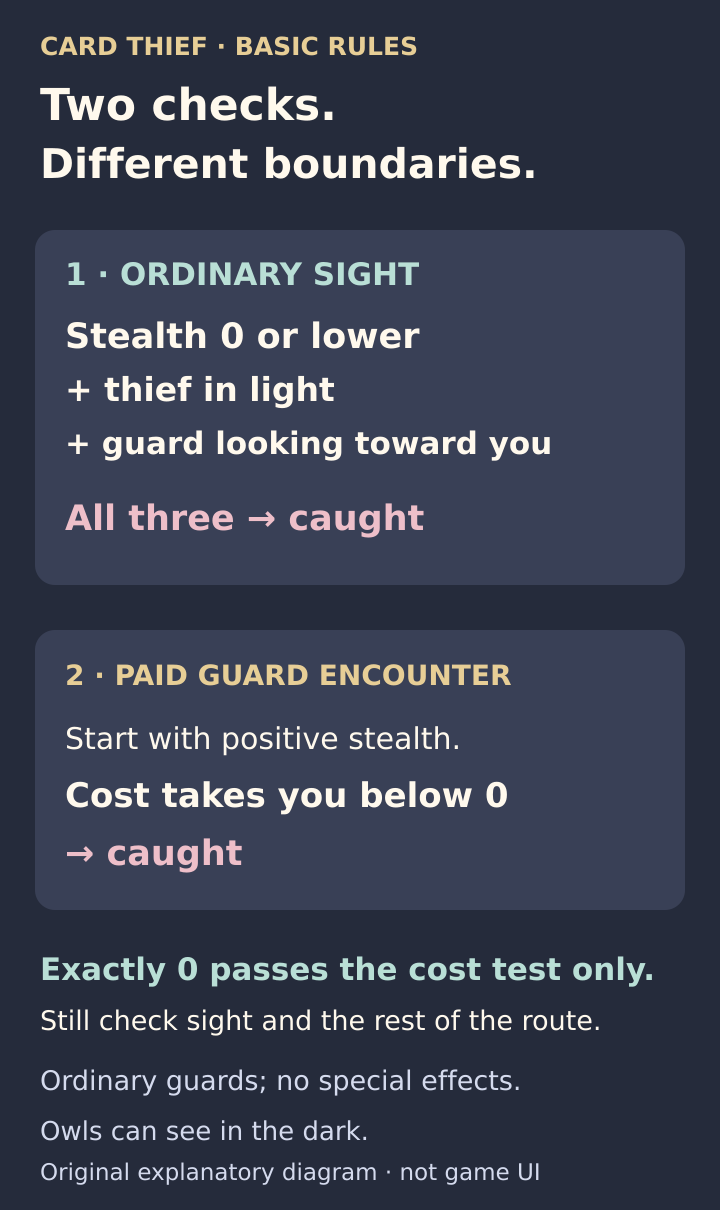
Ordinary sight and guard payment are separate checks. At least 1 stealth protects against ordinary sight; a paid guard encounter must not reduce positive stealth below 0.
Second check: can you afford this guard?
Now consider a normal guard encounter that charges stealth, starting while your stealth is positive. If paying that guard’s effective cost sends you below zero, you are caught. Being in shadow is not permission to ignore that cost.
For example, start with 3 stealth:
- A displayed effective cost of 3 leaves 0. This passes the guard-payment test only. You still need to check detection and the rest of the route.
- A displayed effective cost of 4 would leave −1. This fails the guard-payment test.
Exactly zero is the important boundary. It is not below zero, so do not treat those two examples as identical. Conversely, do not label the first route “safe” merely because the subtraction works. These examples isolate one rule; they are not complete playable board positions.
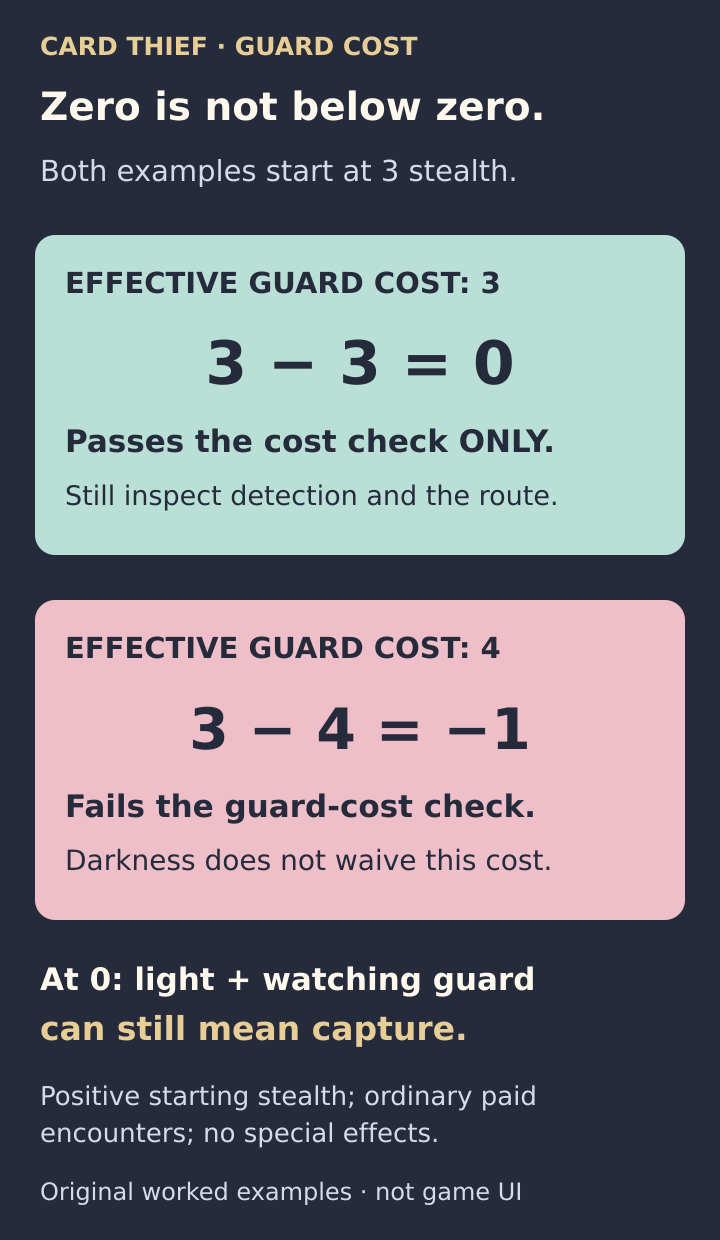
Hypothetical paid encounters: 3 − 3 = 0 passes the cost check only; 3 − 4 = −1 fails it. Both examples start with positive stealth and exclude special effects.
If you are already at zero or below, do not extrapolate those examples into a complete guide to moving through guards. Special interactions such as shadow-stepping require their own conditions. Focus first on the route preview and the rules of the cards involved.
Why obstacles can take you below zero
Torches and doors can lower stealth without capturing you merely because the result is negative. That lets you continue a heist while deeply in debt, provided you avoid the relevant capture conditions. It does not make every negative-stealth route legal.
An extinguished torch can change the lighting, so the useful question is what your proposed move does to the board, not whether torches are always good or always bad to select. Before confirming, look again at the remaining guards, watched cards and your new stealth total.
The game also distinguishes a low-stealth warning from an indication that a move ends the run. TouchArcade’s launch review specifically calls out how easily those warnings can be confused. Treat a negative number as a reason to inspect the route, not as proof that you have already lost.
Recovering from negative stealth
A Sneak card adds its value to your stealth. A usable Hide card restores stealth to 10. Those are different operations: starting at −4, a gain of 3 leaves you at −1, while successfully hiding returns you to 10.
To use a Hide card, finish the path on it. Simply including the barrel somewhere earlier in a route is not the same as ending there. It also needs to be unlit; illuminated recovery cards do not provide their normal recovery.
Plan a route you can actually complete before counting that recovery. A barrel at the end is not a reason to disregard an unaffordable guard on the way. Likewise, do not compare only the route’s final balance: the cost of the particular guard encounter still matters.
Recheck values after changing the path
Card values depend on the developing path, so the cost you saw before selecting other cards may not be the cost you eventually pay. Moving a guard later in the route can change the arithmetic you were relying on.
Try the alternative order, then read the updated values and warnings again. A shorter route that leaves you with a manageable board can be preferable to a long route chosen only for its final treasure total. That is a decision about the current layout, not a promise that short paths always win.
When the basic rule is not enough
Owl-Guards are the explicit exception to the idea that darkness prevents detection. Do not enter a dark position at negative stealth simply because that worked against a basic guard.
Special thieves and equipment also change interactions. The September 6, 2017 update introduced ten thieves with different rules and changed blinded enemies and Owl shadow-stepping. Check the relevant card or thief description before extending ordinary-guard advice to those cases.
A quick check before confirming
- Read your stealth at the relevant point in the route, not only its final total.
- Check effective guard costs after your latest path changes.
- If stealth reaches 0 or lower, inspect illumination and which guards are watching.
- If relying on a Hide card, make it the unlit endpoint and verify the route to it.
- Identify Owls, equipment effects or a special thief that make the basic assumptions insufficient.
Negative stealth is a dangerous position you can sometimes escape from. The goal is to identify the specific capture condition, rather than restarting a surviving run or trusting a route just because its final number looks good.
Sources and further reading
Player question about negative stealth
Read the launch discussion, especially post 14, where a player asks why the game continues after stealth goes negative. For the rules themselves, use the developer explanation below.
Read the sourceDeveloper explanation of stealth and detection
Read Arnold Rauers’s design explanation, particularly the Stealth section. It explicitly separates being seen below 1 stealth from a guard encounter reducing stealth below 0.
Read the sourceGamezebo explanation of the two capture rules
Read the Guards section of Gamezebo’s guide. It independently distinguishes zero-or-lower detection in light from a positive stealth total being reduced below zero by a guard.
Read the sourceReview explaining warnings versus game-over moves
Read the launch review’s discussion of route warnings and negative stealth. It explains why a low-stealth warning should not be confused with an indication that the move ends the game.
Read the sourceLaunch tutorial summary of Hide and Sneak cards
Read the Points section of this launch-era tutorial summary. It distinguishes additive Sneak recovery from Hide restoration and says a Hide card must be the unlit endpoint of the path.
Read the sourceReview of path multipliers and positioning
Read the review’s explanation of path multipliers and starting positions. Use it to understand why a changed route needs a fresh cost check rather than relying on a card’s earlier value.
Read the sourceOfficial app history and special-rule changes
Read the developer’s version history. The September 6, 2017 update introduced special thieves and changed blinded-enemy and Owl interactions, which fall outside a simple ordinary-guard checklist.
Read the source
Latest comments
Log in to join the conversation
Log InNo comments yet. Be the first to share your thoughts!