You finish BABA IS ROCK, but the words get crossed out and Baba stays Baba. Before rebuilding the sentence, look for BABA IS BABA elsewhere on the board. That rule prevents the transformation. The game has not decided that your idea is too clever for this particular level.
Crosses usually point to a conflict with another rule. Two common causes are a same-name rule such as BABA IS BABA and a negative rule such as BABA IS NOT YOU. They do different jobs, and neither is defeated simply by writing your preferred sentence later.
This guide covers ordinary, unconditional IS rules, with small examples rather than level solutions. Advanced conditions and editor-only words can introduce other interactions.
Find the rule that blocks yours
Read the crossed-out sentence, then scan the whole board for rules about the same subject. Include text tucked against an edge or behind an obstacle. A rule does not need to be beside the affected object or beside the sentence it overrides.
- Trying to turn Baba into something else? Look for BABA IS BABA.
- Trying to give Baba control? Look for BABA IS NOT YOU.
- Trying to push rocks? Look for ROCK IS NOT PUSH.
- Only one part of a longer sentence is crossed out? Check that part separately.
Do not assume that the first sentence you made owns the subject forever. In his May 2019 explanation of the rule system, developer Arvi Teikari describes rebuilding the rule list and then marking BABA IS YOU invalid if BABA IS NOT YOU exists. This is a conflict between the current rules, not a contest over which sentence you wrote first.
BABA IS BABA prevents a change of identity
BABA IS BABA looks redundant, but it protects Baba from ordinary transformations into another object. With that sentence intact, BABA IS ROCK cannot turn Baba into rocks.
That restriction is about what Baba becomes, not everything Baba can do. BABA IS YOU can still give Baba control. Do not read the same-name rule as “Baba cannot change in any way,” or as protection from hazards.
If you can safely break BABA IS BABA, an otherwise valid BABA IS ROCK can take effect. If the blocking words are inaccessible, that is useful information: your plan needs to respect the restriction rather than repeatedly rebuilding the same forbidden transformation.
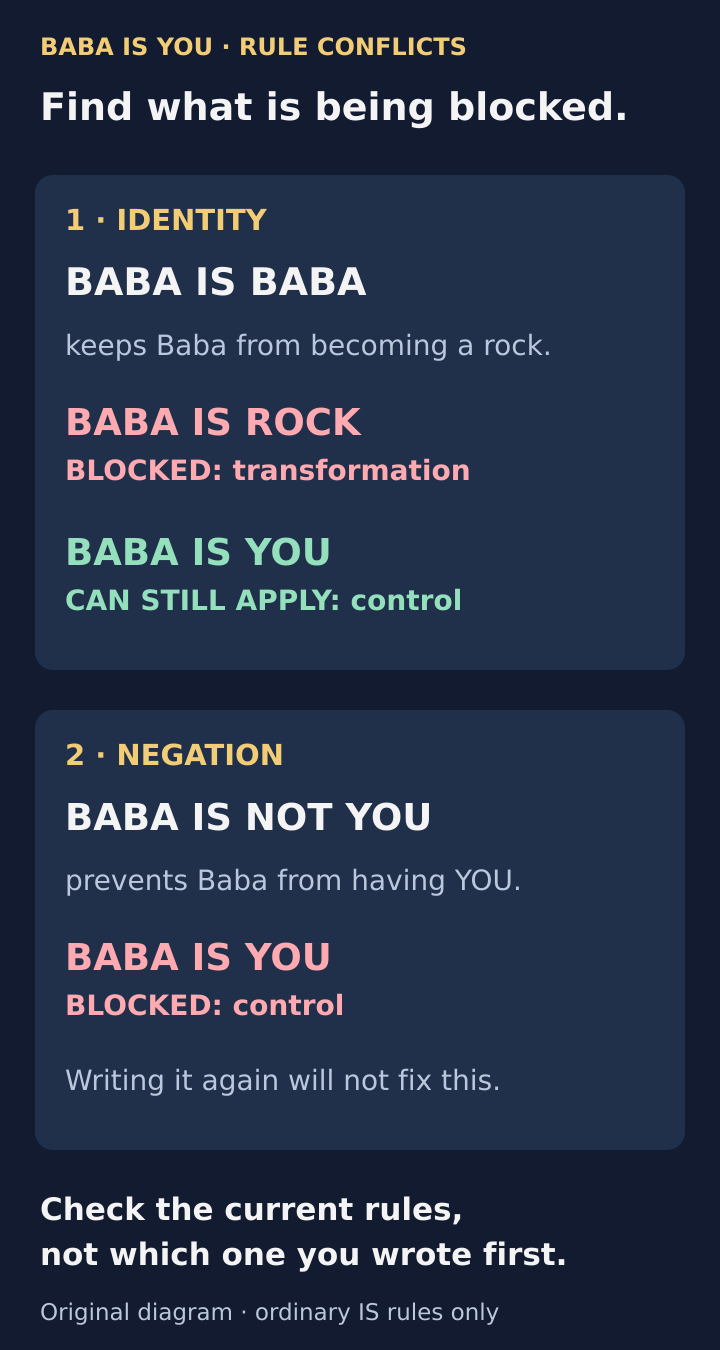
Same-name protection blocks a transformation. IS NOT blocks the matching positive rule. These are explanatory examples, not a game screenshot.
IS NOT is a prohibition, not a different transformation
BABA IS NOT YOU prevents Baba from having YOU even if BABA IS YOU is also on the board. Re-forming the positive rule does not remove that prohibition. Look for a way to break the negative rule, or use a different controllable object if the level allows it.
The same distinction matters with object names. BABA IS NOT KEKE prevents the ordinary BABA IS KEKE transformation. It does not turn Baba into every object except Keke, erase existing Kekes, or switch off a separate KEKE IS DEFEAT rule. A player expecting the first of those results raised exactly this confusion in a community discussion.
For these examples, read IS NOT together: “Baba must not be Keke.” Do not move NOT to the beginning of the sentence and assume the meaning stays the same. Its position matters.
One crossed-out word does not cancel every effect
Suppose the board contains ROCK IS PUSH AND WIN as well as ROCK IS NOT PUSH. The PUSH part is blocked, but WIN can still apply. AND combines effects that can be evaluated separately; it does not make the whole sentence an all-or-nothing package.
This is why looking only at the nearest cross can mislead you. Identify the specific property being denied, then read the remaining rules. A rock that cannot be pushed is not automatically harmless, passable, or irrelevant to winning. Other properties still matter. The community explanation of crossed-out rules explicitly describes this partial-AND behavior.
Keep the object and its word tile separate
The BABA word tile is not a Baba creature. BABA IS ROCK concerns Baba objects, not the letters spelling BABA. Likewise, ROCK IS YOU needs an actual rock to give you something to control; the ROCK word alone is not enough in these ordinary examples.
TEXT is the special noun used to apply rules to the word tiles themselves. That distinction is part of the developer's explanation of the system. It is a different issue from a crossed-out rule, but it explains why a valid-looking sentence can have no visible effect when its subject is absent.
Also check that the words actually form a sentence. Ordinary rules read left to right or top to bottom, with the required words aligned. A broken arrangement and a recognized sentence that another rule suppresses are different problems.
Removing the rule does not reverse a finished transformation
There is an important difference between removing a property and undoing an object change. Once BABA IS ROCK has turned a Baba into a rock, breaking that sentence does not bring the former Baba back. The rock remains a rock. Use Undo to return to the earlier state if that was not what you intended.
Before releasing a blocked transformation, ask what will be controllable afterward. In a simple setup where BABA IS YOU is your only source of control, turning every Baba into a rock leaves that rule with no Baba to control. A valid ROCK IS YOU can provide control of the result. Prepare the necessary rules and access before making the change, rather than counting on the old creature's YOU property to follow it. If several objects are YOU, check what your next move will do to all of them.
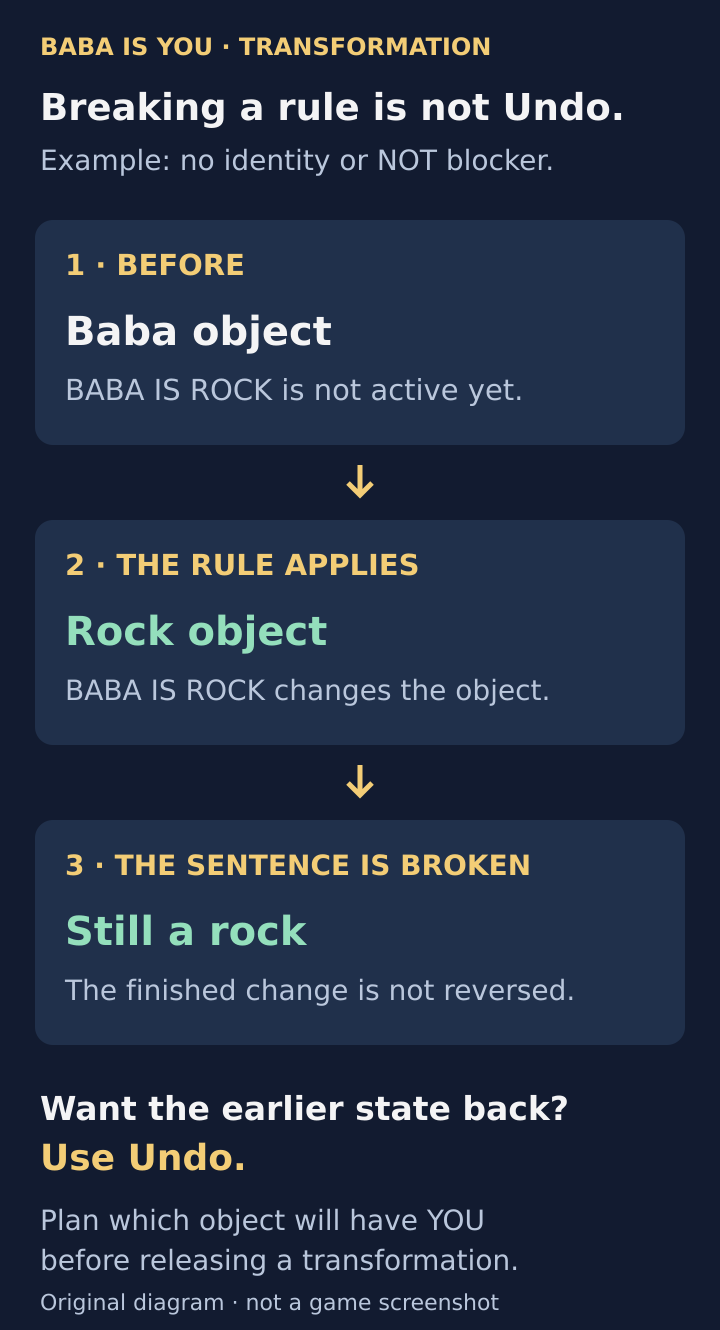
Breaking the sentence stops it applying; it does not rewind the object change that already happened.
A quick check before you abandon the idea
- Read the exact crossed-out effect, including the subject and the position of NOT.
- Search for a same-name rule or a matching negative rule elsewhere on the board.
- If AND is involved, separate the effects before deciding which ones still work.
- Confirm that the subject exists as an object, not just as a word tile.
- Before breaking a restriction, work out what the transformation would leave you able to control.
- Test one change, then Undo if it removes the control or access you need.
The mobile edition also supports rewinding moves, so a failed experiment need not mean restarting the whole level. These examples explain established base-game rules; they have not been playtested in a current mobile build. If a more complex board behaves differently, include all its rules when asking for help, not just the sentence carrying the cross.
Sources and further reading
What causes the X?
A player asks whether crossed-out rules are arbitrary level restrictions. Replies explain same-name protection, negative rules, partial AND conflicts, and removing the blocking sentence.
Read the sourceThe developer explains rule detection
In this May 2019 interview, Arvi Teikari explains syntax checks, rebuilding the active rules, negative-rule precedence and using TEXT to address word tiles.
Read the sourceA discussion distinguishes nouns from properties
The March 2019 discussion clarifies that X IS X conflicts with X IS Y when Y is another object name, and explains why negative rules override their positive counterparts.
Read the sourcePlayers explain the identity conflict
Players answer a beginner’s question about red crosses with concrete examples of same-name protection and IS NOT conflicts.
Read the sourceA worked discussion of rule formation order
The later replies correct the claim that the first rule written wins. They work through ordinary identity protection with rules created in different orders. The thread includes level spoilers.
Read the sourceWhy BABA IS NOT KEKE seems to do nothing
A player expects NOT KEKE to transform Baba into other objects. Replies explain that the rule prohibits a specific transformation rather than producing everything else.
Read the sourceTransformation and Undo in the hints thread
Comment 50 answers a player who expected breaking JELLY IS BABA to restore the original jelly. The community reply explains that the finished change persists and recommends Undo. Other replies contain level hints.
Read the sourceBaba Is You on the App Store
Hempuli’s mobile listing describes changing rules through word blocks. Apple’s editorial introduction also explains rewinding an unsuccessful experiment.
Read the source
Latest comments
Log in to join the conversation
Log InNo comments yet. Be the first to share your thoughts!