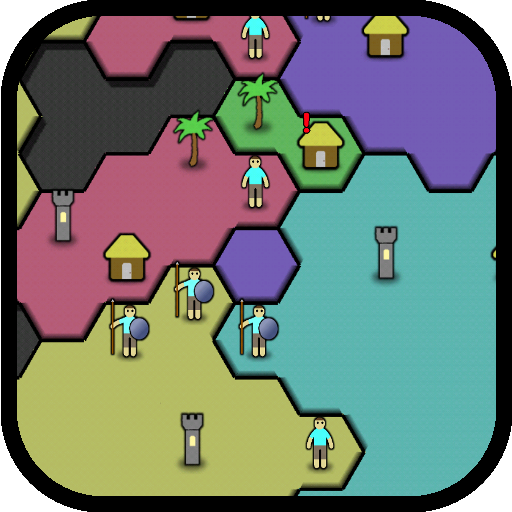
If a whole group of troops disappears and leaves gravestones, check the province’s money before blaming a stronger enemy. In Antiyoy Classic, an army can starve at the start of its owner’s turn. An opponent can then take the undefended land with units that could not have beaten that army directly.
The important numbers are the cash and net income of the province containing those troops. Money in a disconnected province of the same color does not pay their wages.
This guide covers Antiyoy Classic with standard rules, following the developer’s published 2022 ruleset. Later app builds may differ. Slay rules change some costs, and Antiyoy Online and HD are separate versions. Use your selected province’s actual income breakdown if its figures differ from the examples below.
The check to make before ending your turn
- Select the province containing the army you want to keep alive.
- Read its cash balance and its signed net-income number. Tap the income figure to see what earns and consumes money.
- Finish any purchases, upgrades and captures, then read those numbers again.
- Add the remaining cash to the net income. A negative result warns that the province cannot survive its next collection unchanged.
- Inspect the route connecting the troops to the rest of that province. One exposed connecting hex can make the calculation irrelevant.
The quick calculation is: remaining province cash + net income = projected cash at the next collection. Net income already includes unit and tower upkeep. Do not subtract their wages a second time.
At the beginning of the owner’s turn, the province collects its net income. If its resulting cash is below zero, all its units die and its cash resets to zero. Exactly zero does not trigger that bankruptcy check. Negative income is therefore a countdown, not immediate death.
For example, 12 cash and −8 income become 4 cash at the next collection. With no further changes, the following collection would produce −4 and kill the army. Conversely, 0 cash with +4 income is not bankrupt: it collects 4.
Treat this as a forecast, not a guarantee. Enemies can remove land or farms, sever a connection, and change which province owns the troops. Trees can spread, and old gravestones become trees before income is collected. A forecast of exactly zero leaves no room for those losses.
Why fewer units can cost more
Merging existing units does not charge a purchase price, but the stronger unit has a new upkeep bill. It does not keep the combined wages of the two weaker units.
Under Classic’s standard rules, upkeep per turn is:
- Level 1, peasant: 2 coins.
- Level 2, spearman: 6 coins.
- Level 3, baron: 18 coins.
- Level 4, knight: 36 coins.
- Ordinary tower: 1 coin; strong tower: 6 coins.
Two peasants cost 4 per turn separately, but their spearman costs 6. A spearman and peasant cost 8, but their baron costs 18. Two spearmen cost 12, but their knight costs 36. The last upgrade triples the bill while reducing two units to one.
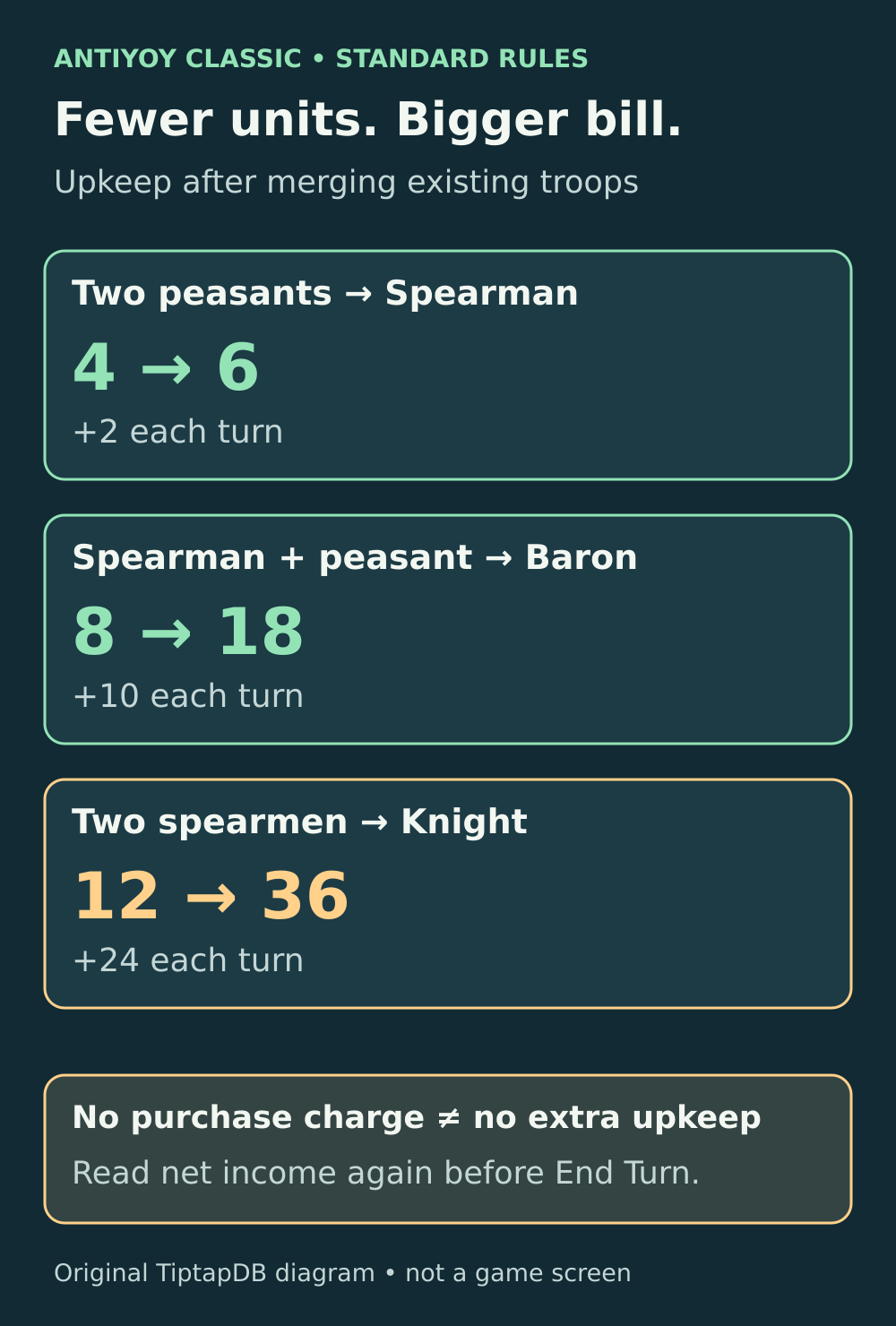
Combining existing troops costs no purchase money, but it can sharply increase the next upkeep bill. These are Classic standard-rule values.
Consider a province with 12 tree-free hexes, one farm, one spearman, one peasant and one ordinary tower. Its land earns 12, the farm adds 4, and upkeep costs 9. Net income is +7.
Merge the spearman and peasant into a baron and upkeep becomes 19: 18 for the baron and 1 for the tower. Net income falls to −3. If only 2 cash remains, the next unchanged collection produces −1 and the province’s entire army starves.
Check the income after merging, not just whether the merge is allowed. If the stronger unit is needed to break a defence, plan the resulting captures and the remaining cash together. Recruiting an additional unit onto an existing one also costs money for the newly purchased strength; it is not the same as merging two units you already own.
Why an army dies while another province is rich
Connected friendly land shares a province economy. Disconnected regions do not share one wallet merely because they have the same color.
When an enemy captures a connecting hex, the surviving pieces are evaluated separately. A newly separated army can be stranded with no cash and too little local income, even though another piece still holds the old reserve. Do not assume the treasury is split evenly or follows your most valuable troops.
In the example below, the connected province has 24 cash and +7 income. The enemy takes its one-hex bridge. The larger section keeps the reserve, but the smaller section has 0 cash and −5 income. If that position is unchanged, its soldiers starve at the start of their owner’s next turn. The rich section cannot cover that deficit across the gap.
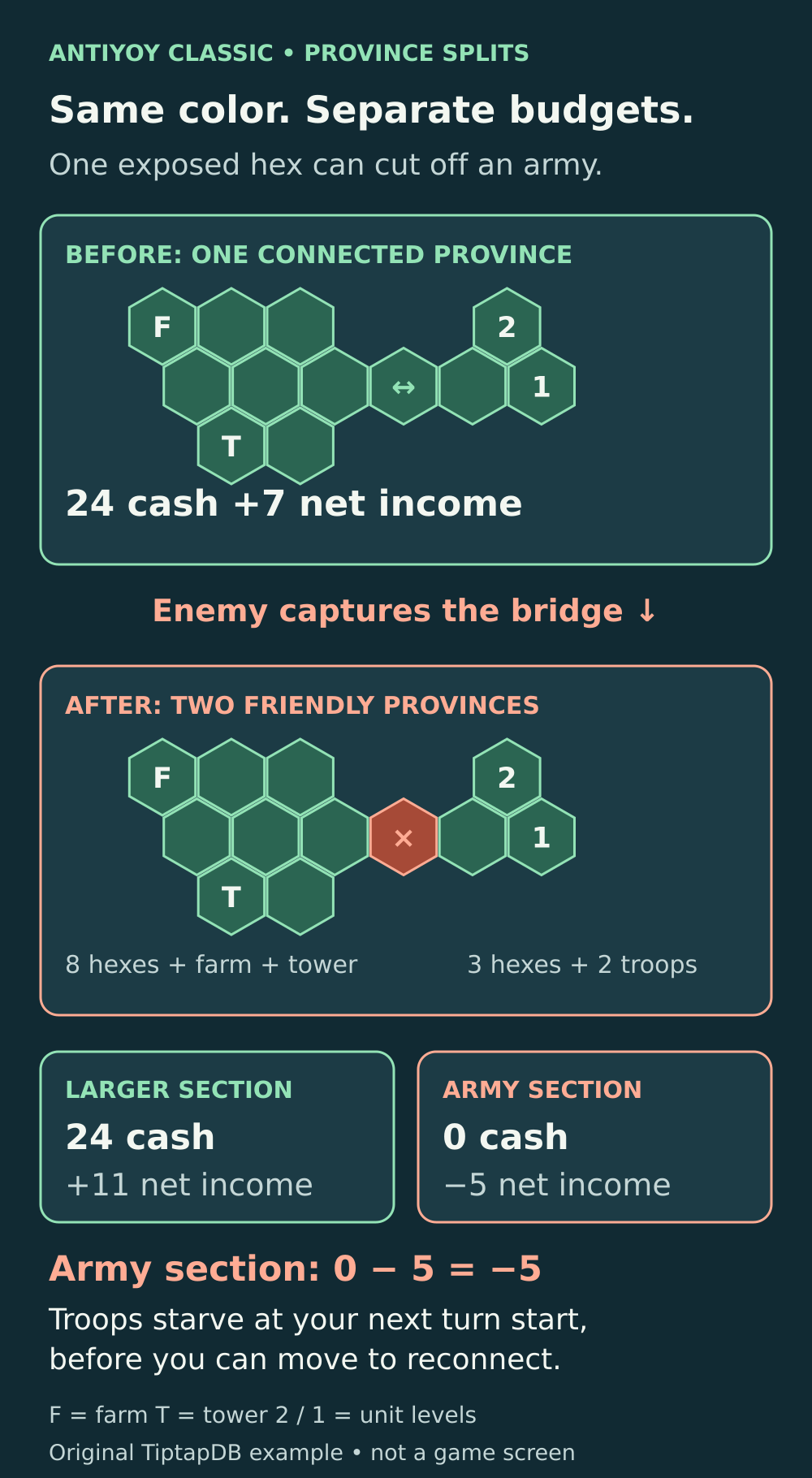
The smaller section has three hexes supporting a spearman and a peasant: 3 income minus 8 upkeep. The larger section has eight hexes, a farm and a tower. The captured bridge was the twelfth hex.
You normally cannot wait until your next turn to reconnect those starving troops. Collection and bankruptcy happen before you regain control. Protect the corridor, broaden the connection where the map allows it, or ensure the exposed army section can support itself before ending the previous turn.
A unit stranded on one isolated hex has an additional problem: it is not in a normal province of two or more connected hexes. Classic checks isolated units separately, so a wealthy friendly region elsewhere still will not save it. Keep a unit’s escape route and its economic connection in mind together.
Farms help income, but can ruin the next collection
In standard rules, an ordinary non-tree hex earns 1 coin. A farm adds 4 more, so its hex earns 5 in total. A tree-covered hex earns nothing. The first farm in a farm-free province costs 12, and each farm currently in that province adds 2 to the next farm’s price.
A farm increases income; it does not put its purchase price back into your treasury immediately. Before buying, calculate the cash left after payment as well as the new net income.
Suppose you have 12 cash, −5 income and no farms. Buying the first farm on an empty, non-tree hex spends all 12 and improves income to −1. The next unchanged collection produces −1, so the army dies. Without that purchase, the same collection would leave 7 cash. You still need to fix the deficit, but the farm has removed the buffer without solving it.
A better emergency move may be a safe land capture, clearing trees on your own land with troops you already have, or postponing an upgrade. Clearing an owned tree restores that hex’s land income and gives a one-time cutting reward under standard rules. Check the resulting numbers rather than assuming every aggressive move pays for itself.
Keeping provinces separate can make their next farms cheaper, because farm prices are local. Connecting them combines their cash and gives their troops access to one shared economy, but the merged province counts all its farms when pricing the next one. Cheap farms are useful only if the separate provinces survive long enough to benefit.
If the troops have already died
First select each surviving province and inspect its finances. Do not spend money immediately on rebuilding the same army that just became unaffordable.
- Check whether the original problem was excess upkeep or a broken connection. Those need different repairs.
- Count towers as ongoing expenses, even while rebuilding a small army.
- Use the cheapest force that can safely defend, clear trees or take useful land. Recalculate before adding another unit.
- Reconnect provinces when that creates an affordable, defensible economy. Reconnection does not resurrect dead troops.
- Clear the aftermath when safe. Bankruptcy leaves gravestones, which later become trees and reduce the land’s income.
If diplomacy is enabled, inspect that part of the income breakdown too. Its payments are included in net income; a calculation based only on land, farms and soldiers can miss the reason the displayed total is negative.
Slay rules: check the knight before upgrading
The standard-rule examples above do not carry over unchanged to Slay rules. In Classic’s Slay ruleset, level-four upkeep is 54 rather than 36, while levels one to three still cost 2, 6 and 18. The ordinary tower has no upkeep in that ruleset, and the standard farm strategy does not apply.
That makes two spearmen becoming one knight an increase from 12 to 54 upkeep. If an upgrade seems far more expensive than expected, check the selected ruleset before treating the number as a bug.
A safer end-turn habit
Check every exposed province, not just the biggest one: cash remaining, net income after your last move, and the land connecting the army to its support. A high-tier unit is only as secure as the province that will pay it at the next collection.
Sources and further reading
Developer explanation of starvation
Read yiotro’s explanation of the income breakdown and why starving troops can leave land open to weaker enemies.
Read the sourceAntiyoy Classic on Google Play
Identify the Classic app and distinguish it from Online and HD.
Read the sourceTurn-start money and starvation
See the published Classic order of income collection, bankruptcy and turn-start processing.
Read the sourceStandard costs and upkeep
Check the standard-rule unit and tower upkeep values in the developer’s published rules.
Read the sourceUnit-merging rules
Compare merging existing troops with the combined strength and resulting unit.
Read the sourceProvince splitting and reconnection
See how the published Classic rules rebuild separated provinces and combine connected treasuries.
Read the sourceProvince income and farm prices
Check local province profit, diplomacy payments and the price of the next farm.
Read the sourceLand, trees and standard income
Review standard land income, farm income and tree-clearing behavior.
Read the source
Latest comments
Log in to join the conversation
Log InNo comments yet. Be the first to share your thoughts!