In Aeon's End, the card you discard first normally comes back first. Recycling your player deck flips the discard pile over without shuffling it, so the oldest card at the bottom becomes the next card on top. Handelabra's digital game preserves that order too.
The catch is that your cards do not all reach the discard pile together. Cast spells, new purchases and played gems arrive at different times. You also refill to five cards, rather than automatically drawing five new ones. Those two details explain many seemingly strange hands.
Start with the normal sequence below. Card abilities and nemesis effects can override it, including effects that explicitly shuffle your cards.
First discarded means first back, not top card first
Think of your discard pile as a line waiting to re-enter your deck. Each ordinary discard joins the back of the line. When the draw deck needs replenishing, the front of that line returns first.
In physical-pile terms, new discards go on top of the face-up pile. Flipping the whole pile face down puts its oldest, bottom card on top of the new draw deck. You do not reverse the order by moving cards across one at a time.
That does not let you rearrange a discard pile you have already built. Your choices happen when an action gives you a choice of which card to cast, gain or discard, and when you order played gems and relics at the start of the draw phase.
The three moments that build your next deck
1. Ordinary cast spells enter immediately
When you normally cast a prepped spell, put it into the discard pile before resolving its Cast effect. If you cast one spell and then another, that sequence matters. A spell that interacts with the discard pile may already be there when its effect resolves. Follow any explicit exception on the card.
You choose the order of spells you cast during your casting phase. That is an early opportunity to influence their order in a future hand, but it is not a reason to ignore urgent damage or a useful spell interaction.
2. A normal purchase enters when you gain it
A card bought from the market goes straight onto your discard pile. It does not wait in the play area with the gems that paid for it.
This means a card bought in your main phase normally sits behind the spells you already cast that turn, but ahead of the gems and relics you will discard at cleanup. That is a description of this sequence, not a permanent rule that all spells must come before all purchases. Extra casts, gains and other card effects can create a different sequence.
3. Played gems and relics wait for cleanup
Ordinary gems and relics you play remain in the play area until the draw phase. They are no longer in your hand, but they are not yet in your discard pile either. At cleanup, put those played cards onto the discard pile in the order you choose.
This is why playing a gem before buying a spell does not put that gem ahead of the new spell in your next deck. The gem was played earlier, but the purchase was discarded earlier.
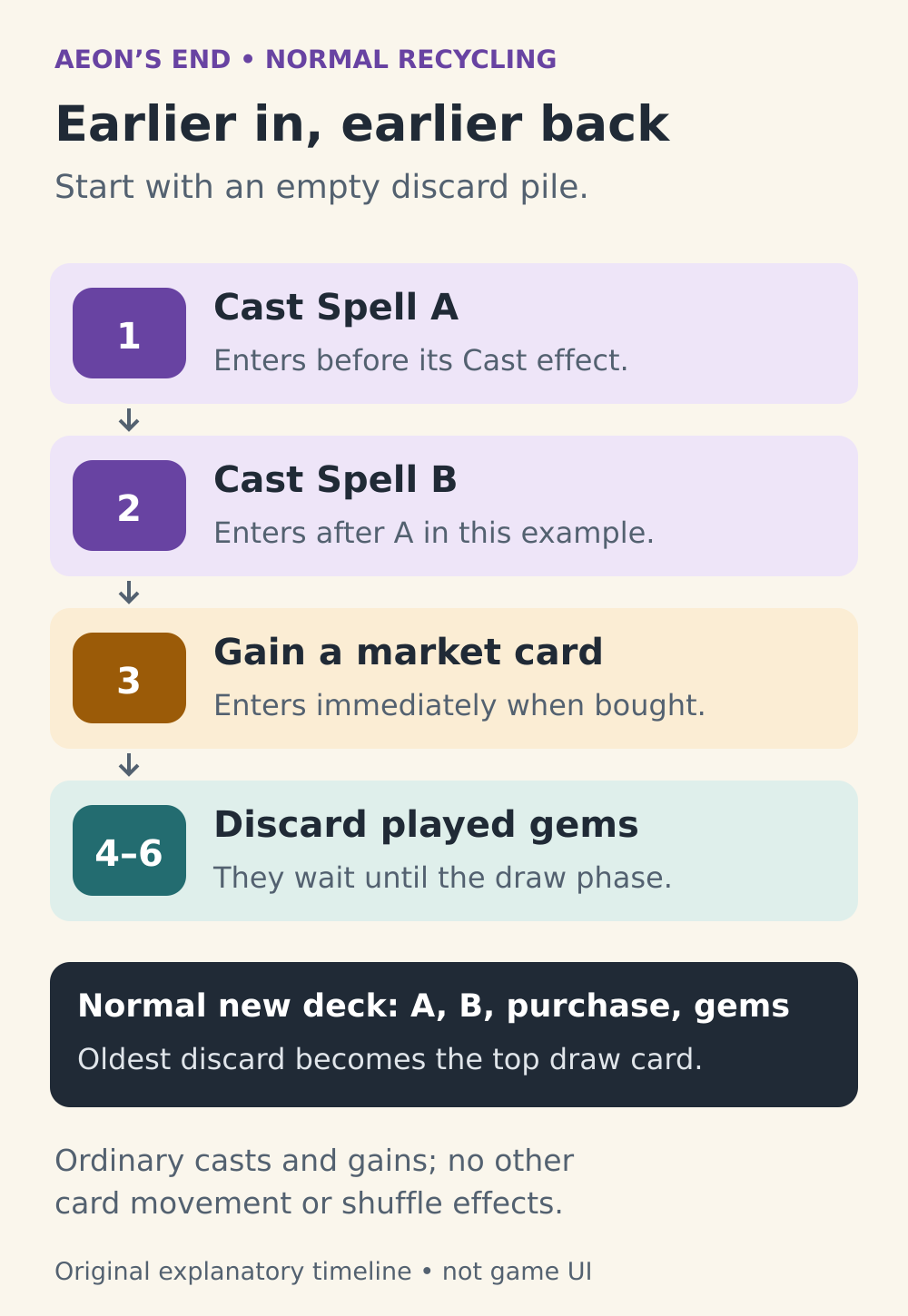
An example starting with an empty discard pile. This is an arrival timeline, not the app's layout; ordinary casts and gains are assumed.
A worked hand: two cards kept, only three cards drawn
Here is a small example that brings the timing together. Spell A and Spell B are labels for two spells, not card names. Assume their effects do not move cards and nothing else changes the piles.
- Your discard pile starts empty, and one card remains in your draw deck.
- During your casting phase, you cast Spell A, then Spell B.
- During your main phase, you play three gems and buy one market card you can afford.
- You leave two other cards unplayed in your hand.
- At cleanup, the three played gems enter the discard pile after the purchase.
The discard's future draw order is now Spell A, Spell B, the purchase, then the three gems. But you still have two cards in hand, so you need only three new cards to reach five.
Draw the one card left in the old deck first. You still need two more, so flip the discard pile without shuffling and draw Spell A, then Spell B. Your five-card hand is now the two cards you kept, the old deck's last card and the two spells. The purchased card is next in your draw deck, followed by the three gems.
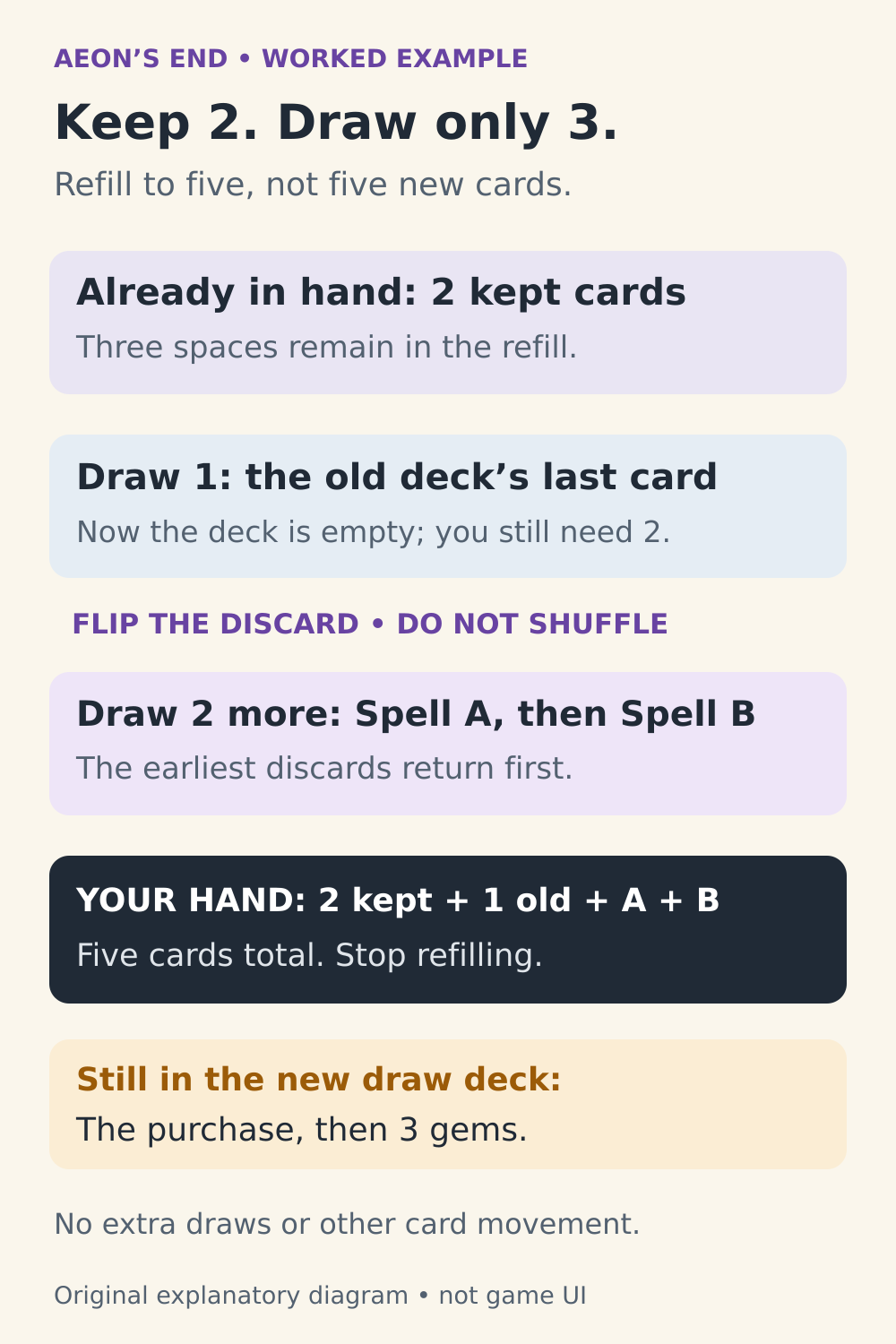
Two kept plus three drawn makes five. No extra draws, forced discards or special deck effects occur in this example.
If your hand had instead been empty, the same sequence would draw five new cards: the old deck's last card, Spell A, Spell B, the purchase and the first gem. Only two gems would remain. Holding cards changed where the new hand ended, even though the discard order was identical.
Keeping cards can help, but it slows the refill
You do not automatically discard unplayed cards at the end of your turn. Keeping a useful card can save it for a later combination. It also occupies a place in the five-card refill, so fewer new cards arrive.
If you are stuck with several unprepared spells, finishing the turn will not clear them out. You need to prep them to legal breaches or use an effect that allows cards in hand to be discarded or otherwise moved. Gems and relics can be played during the main phase even if their effects cannot be fully used, but resolve as much of the text as possible.
Do not confuse playing a card with permission to throw it away. Nor should you expect five new cards just because you pressed the button to finish your turn. Count what is still in your hand first.
Five is the normal refill target, not a maximum hand size. If another effect gives you more than five cards, the normal draw phase does not tell you to discard down to five.
Plan the next useful hand, not an entire perfect deck
A simple check is enough to make discard choices more useful:
- Count how many cards you expect to keep in hand. That tells you how many refill spaces remain.
- Count the cards still in the current draw deck. Those are drawn before the recycled discard.
- Read your discard in future draw order, oldest first. Include cards that were already there before this turn.
- If cleanup order can change which card lands in that refill, place the more useful card earlier in the discard sequence.
- Reconsider the plan after extra draws, gains, forced discards, destruction or a shuffle effect.
Two gems next to each other are not guaranteed to reach the same hand. They may sit on opposite sides of the refill boundary. Likewise, grouping several spells is not automatically useful if you cannot prep them when they arrive. Plan around the cards and breaches you can actually use, rather than arranging an attractive pile with no immediate purpose.
You also do not recycle a player deck just because its last card has disappeared. The normal deck recycle happens when a draw or reveal needs a card that the deck cannot supply. An empty deck can therefore remain empty until another effect needs it. This timing can affect which new discards are included when it finally flips.
When the digital game behaves differently from your plan
The app discarded identical cards without asking
Handelabra's version history documents automatic discarding in some situations where all the relevant cards are the same. That is not evidence that the game shuffled the pile. Swapping identical copies does not produce a different card sequence.
You cannot see every card in a large pile
On iPhone, the version 1.5.1 notes describe viewing large decks and discard piles by scrolling left or right. Check your installed version if the visible row appears cut off. The same release fixed some discard-selection highlighting issues. These are display and selection checks, not a different discard-order rule.
The deck really was shuffled
Read the effect that just resolved. Crooked Mask's Unleash is a concrete exception: it places a gained corruption on top of a player's deck, then instructs that player to shuffle their discard into the deck. The core rulebook shows this on the nemesis mat. A normal recycle preserves order; an explicit shuffle instruction does not.
Keep the turn-order deck separate in your thinking too. Randomizing who acts next is a different system from recycling your mage's cards.
A card went somewhere other than the normal discard
Check the exact spell, relic, mage ability or nemesis instruction. Effects can return cards to hand, move them to another player's discard, destroy them or change a normal cast. The basic sequence is a starting point for following those effects, not permission to ignore their text.
If a sequence still appears inconsistent, note the mage, nemesis, cards involved, game version and the actions just taken. Use Help & Feedback to report the reproducible sequence. “I expected the purchase before the cast spell” is usually a timing misunderstanding; a specific action that contradicts its card text is much better evidence of a problem.
Sources and further reading
Official digital-game overview
Read Handelabra’s explanation of preserved discard order, normal deck recycling and the digital adaptation.
Read the sourceRulebook: player turn and draw phase
Read the original rulebook, particularly printed pages 12–15 for cast/gain/discard timing and page 5 for Crooked Mask’s shuffle instruction.
Read the sourceCast timing and discard-pile effects
Check the community rules FAQ and linked rulings explaining why an ordinary cast spell reaches discard before its effect resolves.
Read the sourceWhere played gems and relics wait
Check the cross-referenced FAQ distinguishing the play area from your hand and discard pile.
Read the sourceCycling cards out of your hand
Read the FAQ on legal ways to move unplayed cards out of hand, including gems, relics and unprepared spells.
Read the sourceMobile release notes and interface fixes
Read the developer’s iOS version history, including identical-card automation and version 1.5.1 pile scrolling and selection fixes.
Read the sourceOfficial help and bug reporting
Read Handelabra’s instructions for reporting a bug or suggestion, including the in-game Help & Feedback route.
Read the source
Latest comments
Log in to join the conversation
Log InNo comments yet. Be the first to share your thoughts!