When a train waits at a red path signal, the first question is not how many signals the line needs. It is where that train would stop next—and whether its entire length could fit there without blocking another route.
Path signals reserve routes through track. They do not turn every empty-looking piece of railway into a safe place to wait. A poorly placed downstream signal can invite a train into a junction and then leave its rear across the crossing. Adding more signals around the same junction can make that problem worse.
This guide covers ordinary, compatible rail using standard and one-way path signals, including pelya’s Android port. The construction controls differ between platforms; custom patch packs and unusual rail-type combinations are outside this layout guide.
What a path signal is waiting for
A path signal normally stays red until an approaching train can reserve a route to a suitable waiting point ahead. That endpoint can be another appropriately facing signal, a depot or the end of a track. The signal is not promising that every place you have designated as an endpoint is physically sensible for your longest train.
Two trains can use separate, non-conflicting routes through the same junction area. They cannot simultaneously reserve the same conflicting stretch just because you put more signal posts around it. Think in terms of the rails each train needs, rather than the apparent size of the area between signals.
For a diagnosis, turn on the setting that highlights reserved track. Then follow the waiting train’s intended route toward its destination. A reservation belonging to another train can explain a wait even when there is no vehicle immediately in front of the red signal.
A red signal on its own is not a fault. If the occupying train is moving and will release the required route, waiting is normal. The warning sign is a queue whose leading train cannot progress because another stopped train occupies the space it needs.
Use the right kind of path signal
Standard and one-way path signals are not interchangeable direction markers.
| Type | Train approaches its front | Train approaches its back |
|---|---|---|
| Standard path signal | The signal controls entry using a route reservation. | The train can pass; the signal does not provide a waiting endpoint in that direction. |
| One-way path signal | The signal controls entry using a route reservation. | The train cannot pass through it in that direction. |
Use one-way path signals where a track really is intended for one direction. Do not place one as a station exit if arriving trains must pass through its back to reach the platform. A standard path signal can serve that kind of two-way access without prohibiting the arrival movement.
Before rebuilding a junction, trace the route in both directions. If a train can leave a platform but cannot enter it, inspect every one-way signal along the approach. Extra platforms do not help when the only approach forbids the direction the train needs.
Put the waiting train before the conflict
The useful place for an approach signal is before the junction, where a stopped train will not occupy the crossing or a switch another train needs. The next waiting point must also leave the whole train clear after it passes through.
That second condition is easy to miss. You may place the approach signal correctly, then add an exit signal just beyond the crossing. The new signal creates a place where a following train can stop—but the front of a train being beyond the junction is not enough. Its rear must be beyond the shared track too.
For a simple diagnosis, mark three things on the route:
- The last point where a stopped train would obstruct a conflicting movement through the junction.
- The actual stopping position of the train’s front at the downstream signal.
- The length of the longest train that uses that route.
Measure usable waiting space between the clearance boundary and that stopping position. Do not count from the decorative edge of a signal sprite, or assume that the signal’s tile centre is exactly where the train’s front stops.
Worked layout: a four-tile train in a three-tile waiting space
Imagine a straight exit from a junction. Your train is four tiles long, but there are only three tiles of usable clear space between the junction’s clearance boundary and the train’s stopped front. This is a length example, not a literal track-building blueprint.
| Layout | Train length | Usable clear waiting length | Result when the train stops there |
|---|---|---|---|
| Short exit space | 4 tiles | 3 tiles | One tile of train length extends back beyond the clearance boundary. |
| Longer exit space | 4 tiles | 5 tiles | The train fits, with one tile of clearance margin. |
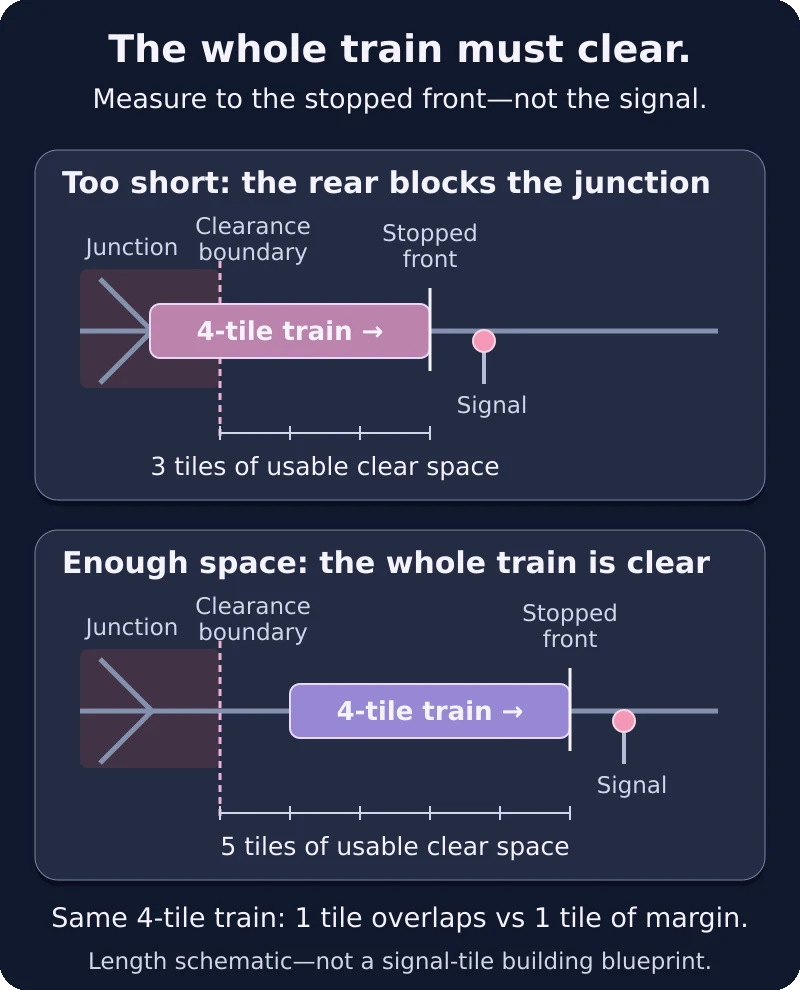
Original length schematic. Measure usable space to the stopped train’s front: a four-tile train overlaps a three-tile space by one tile, but fits within five tiles with one tile spare. Signal symbols are illustrative, not exact tile placement.
In the short layout, the train can have its locomotive beyond the junction while its rear still blocks a crossing movement. A second train waiting for that crossing is not being unnecessarily cautious; the first train is physically in its way.
Moving the stopping point farther along the exit changes the first train’s entire footprint. In the five-tile example it can wait clear, allowing another train to use a genuinely non-conflicting route. The spare tile is margin for this example, not a universal signal-spacing requirement.
Use the length of the longest train assigned to the route, not the first train that happens to pass during construction. A layout that clears comfortably with a short passenger train can stop working after you add longer freight trains. Recheck waiting spaces when you lengthen services.
Two fixes, depending on what lies ahead
One option is to move the downstream signal far enough away to create a proper waiting space. This retains a place for a train to wait after the junction while keeping the shared track clear.
Another is to remove an unnecessary signal immediately after the junction, so the approaching train must reserve farther ahead to a genuinely suitable endpoint. If that farther route is unavailable, the train waits at the approach rather than advancing into the conflict.
Removing a signal is not automatically a fix. Trace the new reservation route first. You still need a reachable endpoint in the correct direction, and the train must have somewhere sensible to go. Do not remove every signal from a busy line just because one exit signal is badly placed.
More platforms do not always mean more usable routes
Suppose a station has two empty platforms, but every arriving train must use the same single track across its throat. Only one conflicting movement can occupy that shared route at a time. The spare platform does not create a second independent entrance.
Now consider two movements that really are separate: an arriving train can reach one platform while another leaves along rails that do not cross its reservation. Path signalling can allow those independent routes without treating the whole junction area as unavailable just because one train is present.
The difference is geometry. Before widening a station, sketch which rails an arrival and a departure actually use. If both require the same switch or crossing, decide whether the delay is acceptable or whether a separate approach would remove that conflict. A signal cannot create an extra physical route.
Also distinguish an empty platform from a reachable platform. A reversed one-way signal, a missing rail connection or a route incompatible with the train will not be repaired by placing another signal beside the platform.
Diagnose from the first stopped train, not the last
Start at the head of the queue. Trains behind it are often waiting correctly; altering their signals can hide the original fault or allow more trains into an already blocked area.
| What you find | What to examine next | Appropriate response |
|---|---|---|
| Another train is moving through the needed route | Whether it will clear the shared rails normally | Let the reservation do its job; do not rebuild because of a brief red signal. |
| A stopped train’s rear remains across the junction | Its downstream stopping point and usable waiting length | Move that waiting point farther away or remove the unnecessary short exit stop. |
| A platform is empty but unreachable from one direction | One-way signal orientation and physical rail continuity | Correct the direction or connection before adding capacity. |
| Both movements require the same rails | Their complete routes through the station throat | Accept sequential movement or redesign the conflict; extra signals alone do not make parallel movement possible. |
| A standard path signal is being passed from behind | Where the reservation can actually end farther ahead | Do not count the back of that signal as the waiting point for this direction. |
| The queue appeared after trains were lengthened | The longest train versus each clear waiting space | Resize the affected space or use a shorter train on that route. |
If the leading train is at its destination waiting to load, its order is a separate issue from junction access. A signal cannot make the loading condition finish. First decide whether the train is waiting as ordered or unable to reach the next place it needs to go.
Make the repair without changing five things at once
Pause before altering the layout. Identify the single stopping point or direction restriction you intend to change, and leave the rest of the working route alone. Avoid using a forced passage past a red signal as your diagnostic method: the reservation system is protecting the movement you are trying to understand.
After the repair, observe the first affected train and then a train taking the competing route. You want to see two specific outcomes: the first train can reach its next waiting position, and its rear is clear of the junction when it stops there. A locomotive passing the signal is only half of that check.
Do not measure success only by whether a queue briefly disappears. Trains arriving at different times can hide a conflict. Look at the stopped footprint and the reserved route; those explain whether you fixed the cause or merely changed when it appears.
See path reservations and signal direction
The OpenTTD project manual explains standard and one-way path signals and the reserved-track display.
Open the path-signal reference
Latest comments
Log in to join the conversation
Log InNo comments yet. Be the first to share your thoughts!