
A crowded platform does not always need another train. Its passengers may lack a connection to their destination, the trains serving it may already be full, or an onward line may be unable to clear the transfer station. Those problems can look similar at the origin but need different repairs.
This guide uses Normal mode, where you can revise the network. Extreme mode's placement restrictions make the same emergency redraw unsuitable. The small networks below are illustrative layouts, not solutions for a particular city.
Follow the waiting shape, not just the warning
The small passenger symbols tell you which station shape they need to reach. A square passenger needs access to a square station. That destination can be on the passenger's current line or reached through a transfer at a station shared with another line.
Start with the shape accumulating at the problem station. Trace a complete journey to a matching destination, including any change of line. Then look at the trains that would serve each leg. A connection on the map answers “can this journey be made?” It does not answer “is the network moving these passengers quickly enough?”
| What you find | First problem to investigate | What a useful repair must change |
|---|---|---|
| No connected route to the needed shape | Missing destination access | Add a usable destination or transfer connection |
| A valid route, but arriving trains are full | Capacity reaching the origin | Make usable space available on the relevant service |
| The origin empties while its transfer station fills | Onward service | Improve the next leg, not just the feeder |
Do not diagnose a whole line from one train passing one station. Look at where that train is going, its visible load, and whether it serves a useful leg of the waiting passengers' journey. An empty train on an unrelated route is not spare capacity for every queue on the map.
Case 1: another train cannot repair a disconnected destination
Consider four stations: C1 and C2 are circles, T1 is a triangle, and S1 is a square. Red connects C1 to T1. Blue connects C2 to S1. Square passengers are waiting at C1, but the two lines share no station.
| Line | Before the repair | Proposed connection |
|---|---|---|
| Red | C1 → T1 | C1 → T1, unchanged |
| Blue | C2 → S1 | C2 → T1 → S1 |
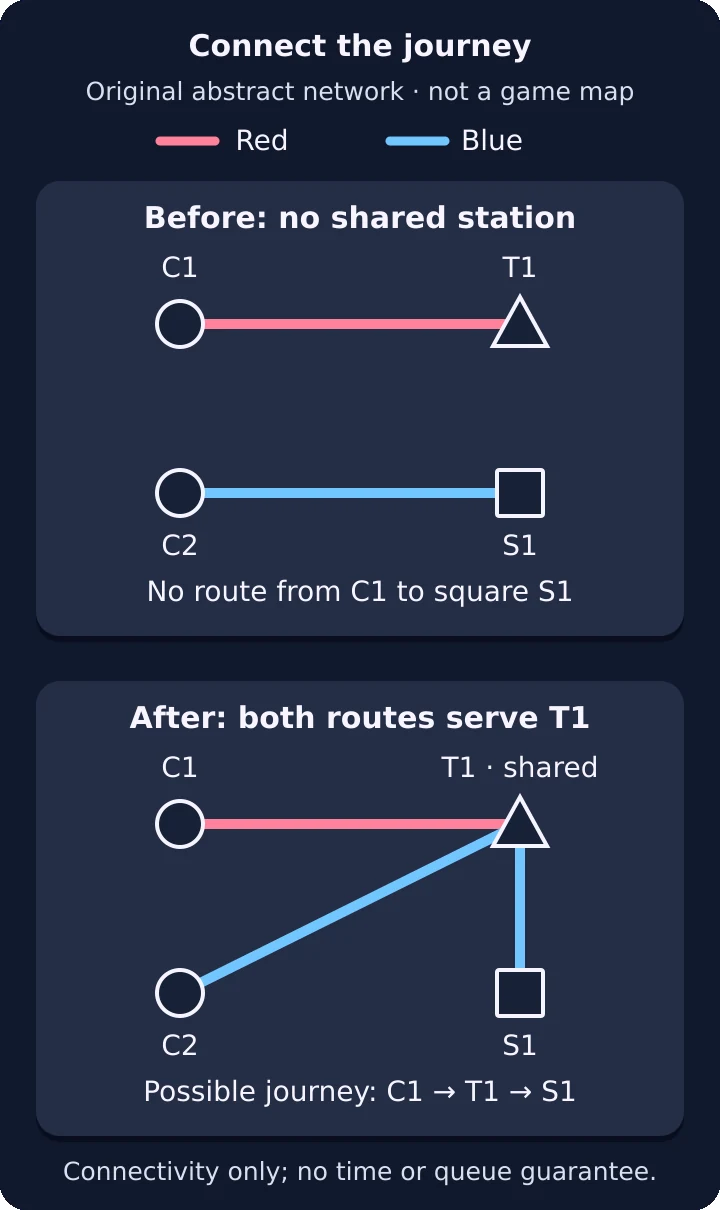
Original practice network: adding T1 to Blue connects the two lines while preserving C2 and S1. This creates a possible transfer journey, not a prediction of passenger routing or travel time.
Adding a train to Red would serve the same disconnected pair more often. It would not connect C1 to a square. The proposed Blue route instead includes T1 while retaining both of Blue's existing stations. That creates a possible journey from C1 along Red to T1, then along Blue to S1.
Before committing the edit, trace it in both directions. C2 must still reach S1; passengers at S1 must still have a connection to a circle; and T1 must genuinely belong to both routes. A line that merely looks close to another line is not the shared station this plan requires.
Now resume and inspect two places, not one. At C1, watch whether the square queue starts moving. At T1, watch whether arriving passengers can continue toward S1. The repair has removed a connectivity failure, but Blue now has another station to serve and may receive additional transfer traffic. If T1 becomes the new pressure point, the next repair belongs to that onward journey.
This is also how to judge a tempting extension to a newly appeared station. Ask what missing destination access it supplies and which existing journeys become longer. A new connection can be valuable without being free of consequences for the rest of the line.
Case 2: the route is connected, but useful seats never arrive
Now imagine a different Red line that already reaches the destination needed by its busiest station. Trains arrive there visibly full, while the waiting queue keeps growing. The route does not need another destination connection just to make those journeys possible. The immediate issue is that the passengers cannot use seats that are already occupied.
Inspect where the load builds up. Is the train filled before it reaches the crowded station? Does it unload shortly afterward? Is the busy station near the far end of a long route, with several other stops between useful visits? These observations distinguish a local shortage of space from a line stretched across too many jobs.
If you have an available train, assigning it to this service is a candidate response. If you are moving one from elsewhere, inspect that donor line first: its current queue may be small because its train is doing essential work. Moving the train trades service between routes; it does not create an extra vehicle.
A carriage is another candidate when more space on the existing train addresses the bottleneck. It does not add a new connection or remove the distance between visits. Conversely, extending the line to more stations may solve access elsewhere while making its return journey longer. Choose the change that addresses what you observed, rather than automatically growing the longest line.
| Observation after your change | What it tells you to examine next |
|---|---|
| The origin's queue shrinks and downstream stops remain manageable | Keep watching as demand changes; the repair is helping this journey |
| Trains still reach the origin full | Inspect upstream loading and whether the extra service is actually reaching the problem |
| The origin improves but another line begins accumulating passengers | Reassess the service you moved away from that line |
| Seats are available but the same destination shape keeps waiting | Retrace the useful route and direction instead of assuming a capacity upgrade fixes it |
The important distinction is between offering more seats somewhere in the network and offering useful service for the journey that is failing.
Case 3: clearing the feeder can overload the transfer
Suppose Red connects C1 to T1, Green connects C2 to T1, and Blue connects T1 to S1. Both circle stations have square-bound passengers. T1 is the shared transfer, and Blue is their only onward connection to the square.
You improve Red's service and its origin starts looking healthier. However, T1's square queue grows. That is not the same result as delivering those passengers to S1: you have moved them to the next waiting point. Adding still more feeder service may increase pressure on the part of the journey that is already struggling.
First inspect Blue. Can its arriving trains take the waiting passengers toward S1, or are they arriving full? If there is suitable available capacity, putting it on the onward service may address the real constraint. Check S1 as well: the next trip away from that destination still matters to the wider network.
A different candidate is to change Green from C2 → T1 into C2 → S1 → T1, if the map and your available resources allow it. Green would then connect its own circle directly to the square while retaining the original shared triangle. This offers a destination connection without requiring every C2-to-square journey to depend on changing to Blue at T1.
That alternative changes Green's workload and route length. It is not automatically better than strengthening Blue. Compare the two plans against the visible pressure: which service is short of useful space, which stations must remain connected, and what would the new route require? Do not redraw Green through S1 and accidentally abandon C2, the very origin you meant to help.
After either change, inspect C1, C2 and T1. An improvement at one circle does not settle the case if the other origin or the transfer is still deteriorating. The goal is a working end-to-end journey, not simply moving the warning to another platform.
Redraw without losing the connections that still work
Pause while you plan a substantial edit. Write the replacement route in your head as a sequence of stations before removing the old one. For every station you intend to drop, identify how its passengers will reach the shapes they need afterward. A cleaner-looking map can still disconnect a useful journey.
Separate the immediate repair from the next expansion. If a transfer is failing now, a speculative extension across the map may consume the same train or line you need to repair it. Weekly additions give you more options, but your present plan must use the assets actually available rather than depending on one particular future offer.
Make the edit, resume, and follow the affected journey through its next useful services. Check the origin, the transfer if there is one, and any route that donated a train. If a queue moves downstream, adjust that leg. If connectivity remains missing, adding vehicles is not a substitute for repairing the map.
As the city grows, repeat the same distinction: destination access first, then the service that carries passengers along the complete route. That gives each change a purpose and makes it easier to tell whether it helped, displaced the pressure, or damaged a connection you need to restore.
Latest comments
Log in to join the conversation
Log InNo comments yet. Be the first to share your thoughts!