
A useful Resin plan answers two questions: what upgrade will you finish, and how much room must you leave before logging out? Emptying the bar into an unrelated Domain solves only the second problem. Saving everything for the perfect farming session can solve neither.
Start with the time you expect to return, choose a material target, then decide whether to claim rewards now or bank Resin for a suitable activity later. Condensed Resin is a way to move work between sessions, not a reason to abandon the upgrade you actually need.
The current rules that change your plan
Original Resin naturally refills at one point every eight minutes, stopping at 200. Fragile Resin restores 60. Treat these as different resources: regeneration is ongoing income, while a Fragile Resin is a stored refill you choose when to consume.
Original Resin rules
Review natural regeneration and refill options in HoYoverse’s help center.
Read Resin helpCondensed Resin now costs 60 Original Resin and provides three normal reward claims in one eligible challenge. It does not increase the individual chance of a rare drop. Older advice describing a 40-Resin craft and double rewards is outdated.
Current Condensed Resin rules
Confirm the current crafting cost and how batched rewards work.
Read Condensed Resin helpThere is still a 40-Resin option: the Luna I update added direct double claims to the interface for rewards normally costing 20 Original Resin. That is not the same as crafting Condensed Resin.
| Option | What you commit | What it solves |
|---|---|---|
| Ordinary eligible claim | 20 Original Resin | A small remaining farming target |
| Direct double claim | 40 Original Resin | Two reward claims without crafting first |
| One Condensed Resin | 60 Original Resin when crafted | Three claims together, including farming deferred to another session |
| One Fragile Resin refill | A stored consumable | More Original Resin for a specific planned spend |
These choices change how you organize claims. Do not read “triple rewards” as three times the value per point of Resin, or assume that every reward screen accepts every option.
Work backward from your next login
Use the natural cap as a scheduling constraint, not a demand to play constantly.
- Approximate minutes until full = (200 − current Resin) × 8.
- Resin generated while away = minutes away ÷ 8.
- Minimum spending before leaving = current Resin + expected generation − 200, or zero if the result is negative.
These are planning estimates; an eight-minute regeneration interval may already be partly complete. Leave a little room when your return time is uncertain.
There is a limit to this method: even an empty bar fills in 26 hours and 40 minutes. If you will be away longer, no one-time spend or craft before leaving can prevent the eventual cap. Stored Condensed Resin does not automatically create new headroom while you are offline. Plan around the break rather than treating unavoidable overflow as a mistake.
| Resin before leaving | Expected absence | Expected generation | Minimum spending to avoid reaching the cap before return |
|---|---|---|---|
| 80 | 8 hours | 60 | None |
| 150 | 8 hours | 60 | 10 |
| 170 | 10 hours | 75 | 45 |
| 200 | 12 hours | 90 | 90 |
The minimum is not necessarily an available claim size. Choose a valid combination that meets the target and advances your farming goal. If you are likely to return late, use that later time rather than the most optimistic estimate.
Worked evening plan: 170 Resin and ten hours away
Without spending, you have only 30 points of headroom. Spending at least 45 prevents the planned 75 points of regeneration from hitting the cap before your planned return. Crafting one Condensed Resin leaves 110 Original Resin; ten hours later, you should have about 185.
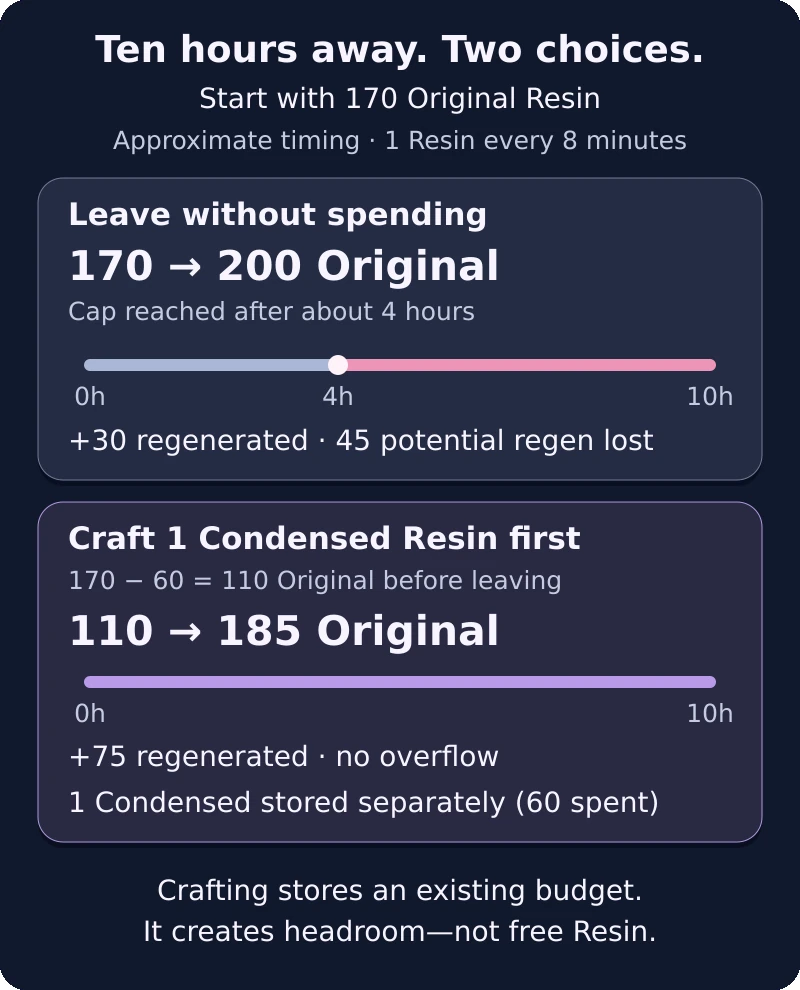
From 170 Original Resin, banking 60 as one Condensed leaves about 185 Original after ten hours, plus the stored item. Requires the recipe, materials, a free Condensed slot and an eligible use; the natural cap remains 200.
That is useful if you already want an eligible Domain or Ley Line reward tomorrow and have room for the item. If tomorrow’s priority is a different activity, do not automatically convert its budget into Condensed Resin. Spend on that priority now where possible, or reserve enough Original Resin for it and use a smaller eligible claim to create the remaining headroom.
The point is to preserve a useful plan, not merely make the bar look tidy. Finishing one more claim can be worthwhile; changing your whole farming target to avoid a small amount of overflow often is not.
Decide the farming target before the claim size
Choose a stopping point you can recognize. “Make this character stronger” is not a stopping point. “Collect the remaining materials for the next weapon upgrade” is. A finite target lets you leave the Domain when the job is done instead of continuing because you still have Resin.
Write down three things: the upgrade you want, what is missing, and what will prevent you from applying it after farming. If you lack another required material, the Resin item alone may not make the upgrade immediately usable. That does not automatically make the farm wrong, but it changes the order of work.
| Your actual obstacle | Useful next step | What not to assume |
|---|---|---|
| One defined upgrade lacks a specific material | Farm that material and stop when the target is met | More copies are automatically today’s best use |
| Several characters each have unfinished upgrades | Pick one near-term team goal and sequence its missing pieces | Dividing every session evenly finishes anything sooner |
| A planned upgrade also needs non-Resin preparation | Schedule that preparation alongside the farm | A full Resin spend guarantees a usable upgrade |
| The current build works but you want a better artifact | Set a session budget for attempts | Spending until the desired roll appears is a predictable plan |
| You have little time today but a clear eligible target tomorrow | Consider banking Condensed Resin | Storage makes the future farming session unnecessary |
This is a prioritization method, not a universal rule that weapons always beat talents or artifacts. A cheap upgrade with no role in your intended team can be less useful than a larger project you actually need. Conversely, a hypothetical perfect artifact should not indefinitely delay an upgrade you can finish.
A two-session target ledger
Suppose your next team project has three unfinished tasks: a weapon material target, a character material target and an artifact improvement you would like rather than need immediately. Give the first session a clear job: work on the weapon target, then record the remaining gap. Give the second session a decision, not a promise: finish that gap if it remains, otherwise move to the character target.
Keep the artifact project as a capped optional spend after those decisions. This prevents a random result from deciding the entire evening. If a good artifact appears early, stop or change projects deliberately; if none appears, the session can still end on schedule.
Do not predict the number of runs needed from an assumed drop rate. Record materials obtained, not only how many clears you completed. The remaining quantity is the useful input for your next session.
Use Condensed Resin as limited storage
The normal crafting and holding limit is five Condensed Resin. At the current crafting cost, five represent 300 Original Resin already committed to that item. This is separate from the natural regeneration cap; crafting does not raise the bar’s cap.
If you are holding four, you have space for one more, not for an entire long break’s future income. If you are holding five, you need to use some before treating crafting as your next logout solution. A full inventory is a signal to schedule a real farming session, not to keep adding postponed work.
For a newer account, the Condensed Resin instructions can be purchased from the blacksmith in Mondstadt or Liyue following the Luna I changes. Learn the recipe before planning around it; the full crafting bill also needs to be available.
Condensed Resin is intended for eligible Domain and Ley Line claims. Do not convert your whole balance merely because you might need it somewhere later. Decide the intended destination before crafting; leave Original Resin available for rewards outside that use case.
Batch size versus a nearly finished target
Imagine you need only a small final quantity of a material. A triple claim may be convenient, but it commits three reward claims to that target. A smaller claim lets you reassess sooner. If you still need a large amount, batching reduces interruptions without changing the project.
The practical question is not “Which button pays the most?” It is “How much of this target do I still want before changing activities?” This also makes it easier to reserve part of the session for another upgrade rather than accidentally spending the whole allocation on the first one.
Fit Daily Commissions into the plan without inventing extra rewards
When you have stored Long-Term Encounter Points, spending 30 Original Resin lets you use them for one Daily Commission reward, up to the daily total of four. Those stored points do not reset with Daily Commissions.
For planning, 120 Original Resin corresponds to four such conversion increments, provided you have enough points and still need all four rewards. If two rewards are already handled, the remaining target is different. Do not spend extra solely to satisfy a number that no longer applies to your day.
This system uses a stored balance; it does not mean every account gets commission rewards automatically by spending Resin. For your resource budget, do not count crafting and later consuming the same item as two separate quantities of Original Resin. Keep the conversion separate from your reward-claim tally and collect the daily rewards you have actually made available.
When a Fragile Resin is worth using
A stored refill is most useful when you can name both its destination and the stopping point. “I have time now and want to complete this remaining material target” is a stronger reason than “my bar is low.” A low bar is normal after a productive session.
Before using one, ask whether you have time to spend the extra balance, whether the required activity is available, and whether another material would still block the upgrade. If the answers are unclear, keep the refill. Saving it preserves the ability to solve a specific shortage later.
There is no need to buy a Primogem refill to make this scheduling method work. The plan is about organizing the resources you already have, not turning a missed login into a purchase.
A short routine you can reuse
- Choose one upgrade or a deliberately limited artifact-farming budget.
- Calculate headroom until your realistic next login.
- Select a valid spend that advances the target and creates enough room.
- Bank Condensed Resin only for an intended eligible use, within its storage limit.
- Reassess after a target is finished instead of spending the remainder automatically.
- Handle any available Encounter Point rewards, then record the next session’s missing materials.
A good schedule leaves you with a clear next action and fewer half-finished projects. It does not require a perfect login streak. If the bar caps while you are away, resume the plan when convenient rather than spending on the wrong target to make up for it.
Latest comments
Log in to join the conversation
Log InNo comments yet. Be the first to share your thoughts!